


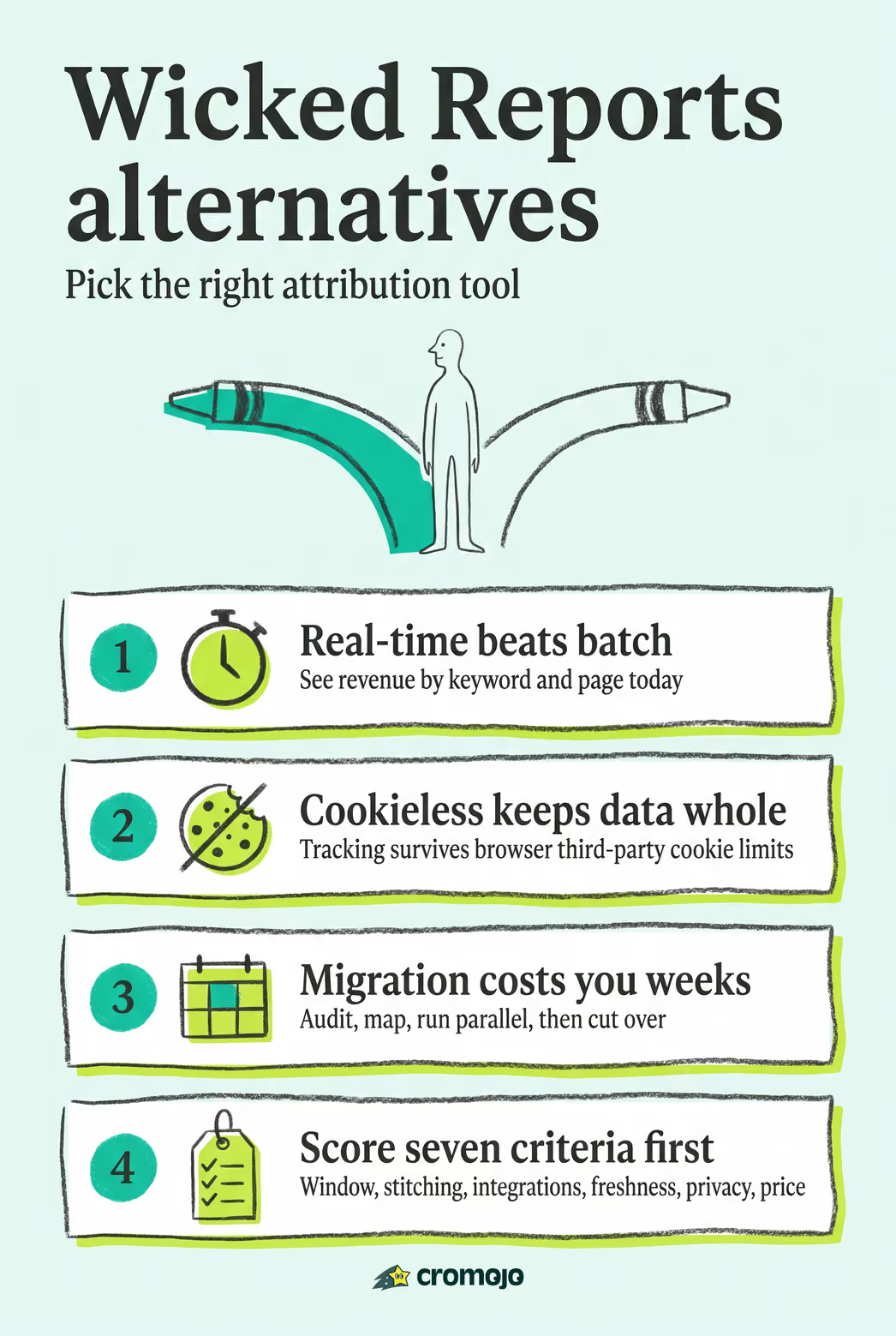
If you need a modern revenue-attribution alternative to Wicked Reports, the strongest match for most US ecommerce teams and agencies is Cromojo, with SegMetrics and Triple Whale as close runner-ups depending on your funnel structure. Wicked Reports is a contact-centric, long-window attribution tool built for email-heavy DTC and info-product businesses, with attribution windows of up to several months and reported pricing in a mid-market range. That niche focus is exactly what makes it the wrong fit for teams that need real-time revenue visibility, cookieless tracking, or simpler setup.
Here is where to start your evaluation:
- Cromojo: best for US ecommerce brands and agencies that need real-time revenue-by-page/keyword attribution and privacy-forward, cookieless tracking
- SegMetrics: best for email/SMS-heavy businesses tracking revenue by customer cohorts and lifecycle funnels
- Triple Whale: best for Shopify DTC teams wanting a unified BI dashboard with pixel-based ad performance
- Northbeam: best for creative-led performance teams needing channel-level and creative-level attribution with MMM
- Hyros: best for long-cycle info-product advertisers with high AOV and extended attribution windows
The primary trade-off categories to weigh: price vs. attribution depth, setup complexity vs. time-to-insight, and long-window lifecycle focus vs. session-level or real-time optimization.
Key Takeaways
Cromojo is the strongest starting point for US ecommerce teams and agencies that need real-time, cookieless revenue attribution without enterprise-level setup complexity.
Which Wicked Reports alternatives should you actually evaluate?
The G2 alternatives page and SaaSHub's comparison listing surface more than a dozen options, but most buyers need far fewer. Below are the twelve most relevant tools, organized by the job they do best.
Cromojo is a revenue-first analytics platform built for ecommerce teams and agencies. It attributes real-time revenue to specific pages, keywords, and marketing channels, integrating directly with Shopify and Stripe. Cookieless tracking and automated site monitoring are built in, not bolted on. Setup takes minutes via a lightweight script, with no developer required.
- Best for: US ecommerce brands and agencies needing real-time revenue attribution and privacy-forward tracking
- Core differentiator: Real-time revenue by keyword/page plus cookieless tracking and built-in site health monitoring
- Pricing: Tiered by pageviews; free trial available
SegMetrics focuses on lifecycle analytics, tying email and SMS subscriber data to cohort revenue. It is the closest like-for-like replacement for teams that rely on Wicked Reports' email-identity stitching. SegMetrics positions itself directly as a Wicked Reports alternative.
- Best for: Subscription and info-product businesses tracking revenue by customer cohort and email funnel
- Core differentiator: Strong lifecycle cohort reporting tied to customer lists
- Pricing: Starts around $175/month; scales with contacts
Triple Whale combines Shopify-native data with ad pixel attribution in a single BI dashboard. It is purpose-built for DTC brands running paid social and wanting fast, visual performance reporting.
- Best for: Shopify DTC teams wanting unified ad-pixel and store data
- Core differentiator: Unified Shopify and ad-pixel dashboards
- Pricing: Starts around $129/month for Shopify stores
Northbeam offers creative-level multi-touch attribution and media mix modeling. It suits performance teams that run significant paid creative budgets and need to test creative performance across channels. See also the Northbeam alternatives guide for DTC-specific context.
- Best for: Creative-led performance teams with larger ad budgets
- Core differentiator: Creative-level MTA and MMM
- Pricing: Custom; typically mid-to-high enterprise range
Hyros targets long-cycle sales with contact-level attribution windows and ad-platform optimization hooks. It is well-suited to info-product advertisers and B2B sellers where a sale may close weeks after the first ad click.
- Best for: Long-cycle info-product and high-AOV advertisers
- Core differentiator: Long-window contact attribution with ad-optimization integrations
- Pricing: Custom; typically $500+/month
Rockerbox combines multi-touch attribution with MMM for mid-enterprise DTC brands. It is designed for brands at $20M+ in revenue that need rigorous multi-channel measurement and budget planning.
- Best for: Mid-enterprise DTC brands needing MTA plus MMM
- Core differentiator: MTA and MMM in one platform
- Pricing: Custom enterprise pricing
AnyTrack offers server-side pixel syncing and cross-channel attribution at a lower entry price, making it a practical starter for SMBs and affiliate-heavy operations.
- Best for: SMBs and affiliate operators wanting affordable cross-channel tracking
- Core differentiator: Server-side pixel syncs at lower cost
- Pricing: Starts around $50/month
RedTrack focuses on ad-level attribution and campaign optimization, particularly for performance marketers and agencies managing multiple ad accounts across channels.
- Best for: Advertisers and agencies focused on ad-level campaign tracking
- Core differentiator: Ad-level conversion routing and campaign optimization
- Pricing: Starts around $149/month
ThoughtMetric is a modern-UI ecommerce attribution tool aimed at mid-market merchants who want clean dashboards and practical pricing without enterprise complexity.
- Best for: Mid-market ecommerce teams wanting a clean, affordable attribution UI
- Core differentiator: Modern UX with practical ecommerce attribution
- Pricing: Starts around $99/month
Improvado is an enterprise-grade ETL and marketing analytics platform. It ingests data from dozens of ad platforms and pushes it to BI tools like Looker or Tableau. Improvado positions itself as a Wicked Reports alternative for teams that need centralized data pipelines rather than out-of-the-box dashboards.
- Best for: Enterprise analytics teams needing custom data pipelines and BI outputs
- Core differentiator: Robust ETL capabilities for complex analytics stacks
- Pricing: Custom enterprise pricing
d-lens takes a different approach entirely. Rather than attribution math, it audits ad accounts and produces concrete, prioritized next actions. It is most useful as a complement to an attribution tool, not a replacement.
- Best for: Teams that want prescriptive ad-account audit findings
- Core differentiator: Automated audit and action-oriented recommendations
- Pricing: Not publicly listed
Google Analytics 4 remains a viable session-level analytics option for teams that do not need contact-level long-window attribution. It is free for most use cases and integrates broadly, though it does not stitch email identity or attribute revenue across multi-week windows.
- Best for: Teams needing free, broad session-level analytics
- Core differentiator: Free, widely integrated, strong session-level reporting
- Pricing: Free (GA4 360 is enterprise-priced)
How do these tools compare side by side?
The table below covers the dimensions that matter most to ecommerce buyers: attribution model, key integrations, data freshness, ecommerce-specific features, privacy options, pricing shape, and setup effort.
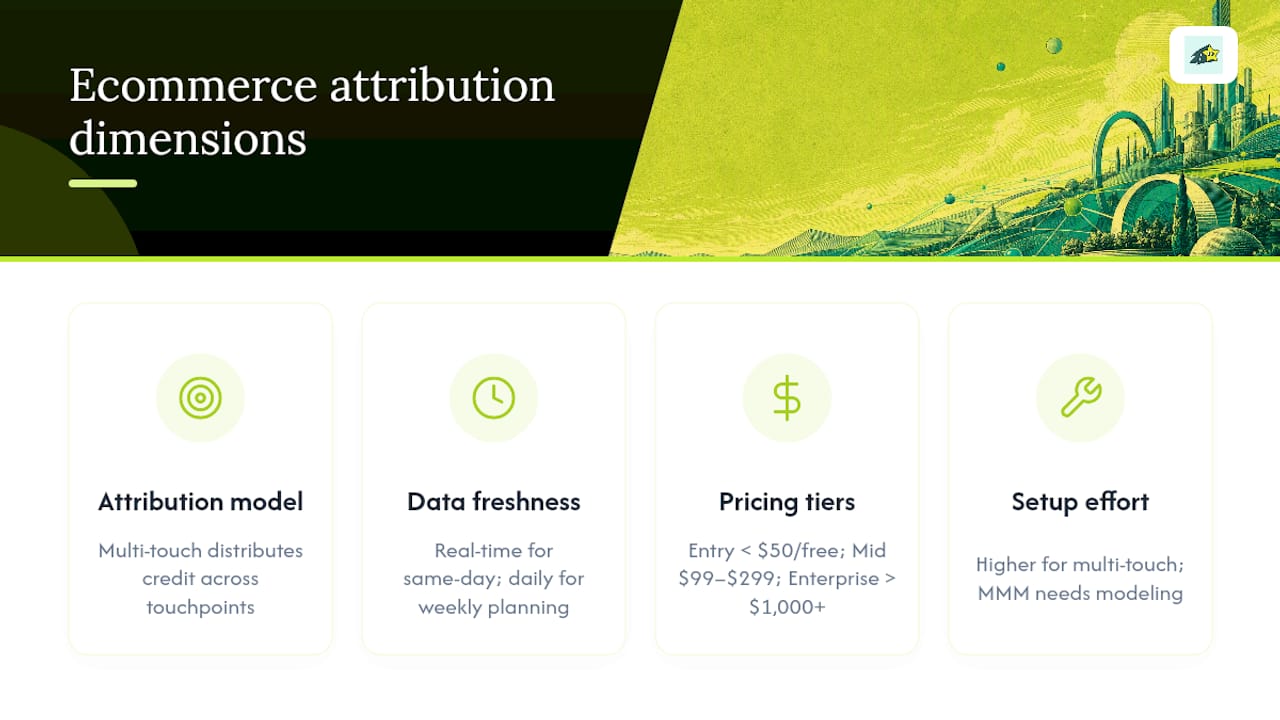
A note on attribution models: "Multi-touch" means credit is distributed across multiple touchpoints in a buyer's journey, which gives a more complete picture than last-click but requires more data and setup. MMM (media mix modeling) adds statistical modeling of channel contribution, useful for larger budgets but overkill for most SMBs.
On data freshness: Real-time attribution matters most when you are making same-day bid or budget decisions. Daily refresh is fine for weekly planning cycles. Cromojo's real-time revenue attribution is a practical advantage for teams that optimize campaigns daily.
Pricing tiers observed across the market: Entry-level tools (AnyTrack, Windsor.ai, Mixpanel free tier, GA4) start under $50/month or free. Mid-market tools (ThoughtMetric, RedTrack, Triple Whale, SegMetrics) run $99-$299/month. Enterprise platforms (Rockerbox, Improvado, Adobe Analytics, Hyros) are custom-quoted and often exceed $1,000/month. Most tools offer a free trial or demo; Cromojo includes a free trial. Wicked Reports' reported $249-$1,799/month range puts it in the mid-to-high tier, which is one reason community discussions on Reddit frequently surface lower-cost alternatives like ThoughtMetric.
How do you choose the right Wicked Reports alternative?
The single most important filter is your dominant measurement lever: long-window lifecycle attribution, short-window ad optimization, or BI-driven DTC reporting. Pick the wrong category and no feature list will save you.
Must-have criteria (evaluate these first):
- Attribution window length: Do you need 30-180 day windows to capture email-influenced revenue, or is a 7-30 day window sufficient for your sales cycle?
- Identity stitching: Can the tool connect email/SMS subscriber data to ad clicks and on-site behavior? This is the core of what Wicked Reports does; not every alternative replicates it.
- Ecommerce integrations: Shopify and Stripe connectivity should be native, not via a third-party connector that adds latency or breaks on updates.
- Data freshness: Real-time vs. daily refresh matters if you are making same-day budget decisions.
- Privacy and cookieless tracking: With third-party cookies increasingly restricted, server-side or cookieless options are a practical requirement, not a nice-to-have.
Nice-to-have criteria:
- Creative-level attribution (useful for large paid social budgets)
- MMM capabilities (relevant at $20M+ ad spend)
- Built-in site monitoring and SEO health checks
- White-label reporting for agencies
Questions to ask vendors during demos:
- What is your data retention period, and can I export raw event data?
- How do you handle identity stitching when a user switches devices or clears cookies?
- Do you support server-side tracking or a first-party data approach?
- What is your SLA for data ingestion and dashboard refresh?
- How do you reconcile attributed revenue against Shopify or Stripe order exports?
Red flags to watch for: Vendors that cannot show you order-level revenue reconciled against your payment processor are selling you a black box. Avoid any tool that attributes revenue only at the session level if your sales cycle spans multiple sessions.
Pro Tip: *Before signing a contract, export 30 days of order data from Stripe or Shopify and ask the vendor to match their attributed revenue to that export.
What does migrating off Wicked Reports actually involve?
Migration from Wicked Reports is manageable, but it takes more than swapping a tracking script. The typical phases run in sequence:
- Audit (1-2 weeks): Document every data source Wicked Reports currently touches: ad platforms, email lists, Shopify/Stripe, UTM conventions, and any offline order imports. Note which attribution windows you rely on and which reports your team uses weekly.
- Mapping (1 week): Map each data source to the new tool's connector or API. Confirm that UTM parameters pass through correctly and that email subscriber IDs will stitch to ad click data in the new system.
- Parallel run (2-4 weeks): Run both tools simultaneously. Compare attributed revenue figures weekly. A parallel run is the only reliable way to catch double-counting, mismatched LTV windows, or broken identity stitching before you cut over.
- Cutover (1 day to 1 week): Disable Wicked Reports tracking only after the parallel run shows revenue figures within an acceptable tolerance. Update any automated reports or dashboards that pull from Wicked Reports.
- Validation (ongoing, first 30 days): Continue reconciling attributed revenue against Stripe or Shopify exports weekly for the first month. Watch for anomalies in cohort LTV figures, which can lag by several weeks.
Testing checklist before cutover:
- Order IDs from Shopify/Stripe appear correctly in the new tool's revenue reports
- UTM parameters pass through from ad click to order record without truncation
- Email and SMS subscriber identities stitch to on-site sessions
- Offline or manual orders are accounted for (or explicitly excluded)
- Attribution window settings match your sales cycle length
Common pitfalls include double-counting revenue when both tools fire on the same conversion event, and mismatched LTV windows that make cohort comparisons meaningless across the transition period.
Pro Tip:Run your parallel period for at least 14 days before drawing conclusions. Short windows will show variance from normal weekly seasonality, not from tracking errors, and you will make the wrong call.
Why Cromojo is a strong pick for US ecommerce and agency teams
Cromojo fits ecommerce teams and agencies because it combines real-time revenue attribution, cookieless tracking, and native Shopify/Stripe integrations in a single platform that requires no developer to set up.
Here is how specific features map to the buyer problems this article has covered:
- Revenue by keyword and page: You see exactly which search terms and landing pages generate actual sales, not just traffic. This is the insight most attribution tools bury in aggregate channel data.
- Cookieless, privacy-first tracking: Cromojo's tracking works without third-party cookies, which matters as browser restrictions tighten. You can read more about the privacy approach on the Google Analytics alternative page.
- Shopify and Stripe integrations: Native connectors mean order-level revenue data flows in without custom engineering.
- Automated site monitoring: Downtime alerts, SEO health checks, and indexing status are built in, which is particularly useful for agencies managing multiple client sites. The agency monitoring guide covers this workflow in detail.
- Automated indexing: Cromojo submits URLs to Google, Bing, Yandex, and Baidu automatically, so new pages get discovered faster.
- Lightweight setup: A single script installs in minutes. No data engineering, no warehouse configuration.
For agencies, the revenue-first analytics playbook explains how to structure multi-client reporting around revenue attribution rather than traffic metrics.
Pricing is tiered by pageviews, with overages billed per 1,000 additional pageviews. A free trial is available with no credit card required upfront.
What actually matters when picking an attribution tool in 2026
The most important shift for 2026 buyers is this: stop evaluating attribution tools by feature count and start evaluating them by how quickly you can act on their output. A tool that shows you yesterday's revenue by channel in a clean dashboard beats a tool that shows you 90-day multi-touch attribution in a spreadsheet export you never open.

My practical advice: start your evaluation by pulling one week of Shopify or Stripe order data and asking each shortlisted vendor to show you how their tool would attribute those specific orders. That single exercise will tell you more than any demo script. The vendors that hedge or redirect that question are the ones to deprioritize.
One cautionary note on long-window attribution: the 30-180 day windows that made Wicked Reports valuable for info-product businesses can actually obscure short-cycle optimization signals. If your average order cycle is under two weeks, a long-window tool will credit touchpoints that had no real influence on the purchase. Match the window to your actual sales cycle, not to the tool's default setting.
Cromojo gives you real-time revenue attribution without the complexity
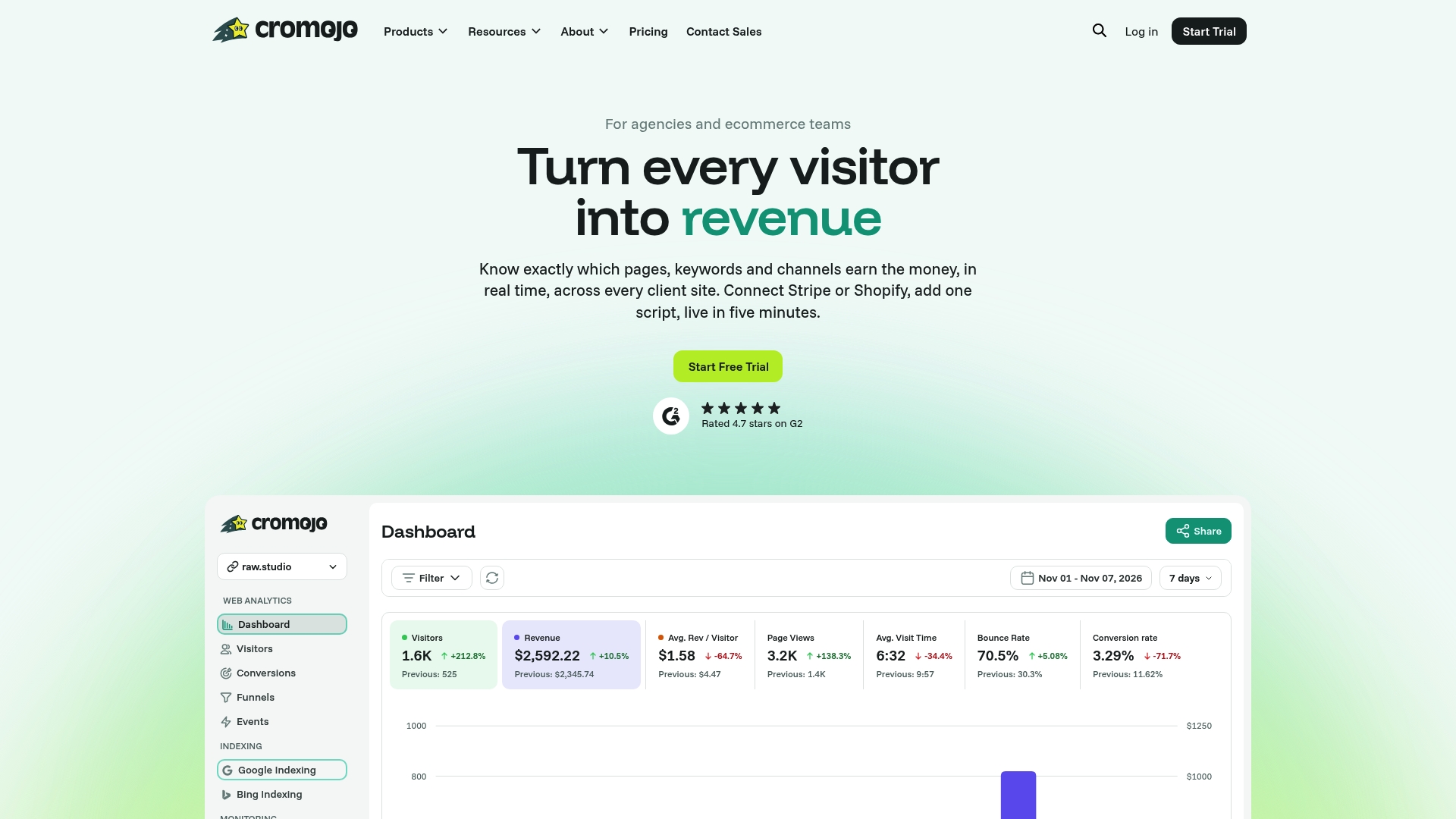
Most attribution tools make you choose between depth and speed. Cromojo's revenue attribution analytics gives you both: order-level revenue tied to the keyword, page, and channel that drove each sale, updated in real time, with cookieless tracking that respects visitor privacy.
Three reasons ecommerce teams and agencies choose Cromojo after evaluating the alternatives:
- Real-time visibility: See which pages and keywords are generating revenue today, not in yesterday's batch report
- Privacy-first by design: Cookieless tracking works as browsers restrict third-party cookies further in 2026
- All-in-one for agencies: Revenue attribution, site monitoring, and indexing management in one platform, without stitching together three separate tools
Start a free trial at Cromojo. No developer required, no long-term contract, and setup takes under 15 minutes for most Shopify or Stripe-connected stores.