


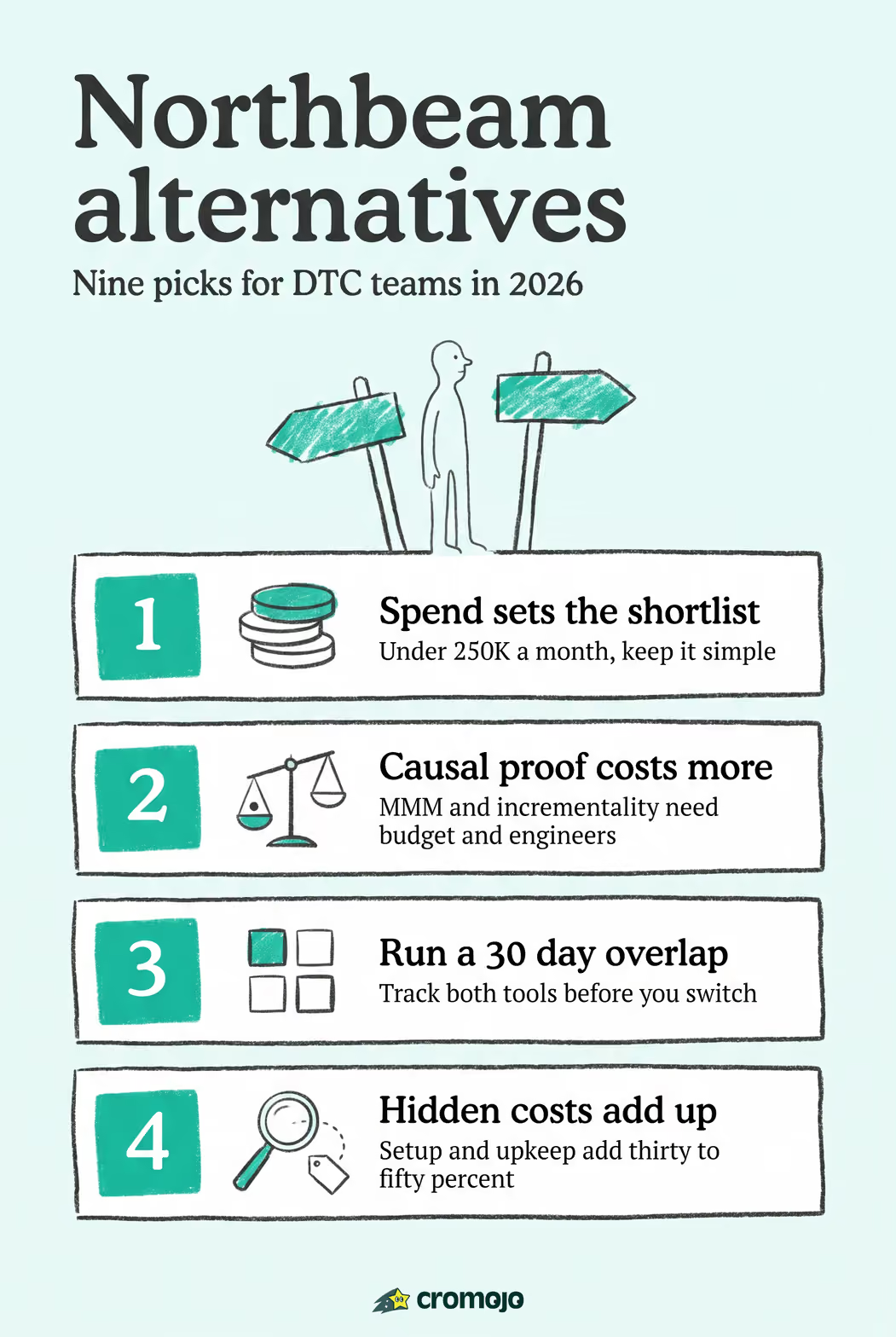
The strongest Northbeam alternatives for mid-to-large DTC and Shopify brands in 2026 are Cromojo (revenue-first, cookieless, fast setup), Triple Whale (Shopify-native, transparent pricing), Rockerbox (enterprise cross-channel MMM), and SegmentStream (warehouse-native probabilistic modeling). Which one fits your team depends on three things: your monthly ad spend, how much data engineering capacity you have, and whether you need causal proof or just cleaner dashboards.
- Cromojo - best for ecommerce teams that want real-time revenue attribution by channel, keyword, and page, with Shopify + Stripe integration and cookieless privacy-first tracking. Low implementation overhead, no data science team required.
- Triple Whale - best for Shopify-first DTC brands under roughly $250K/month in ad spend that prioritize quick setup and public pricing tiers.
- Rockerbox - best for enterprise omnichannel brands running TV, OOH, or podcast budgets alongside digital, where unified MMM is non-negotiable.
- SegmentStream - best for enterprise teams with in-house data science capacity that need ML-driven incrementality and automated budget optimization.
Pro Tip: Before you demo any replacement, export your last 90 days of Northbeam channel-level ROAS. That baseline is your validation benchmark - any new tool should reproduce it within an acceptable margin before you commit.
Northbeam's entry pricing is commonly reported as starting around $1,000+ per month, with enterprise tiers reaching several thousand. That price point made sense when deterministic pixel tracking was reliable. Apple's App Tracking Transparency (ATT) and the gradual deprecation of third-party signals have changed the math. Google Analytics 4 (GA4) fills some gaps but doesn't give you channel-level revenue attribution. The tools below do.
Side-by-side snapshot of the top alternatives
The G2 competitor listings for Northbeam show a broad competitive set spanning both MTA-first and MMM-first vendors. The table above reflects that range - the right pick depends on methodology fit, not feature parity.
SegmentStream: when your team has the engineering to match the model
SegmentStream is a warehouse-native probabilistic attribution platform built for enterprise teams that have data science capacity and want automated budget optimization. It connects directly to your data warehouse, runs ML-driven incrementality models, and surfaces budget recommendations without requiring manual analyst interpretation.
Key capabilities:
- Probabilistic MTA that accounts for signal loss rather than ignoring it
- Warehouse-native architecture - models run on your own data infrastructure
- Automated budget optimization based on modeled incrementality
- Cookieless by design, which makes it more durable as third-party signals continue to erode
The trade-off is real: SegmentStream requires meaningful data engineering investment upfront. You need a functioning data warehouse, clean event schemas, and someone who can configure and maintain the models. For a Shopify brand with no in-house engineer, the time-to-value is long. For an enterprise team with a data science function, it's one of the most technically rigorous options available.
When to choose SegmentStream over an out-of-the-box Shopify-native tool: when your channel mix is complex (paid social, paid search, affiliate, email, influencer), when you need statistically defensible incrementality outputs, and when your team can absorb a longer implementation window in exchange for more accurate modeling.
Triple Whale: the practical Shopify-first pick
Triple Whale is widely adopted among Shopify-native DTC teams and is consistently recommended as the most practical Northbeam alternative for brands that prioritize time-to-value. Its pixel plus server-side tracking combination covers the attribution gaps that browser restrictions create, and its Shopify-native dashboards surface daily performance without requiring a data team.
Key capabilities:
- Pixel + server-side tracking for improved conversion capture
- Shopify-native dashboards with daily refresh cadence
- Public pricing with free and low-cost entry tiers
- Ad platform integrations covering Meta, Google, TikTok, and Snapchat
The practical decision rule by ad spend: if you're spending under $250K per month and your primary channel is Shopify, Triple Whale delivers fast, readable attribution with minimal setup. Above that threshold, the limitations of its MTA approach start to show - complex multi-touch journeys across offline and online channels benefit from MMM modeling that Triple Whale doesn't offer at depth.
The main limitation is methodological rigor. Triple Whale's MTA is solid for Shopify-centric workflows, but it doesn't provide the causal proof that incrementality experiments deliver. For teams that need to defend channel budgets to a CFO with statistical evidence, it's a starting point rather than a final answer.
Rockerbox: cross-channel measurement at enterprise scale
Rockerbox is built for enterprise ecommerce brands running substantial budgets across both digital and offline channels. Its core strength is unified measurement that combines MTA, MMM, and offline channel attribution - TV, out-of-home, podcasts, and direct mail - into a single view. Industry summaries consistently position Rockerbox as an enterprise-grade option for customers that need MMM and offline coverage.
Key capabilities:
- Unified MTA + MMM in a single platform
- Offline channel attribution (TV, OOH, podcasts, direct mail)
- Enterprise-grade integrations across ad platforms and data warehouses
- Cross-channel budget planning tools
The limitation is cost and implementation time. Rockerbox is not a quick-setup tool. Enterprise integrations, offline data ingestion, and MMM calibration take time. Brands spending under $500K per month on media rarely justify the complexity.
Choose Rockerbox over a pixel-first product when your media mix includes meaningful offline spend, when you need a single measurement layer across all channels, and when your organization has the analyst capacity to act on MMM outputs.
Polar Analytics: clean dashboards for mid-market Shopify teams
Polar Analytics targets mid-market Shopify brands that want better reporting without the engineering overhead of enterprise MMM tools. Its connectors pull data from Shopify and major ad platforms into clean, readable dashboards that non-technical marketers can use without analyst support.
Key capabilities:
- Shopify and ad platform connectors with fast setup
- Clean dashboards designed for marketing teams, not data engineers
- Lower-cost tiers compared to enterprise MMM platforms
- Straightforward reporting on channel performance and blended ROAS
The honest limitation: Polar Analytics is a reporting and dashboard tool, not a causal measurement platform. It doesn't offer incrementality testing or MMM. For teams that need to understand what actually caused a revenue change, Polar works best as a complement to a server-side tracking layer or GA4, not as a standalone attribution solution.
For a mid-market Shopify brand that has outgrown GA4's ecommerce reporting but doesn't need enterprise MMM, Polar Analytics fills that gap cleanly and affordably.
Measured: experiment-calibrated MMM for large media investments
Measured specializes in experiment-calibrated media mix modeling. Its core methodology combines controlled incrementality experiments with MMM, which addresses the "black box" criticism that plagues many MMM platforms. Rather than relying purely on historical correlations, Measured uses geo holdouts and matched-market tests to calibrate its models with causal evidence.
Key capabilities:
- Experiment-calibrated MMM that uses incrementality tests to validate model outputs
- Geo holdout and matched-market experiment design
- Planning tools built for large media investment decisions
- Causal inference framework that goes beyond correlation-based attribution
The trade-offs are significant for smaller teams. Measured requires substantial data volume to produce statistically reliable MMM outputs. Brands spending under $1M per month on media typically don't have the signal volume to run meaningful geo holdouts. Implementation is also time-intensive - expect several months before the models are calibrated and producing reliable outputs.
For enterprise teams focused on causal media planning and willing to invest in rigorous measurement infrastructure, Measured is one of the most defensible options available. For everyone else, the cost and data requirements make it hard to justify.
Dreamdata: B2B pipeline attribution
Dreamdata is built for B2B SaaS and high-consideration purchase workflows, not DTC ecommerce. Its core value is touchpoint-to-revenue mapping across long sales cycles, with CRM integrations that connect marketing touches to closed pipeline.
Key capabilities:
- Pipeline attribution that maps marketing touches to CRM-tracked revenue
- Integrations with Salesforce, HubSpot, and other CRM systems
- Multi-touch attribution across long B2B buying journeys
- Revenue lifecycle tracking from first touch to closed deal
For a pure Shopify DTC brand, Dreamdata is the wrong tool. Its architecture assumes a CRM-driven pipeline with multiple stakeholders and a sales cycle measured in weeks or months. If your revenue comes from direct Shopify transactions, the CRM-linkage model doesn't apply.
Dreamdata belongs on this list because some DTC brands have B2B wholesale or subscription components with longer sales cycles. If that describes your business, Dreamdata's pipeline measurement is genuinely useful. If you're purely DTC, skip it.
Hyros and Supermetrics: two niche picks
These two tools solve different problems from the rest of the list. Neither is a direct Northbeam replacement, but both appear frequently in comparison searches.
Hyros focuses on click-level ad tracking with phone-call funnel attribution. It's built for high-ticket direct-response funnels where phone calls are a significant conversion event - think supplement brands, coaching programs, or financial services. Its strength is granular click-level accuracy across ad platforms. The limitation is narrow applicability: if your funnel is purely digital and phone calls aren't a meaningful conversion path, Hyros adds complexity without proportional value.
- Best fit: high-ticket DTC or direct-response brands where phone attribution matters
- Setup effort: medium - requires pixel implementation and call tracking integration
- Trade-off: accuracy at the click level, but limited MMM or incrementality capability
Supermetrics is an ETL and reporting pipeline tool, not an attribution platform. It pulls data from ad platforms, CRMs, and analytics tools into data warehouses, Google Sheets, Looker Studio, or BI platforms. Teams use it to build consolidated reporting dashboards and custom data pipelines.
- Best fit: teams that need a centralized data feed for custom BI dashboards
- Setup effort: medium - connector configuration and destination mapping required
- Trade-off: maximum infrastructure flexibility, but no built-in attribution modeling
Neither Hyros nor Supermetrics replaces Northbeam's attribution function directly. They solve adjacent problems: Hyros improves click-level accuracy for specific funnel types, and Supermetrics consolidates data for teams that build their own reporting layer.
Cromojo: revenue-first attribution for ecommerce teams
Cromojo is built around a single premise: you should be able to see which channels, pages, and keywords are generating actual revenue, in real time, without a data engineering team to set it up. That focus makes it a strong fit for ecommerce teams and agencies that need fast, accurate revenue attribution and don't want to spend months on implementation.
Key capabilities:
- Real-time revenue attribution by channel, page, and keyword
- Native Shopify and Stripe integrations via a lightweight script
- Cookieless, privacy-first tracking that doesn't depend on third-party cookies or ATT-affected signals
- Conversion funnels and visitor journey analysis
- Automated website indexing, site monitoring, and SEO health checks
- Goal tracking and advanced segmentation
- Actionable email reports without requiring analyst interpretation
Typical customers are ecommerce teams and agencies managing multiple client sites that need revenue accuracy, quick setup, and a privacy-first posture. Cromojo's analytics approach is designed to surface the revenue impact of every marketing decision without the overhead of warehouse-native platforms.
The honest limitation: if your team needs enterprise MMM or statistically calibrated geo holdout experiments, Cromojo is best paired with a specialized MMM tool rather than used as a standalone causal measurement platform. For the majority of mid-market DTC and Shopify brands, that level of modeling complexity isn't the bottleneck - getting clean, real-time revenue data by channel is.
Pro Tip: Cromojo's cookieless tracking is particularly valuable for brands with significant iOS traffic. Because it doesn't rely on third-party cookies or ATT-affected signals, it captures conversions that pixel-based tools systematically miss. Run a 30-day parallel comparison against your current tool to quantify the gap before you switch.
How to choose the right Northbeam alternative for your team
The right tool depends on where you are in three dimensions: ad spend, in-house technical capacity, and measurement maturity. Here's a practical framework.
Decision checklist by ad spend tier
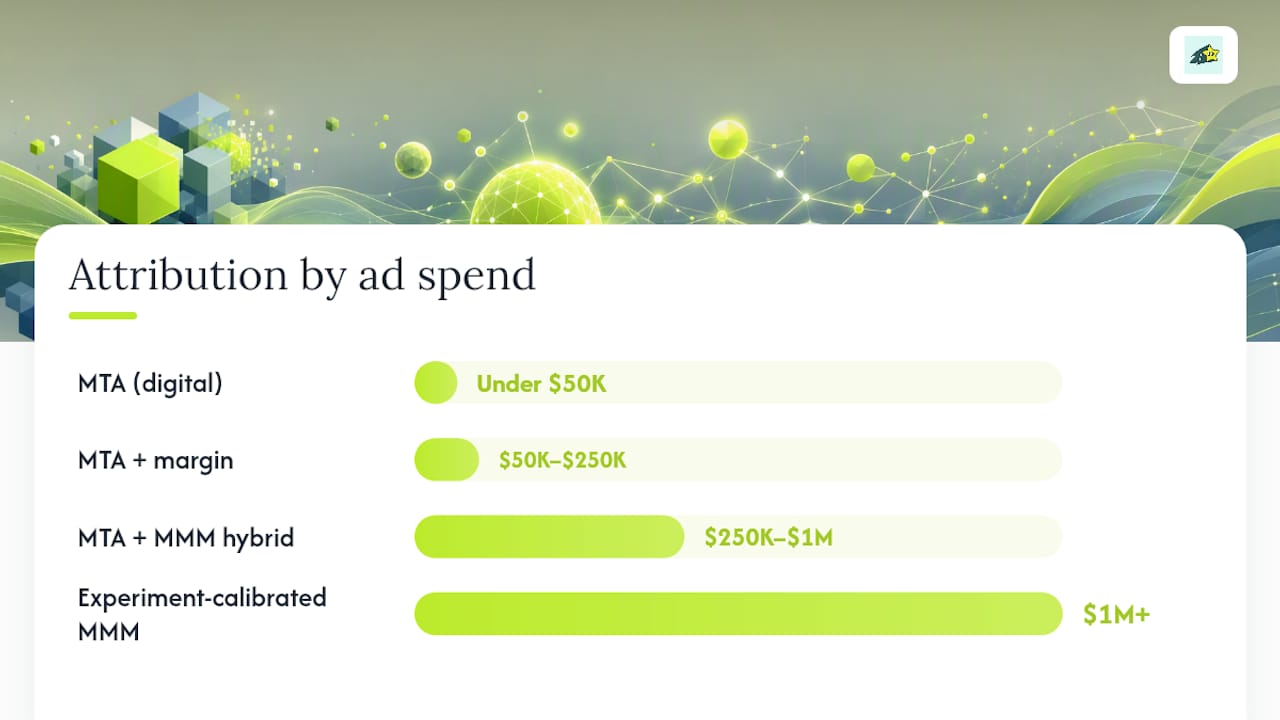
- Under $50K/month - Start with Cromojo or Triple Whale. Both offer fast setup, Shopify-native integrations, and pricing that fits the budget. You don't need MMM at this spend level; clean MTA with real-time revenue data is sufficient.
- $250K-$1M/month - Rockerbox or SegmentStream depending on whether your channel mix includes meaningful offline spend. If it does, Rockerbox's unified MMM is worth the implementation cost. If you're purely digital, SegmentStream's probabilistic MTA with incrementality testing is more appropriate.
- $1M+/month - Measured or Rockerbox for causal MMM. At this spend level, the cost of a wrong budget allocation decision exceeds the cost of rigorous measurement infrastructure.
Questions to ask in every vendor demo
- What is your data latency? How quickly does a conversion appear in the dashboard after it happens?
- Who owns the event data? Can we export our full historical record if we leave?
- What does onboarding actually require from our engineering team, and what's the realistic time to first useful output?
- Do you offer incrementality testing, and if so, what's the minimum spend required for a statistically valid geo holdout?
- What's your SLA for support, and is there a managed services option?
- How does your model handle ATT-affected iOS traffic?
Red flags to watch for
Gartner Peer Insights reviews consistently show that buyers evaluate alternatives across contracting terms, integration depth, deployment complexity, and support quality - not just feature lists. Weight those dimensions equally in your evaluation.
Common mistakes when switching from Northbeam
Most migration problems are preventable. The teams that switch cleanly share one habit: they treat the migration as a measurement project, not an IT project.
Switch checklist
- Export 90-day baseline from Northbeam (channel ROAS, conversion counts, revenue by channel)
- Map all current integrations and confirm new platform supports each one
- Validate conversion taxonomy alignment between old and new platform
- Implement server-side tracking before go-live if not already in place
- Run both platforms in parallel for a minimum of 30 days
- Validate that the new platform's channel-level outputs are within an acceptable margin of the baseline
- Schedule a staged cutover starting with your highest-confidence channel
- Set a 90-day review checkpoint to assess model accuracy and budget decision quality
Pro Tip: The 30-day parallel run is where most teams find analytics blind spots - conversion events that one tool counts and the other misses. Document every discrepancy and trace it to a root cause before you fully cut over.
Timeline guidance: expect 2-4 weeks for Shopify-native tools (Cromojo, Triple Whale, Polar Analytics), 4-8 weeks for mid-market platforms (Rockerbox, SegmentStream at mid-tier), and 3-6 months for full enterprise MMM implementations (Measured, Rockerbox enterprise, SegmentStream warehouse-native).
MTA vs MMM vs incrementality: which methodology fits your situation?
These three approaches answer different questions. Choosing the wrong one for your context is the most common measurement mistake DTC teams make.
Multi-touch attribution (MTA) assigns credit to individual touchpoints in a customer's path to purchase. It's deterministic when tracking is complete, fast to implement, and easy to act on. The limitation is signal loss - ATT and browser restrictions mean MTA models are working with incomplete data, especially for iOS traffic and cross-device journeys.
Media mix modeling (MMM) uses aggregate statistical modeling to estimate the contribution of each channel to revenue. It doesn't rely on individual-level tracking, which makes it more durable in a privacy-constrained world. The trade-off is data volume: MMM requires sufficient historical spend and conversion data to produce reliable confidence intervals. At low spend levels, the black-box concerns are real - models can produce plausible-looking outputs that aren't statistically defensible.
Incrementality testing uses controlled experiments (geo holdouts, matched-market tests, audience holdouts) to measure the causal effect of a channel or campaign. It's the most rigorous approach and the hardest to scale. Each experiment requires a minimum spend threshold, a clean test design, and enough time to reach statistical significance.
Recommendation matrix
When to run geo holdouts: when you need to defend a channel budget to a CFO and correlation-based attribution isn't sufficient. A simple geo holdout on your top paid social channel - pausing spend in a matched market for 4 weeks - gives you causal evidence that no MTA model can replicate.
When to pair MTA with MMM: when your channel mix includes TV, OOH, or podcast spend that pixel tracking can't capture. MTA handles the digital channels; MMM handles the offline ones.
When to prioritize transparent rule editors: when your team needs to explain attribution decisions to non-technical stakeholders. Inspectable models that show how credit is distributed are worth more than opaque automated logic, even if the automated logic is technically more accurate.
Final recommendation by buyer type
Here's the one-line pick for each buyer bucket, with the reasoning behind it.
- Mid-market DTC, $50K-$250K/month: Cromojo for revenue attribution and site monitoring, with Triple Whale as an alternative if you want a larger user community and public pricing tiers. At this tier, contribution-margin views matter - make sure your tool surfaces revenue net of returns and discounts, not just gross.
- Growth-stage DTC, $250K-$1M/month: Rockerbox if your channel mix includes offline spend; SegmentStream if you're purely digital and have data science capacity. Both require meaningful implementation investment.
On pairing: Cromojo works well as a standalone tool for most mid-market DTC teams. For brands that need enterprise MMM or geo holdout experiments, Cromojo handles the real-time revenue layer while a specialized MMM platform handles the causal modeling. The two don't conflict - they answer different questions.
Key Takeaways
The strongest Northbeam alternative for most mid-market DTC and Shopify teams is a revenue-first, cookieless platform like Cromojo that delivers real-time channel attribution without requiring data engineering capacity or enterprise-level budgets.
The measurement tool that actually drives decisions
The most common mistake I see teams make when evaluating Northbeam alternatives is optimizing for methodological sophistication instead of decision frequency. A team that runs a weekly budget review needs a tool that refreshes daily and surfaces channel-level revenue clearly. A tool that produces a beautiful MMM report every quarter doesn't help that team move budget on Monday.
The measurement trifecta - MTA, MMM, incrementality - is real and worth understanding. But for most DTC brands under $500K per month in ad spend, the bottleneck isn't measurement sophistication. It's data quality and actionability. Clean server-side tracking, real-time revenue attribution by channel, and a dashboard your media buyer can read without an analyst: that's what drives better decisions at that scale.
The enterprise tools on this list are genuinely impressive. SegmentStream's probabilistic modeling and Measured's experiment-calibrated MMM represent the state of the art. But state-of-the-art measurement infrastructure requires state-of-the-art data engineering capacity to support it. Most teams don't have that, and they shouldn't pretend they do by buying a platform they can't fully use.
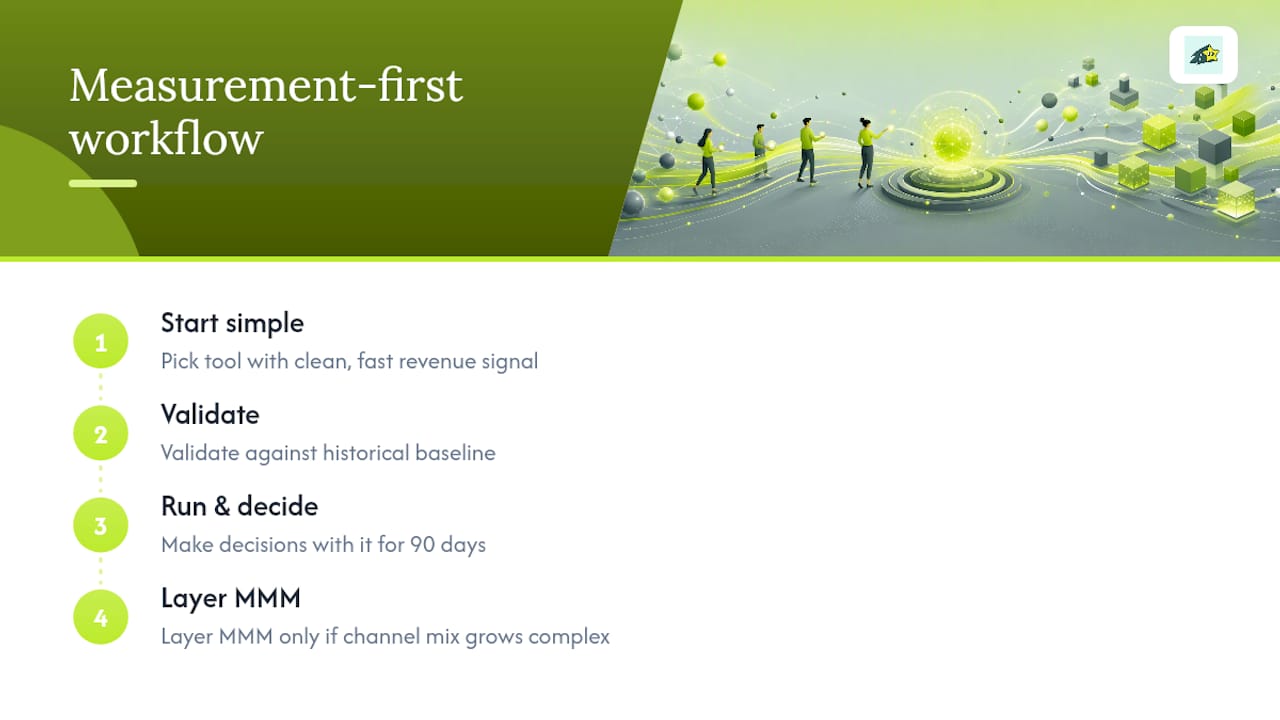
The practical advice: start with the tool that gives you the cleanest revenue signal fastest. Validate it against your historical baseline. Make decisions with it for 90 days. Then, if you find that your channel mix has grown complex enough to justify MMM, layer it in. Don't buy the complexity before you've earned the need for it.
Cromojo gives you real-time revenue attribution without the setup overhead
Most of the tools on this list require weeks of implementation, data warehouse connections, or dedicated engineering time before they produce useful outputs. Cromojo takes a different approach: a lightweight script connects to your Shopify store and Stripe account, and you're seeing real-time revenue attribution by channel, keyword, and page within hours.
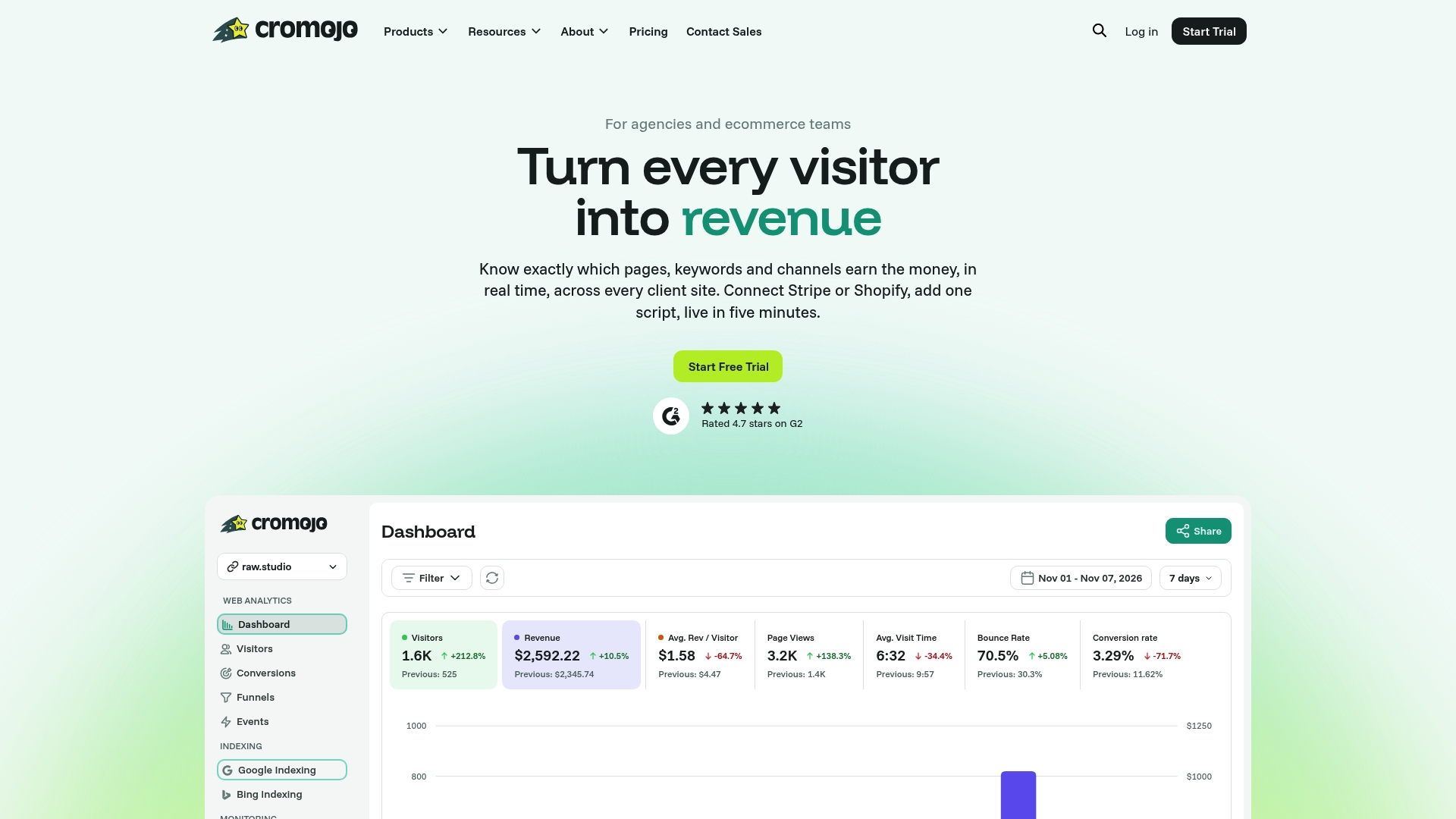
For ecommerce teams that need to know which campaigns are actually generating revenue - not just traffic or clicks - Cromojo's revenue attribution analytics surfaces that data in real time, without cookies, without a data science team, and without a six-figure annual contract. The cookieless tracking captures conversions that ATT-affected pixel tools miss, which matters especially for brands with significant iOS traffic. Built-in site monitoring and SEO health checks mean you're not paying for a separate tool to track downtime or indexing issues.
If you're ready to see what your channels are actually worth in revenue terms, start a free trial at Cromojo and have your first revenue attribution dashboard live today.