


For most Shopify and Stripe-connected ecommerce teams, Cromojo is the strongest Segmetrics alternative because it attributes revenue in real time without cookies or heavy engineering. If you're running high-ticket, ad-heavy funnels, Triple Whale fits the ad-native, fast-setup mold better. If you're spending big across many channels and need rigor over speed, Northbeam is the more defensible choice.
Segmetrics Alternatives Compared at a Glance
Every tool on this list solves a version of the same problem: Segmetrics users hit pricing gates, multi-currency limits, or API restrictions on higher tiers and start shopping. Some roundups list these gates as the main reason buyers switch, alongside the split between tools that start from ad spend and tools that start from billing data.
That split matters more than any feature checklist. Ad-attribution tools like Triple Whale work forward from campaign spend toward revenue. Revenue-attribution tools like Cromojo or TrackRev work backward from actual Stripe or Shopify transactions toward the channel that earned them. TrackRev's own comparison frames this as the deciding factor for picking a tool, not raw feature count.
Here's how the main contenders stack up on the dimensions that actually change your buying decision:
A few patterns jump out once you line these up. Shopify-native tools like Triple Whale and Cromojo emphasize fast installs and auto-mapping to restore signal quickly, while sales-assisted platforms like Hyros, Northbeam, and Dreamdata trade setup speed for depth. If you're billing through Stripe or Paddle rather than running pure ad campaigns, TrackRev and Cromojo both start from the transaction rather than the click, which changes how renewals and refunds get counted.
What Each Segmetrics Competitor Actually Does Well
Picking among Segmetrics competitors gets easier once you know which buyer job each one was actually built to solve. Here's the breakdown, starting with the tool built specifically for revenue-first ecommerce measurement.
- Cromojo connects directly to Shopify and Stripe to attribute real-time revenue by page, keyword, and channel, without relying on cookies. Setup is a lightweight script rather than a server-side deployment, so most stores are live within a day. Pricing details are available on the pricing page for teams that want to test attribution before committing to a paid tier.
- ThoughtMetric targets Shopify brands that want attribution reporting built around ecommerce-specific metrics rather than generic marketing KPIs. Guides frequently group it with Hyros, Wicked Reports, and Triple Whale as a standard ecommerce shortlist, and its dashboards lean toward bundled ecom reporting over raw click data.
- Hyros was built for high-ticket, long-cycle funnels, the kind that involve a sales call rather than an instant checkout. Its server-side tracking and call-tracking features matter most to businesses selling coaching, consulting, or high-price courses, where a single lead might take weeks to close.
- Wicked Reports leans hard into cohort and lifetime-value modeling, which makes it a better fit for subscription DTC brands than one-time purchase stores. If your business cares more about 12-month customer value than single-order ROAS, this is where that math happens.
- Triple Whale wins on speed. The Shopify app installs quickly and gives daily blended ROAS numbers without much configuration, which is exactly what growth teams want when they're iterating on ad creative weekly. It trades some measurement rigor for that immediacy.
- Northbeam adds marketing-mix modeling on top of multi-touch attribution, which suits brands spending heavily across many channels at once. The tradeoff is a heavier setup process and a steeper learning curve than a simple dashboard tool.
- Polar Analytics functions more like a business-intelligence layer for Shopify than a pure attribution tool. Teams that want to own their data model and connect it to a warehouse gravitate here rather than to a locked-in dashboard.
- Dreamdata is built for B2B, tying CRM pipeline stages and renewal events to revenue rather than to a single purchase event. It fits SaaS companies with account-based sales motions far better than it fits a Shopify store.
- SourceLoop syncs conversions back to Meta, Google, and LinkedIn while tracking the longer journey a B2B buyer takes from demo request to closed deal. SourceLoop's own comparison positions it specifically for teams whose sales cycle spans weeks or months, not minutes.
- TrackRev attributes revenue from the billing event itself, syncing directly with Stripe or Paddle so renewals and refunds get counted correctly. TrackRev frames this billing-first approach as the right fit for product-led SaaS, where a free trial converting to a paid plan weeks later needs to trace back to the original campaign.
- Attribution.app offers a genuinely useful free tier for teams that just need basic multi-touch views without much budget. It won't match the depth of a Northbeam or Dreamdata, but for a small team testing whether attribution software is worth paying for, it's a reasonable entry point.
- RedTrack serves a different crowd entirely: affiliate networks and performance media buyers who need creative-level and publisher-level tracking rather than a revenue dashboard. RedTrack's comparison leans into click and postback tracking built for pay-per-action campaigns.
Beyond this core group, the broader Segmetrics comparison landscape includes tools like Adobe Analytics, Google Analytics 360, Looker, and Funnel for teams building custom data warehouses; Phonexa and LeadsRx Attribution for call and lead-based attribution; Improvado and Adverity for marketing data aggregation; Factors.ai and ROIVENUE for B2B revenue modeling; Singular and AnyTrack for mobile and cross-device tracking; Lebesgue and Peel Insights for ecommerce-specific benchmarking; and lighter-weight pixel and tracking tools such as Microsoft Clarity: AI Insights, wetracked.io Connect, Parkour: Facebook Pixel & Feed, Omega Facebook Pixel, Meta Ads, Google Ads Pixel by Nabu, and Analyzify (GA4 & Ads Tracking). Most of these serve a narrower slice of the attribution stack, either as a data pipe into a warehouse or as a single-channel pixel manager, rather than a full revenue-attribution replacement for Segmetrics.
How Do You Choose the Right Segmetrics Alternative?
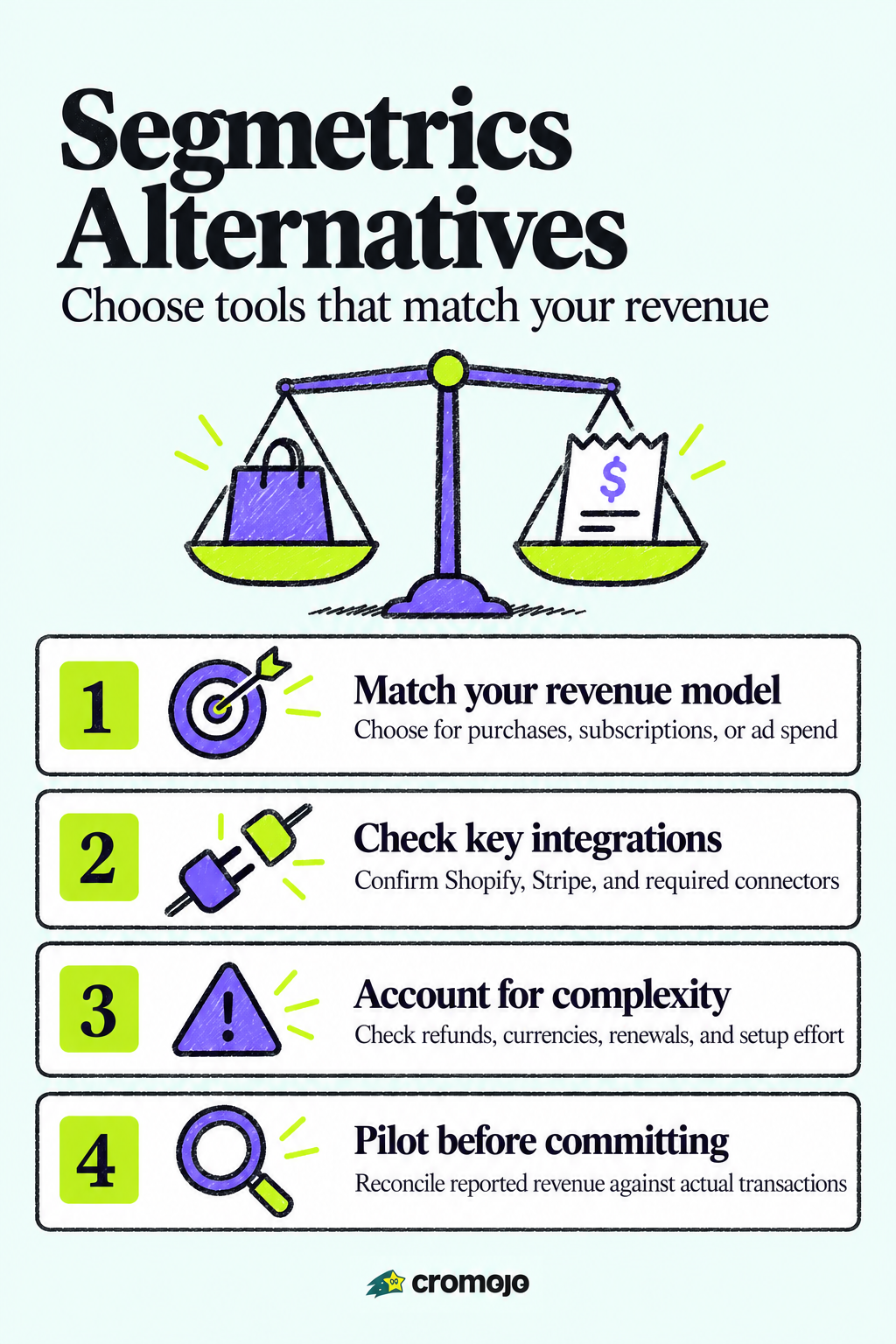
Start with your revenue model, not a feature list. An ad-native tool like Triple Whale wins for Shopify DTC brands optimizing daily ad spend, while a billing-first tool like TrackRev or Cromojo wins when your revenue runs through Stripe subscriptions with renewals and refunds in the mix. That single decision eliminates half the tools on this list before you book a single demo.
Run through this checklist before you sign anything:
- Confirm whether you're ad-native (Shopify DTC, campaign-first) or billing-first (SaaS, subscription-first), since the two require different attribution logic.
- List every required integration: Shopify, Stripe, your CRM, and any ad platforms you actively spend on.
- Check multi-currency support if you sell internationally. This is one of the pricing pain points buyers name most often when they leave Segmetrics.
- Ask how the tool handles LTV, refunds, and subscription renewals, especially if a chunk of your revenue comes from repeat customers.
- Clarify data ownership and retention policy before you connect production billing data.
On the demo call, push past the sales pitch with specific questions: What's the data latency between a sale and it showing in the dashboard? How are refunds and renewals reconciled against the original attribution? How does identity stitching work across devices? What's the support SLA, and can you export raw data if you leave? A vendor that dodges the export question is telling you something about how hard it'll be to leave later.
Watch for red flags during evaluation. Opaque pricing that only appears after a mandatory sales call, no clearly named attribution model, missing Shopify or Stripe connectors, and vague answers about cookie use or data retention are all signs to walk away. A tool built around journey mapping that ties visits to revenue should be able to explain that mapping in plain language, not hide it behind a black box.
Pro Tip:Run a 30-day pilot with a single KPI, revenue per campaign, and reconcile it against your actual billing data every week. If the numbers drift more than a few percentage points from what your payment processor shows, that's your answer before the trial even ends.
How Cromojo Maps to the Ecommerce Attribution Job
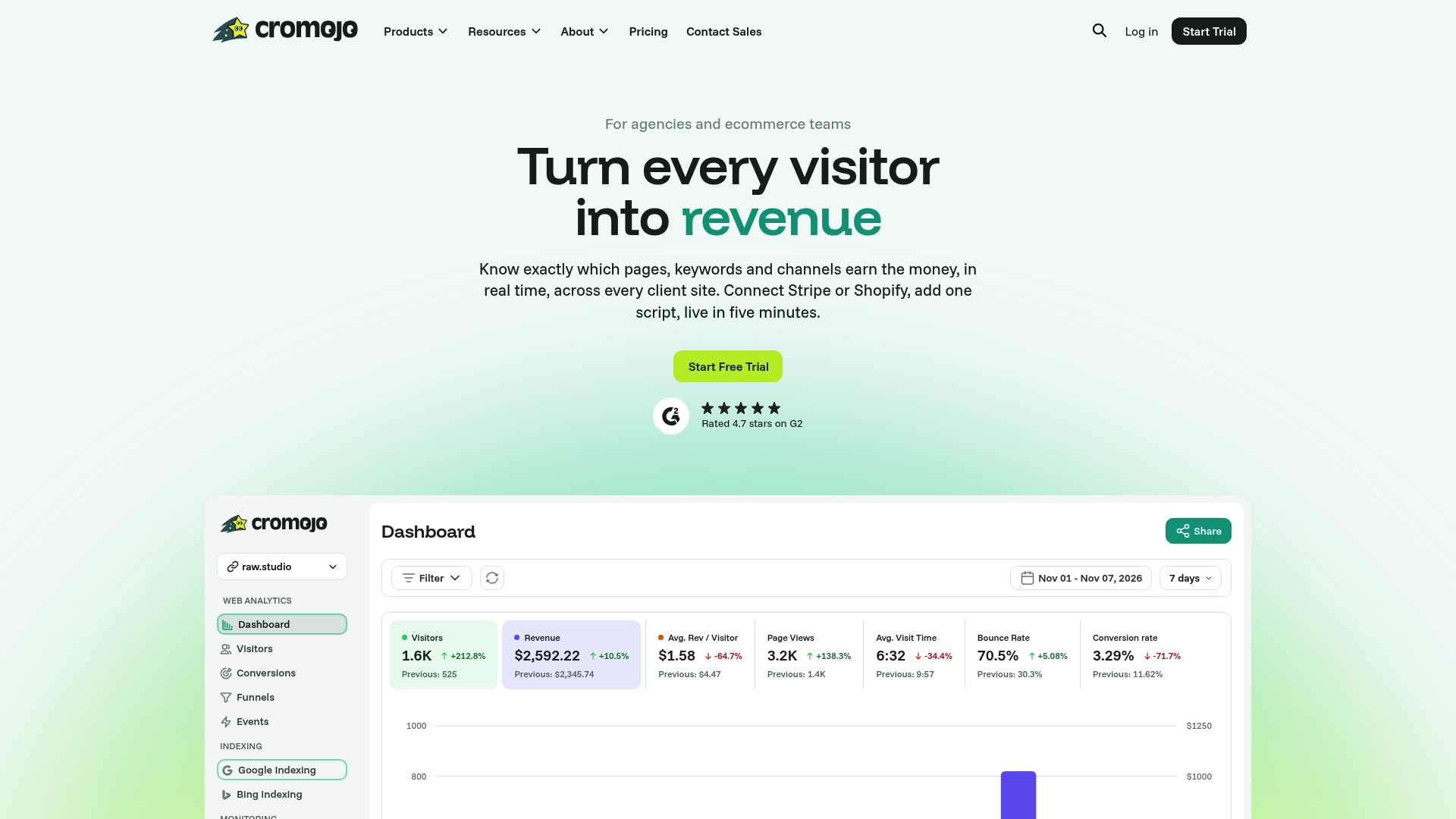
Cromojo was built around one specific buyer job: telling ecommerce teams which pages, keywords, and channels actually generate sales, not just traffic. It does that by connecting directly to Stripe and Shopify, so every attributed dollar traces back to a real transaction rather than a modeled estimate.
The core feature set includes:
- Real-time revenue attribution by page, keyword, and channel, tied directly to Stripe and Shopify sales data.
- Conversion funnels and visitor journey analysis that show where a buyer dropped off before purchase.
- Automated website indexing and re-indexing across Google, Bing, Yandex, and Baidu, plus site monitoring for downtime, errors, and SEO health.
- Cookieless, privacy-first tracking delivered through a lightweight script, so setup doesn't require a developer sprint.
That privacy angle matters more every year as browsers restrict third-party cookies. Cromojo's real-time analytics run without cookies at all, which sidesteps consent-banner friction and keeps data collection intact regardless of browser policy changes.
Most teams start the same way: connect Shopify and Stripe, enable revenue attribution, then pull a sample of recent conversions and check that the dashboard's numbers match what actually landed in the bank account. That reconciliation step, done once at setup and then spot-checked monthly, is the fastest way to trust a new analytics platform instead of just hoping it's right.
What Do Users Actually Say About These Tools?
Feedback on Segmetrics alternatives tends to split along the same lines as the tools themselves. Shopify-native platforms like Triple Whale draw praise for how fast teams get a working dashboard, usually within a day of installing the app, but some users note that speed comes at the cost of attribution depth once campaigns get complex.
Server-side and enterprise tools like Northbeam and Hyros collect a different kind of feedback: users appreciate the accuracy once the setup is finished, but the onboarding lift is real. Marketing teams without dedicated engineering support often describe a multi-week ramp before the data looks trustworthy.
For billing-first tools, the recurring theme in community discussion is reconciliation confidence. Teams using TrackRev or similar Stripe-connected platforms report that seeing attribution numbers match actual billing events, rather than a modeled approximation, is what convinced them to keep paying for the tool past the trial. That same reconciliation habit applies to Cromojo, where connecting Stripe directly means the revenue number in the dashboard should already match what shows up in your payment processor.
Common complaints across the category, regardless of vendor, center on multi-currency handling, delayed support responses during onboarding, and dashboards that look impressive but take too long to actually load for a merchant checking numbers between meetings.
What Should You Expect From Support and Onboarding?
Onboarding quality varies sharply based on how much engineering the tool requires. Shopify-native tools with app-based installs, including Cromojo and Triple Whale, tend to get most users to a working dashboard within a day or two, since there's no server-side tag manager configuration required.
Sales-assisted platforms like Hyros, Dreamdata, and Northbeam operate differently. Onboarding usually starts with a guided setup call, followed by a period of data validation that can run several weeks before the team trusts the numbers enough to make budget decisions from them. That's not a flaw, it's the cost of the deeper measurement rigor those tools provide, particularly the marketing-mix modeling layer inside Northbeam.
Support responsiveness during that window matters more than most buyers expect going in. A tool that takes days to answer a basic integration question during onboarding will likely be just as slow when something breaks after a Shopify theme update six months later. Ask directly during your evaluation what the support SLA looks like, and whether onboarding includes a named contact or just a shared inbox.
Cromojo's setup process, since it runs on a single lightweight script rather than a server-side deployment, is designed to need minimal support intervention in the first place. Most configuration questions get resolved by checking the Stripe and Shopify connection status directly in the dashboard rather than filing a ticket.
Do These Tools Offer Free Trials and Refunds?
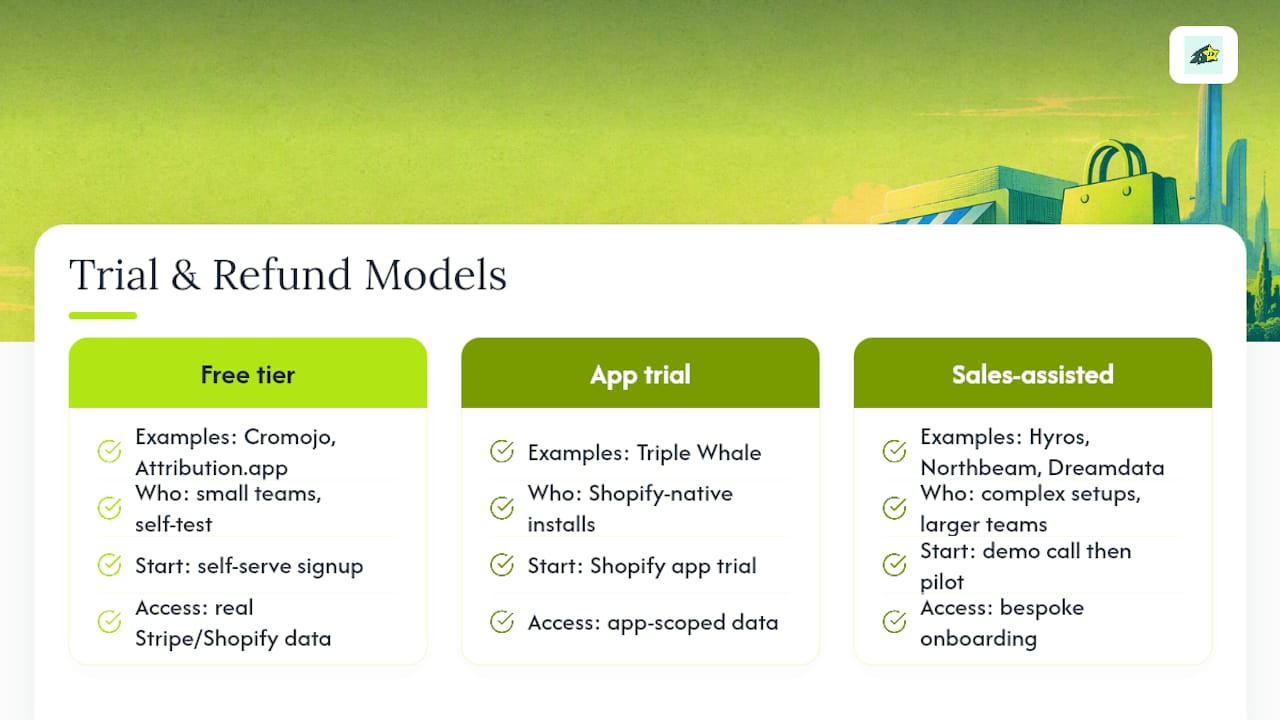
Trial structures differ meaningfully across this list, and that difference should factor into your evaluation timeline. Cromojo offers a free plan alongside its paid tiers, which lets a team test real-time revenue attribution against actual Stripe and Shopify data before committing to the Starter plan at $19 per month or moving up to Pro, Business, or Agency.
Attribution.app similarly keeps a free tier available, aimed at smaller teams who want to see multi-touch attribution working before paying for anything. Triple Whale typically offers a trial period tied to its Shopify app listing, consistent with how most Shopify-native tools handle first exposure.
Sales-assisted platforms like Hyros, Northbeam, and Dreamdata generally skip a self-serve free trial in favor of a demo call followed by a paid pilot period, since their setup complexity makes a true self-serve trial impractical. Refund policies across the category tend to follow standard SaaS norms: monthly billing that you can cancel anytime, with few vendors offering money-back guarantees given how usage-based most of these platforms are.
If refund terms matter to your evaluation, get them in writing during the demo rather than assuming standard SaaS practice applies. Pricing gates on higher tiers, the exact issue that pushes many teams away from Segmetrics in the first place, show up in some competitors too, so read the fine print on multi-currency and API access before you commit to an annual plan.
Where Are These Tools Headed Next?
Server-side tracking is the clearest trend across this entire category. As browser cookie restrictions tighten, tools that depend on client-side pixels are under pressure to add server-side options, and technical comparisons already show this shift underway among Shopify-focused vendors. Expect more platforms to add or expand server-side Google Tag Manager support over the next product cycles.
Consolidation is the second trend worth watching. Marketing teams increasingly want a single platform that handles both attribution and basic site health, rather than stitching together separate tools for analytics, indexing, and monitoring. Cromojo's roadmap already reflects that direction by bundling revenue attribution with automated indexing and website monitoring in one product rather than three.
B2B-focused tools like Dreamdata and SourceLoop continue pushing deeper CRM integration, since account-based attribution only gets more valuable as pipeline data gets richer. Expect tighter native connections to Salesforce and HubSpot rather than generic webhook-based syncing.
Privacy-first, cookieless tracking is likely to stop being a differentiator and become table stakes. Tools that still depend heavily on third-party cookies will face growing pressure to rebuild around first-party data collection, which is the approach Cromojo already uses by default.
Editorial Perspective: When One Tool Isn't Enough
Most guides push you toward picking one winner, but that framing misses how sophisticated teams actually operate. There's a real taxonomy here: ad-native tools like Triple Whale, revenue-first platforms like Cromojo, account-based systems like Dreamdata, and self-reported attribution surveys that some brands still run manually. Each answers a different question, and pretending one tool answers all of them is where most attribution headaches start.
Pairing makes sense more often than the marketing suggests. Some teams genuinely run two tools, an ad-native tracker for daily ROAS decisions and a billing-connected revenue tool for the reconciled numbers that actually inform budget meetings. That's not wasteful duplication. It's using each tool for the decision it's actually built to support.
If you're testing this setup, measure three things over a 30-day pilot: reconciliation rate against billing data, data latency between a sale and it appearing in the dashboard, and whether the switch actually changed how you allocate ad spend. If none of those numbers move, you probably didn't need the second tool.
Try Cromojo: Trial, Pricing, and First Steps
Every alternative on this list solves a piece of the attribution puzzle, but Cromojo is built specifically to answer the question Segmetrics users keep asking: which page, keyword, or channel actually produced this sale, right now, without waiting on a modeled estimate. Because it reads directly from Stripe and Shopify, the revenue number in your dashboard should already match what your payment processor shows, no reconciliation guesswork required.
Getting started takes three steps: connect your Shopify and Stripe accounts, turn on revenue attribution, and pull a handful of recent conversions to confirm they reconcile against your actual sales. From there, most teams add conversion funnels and automated indexing once the core attribution is trusted. Check the Cromojo pricing page to compare the Starter, Pro, Business, and Agency tiers, or start with the free plan if you want to see real revenue attribution against your own store before paying anything. Teams that want hands-on help setting up conversion tracking can also look at the Conversion Optimization Services for a more guided rollout.