
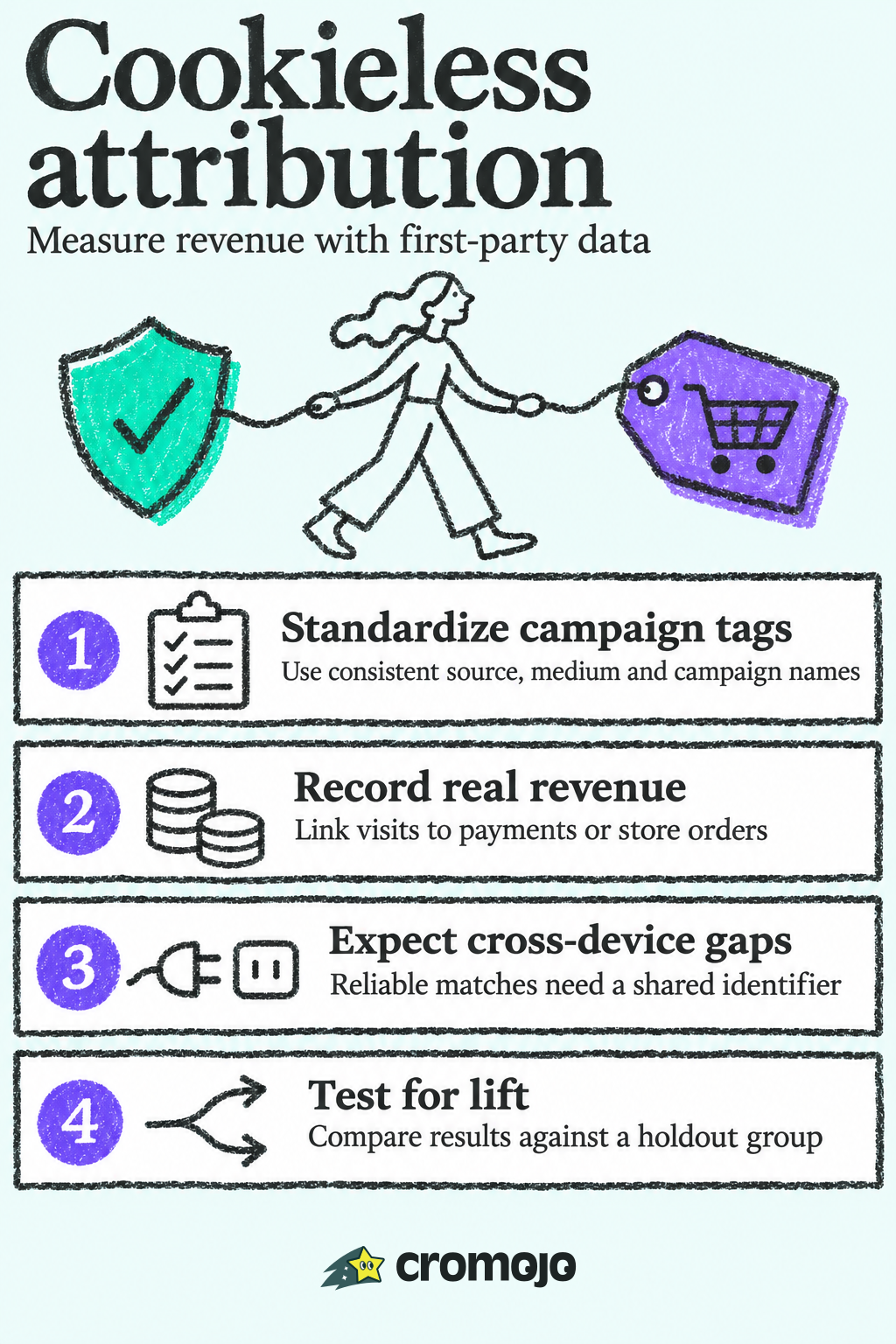
Cookieless attribution is a way of crediting marketing channels, campaigns and keywords for conversions without relying on third-party browser cookies. Instead, it uses first-party data you collect on your own site, server-side events, consented identifiers and statistical modeling. It gives you a usable picture of what drives revenue, but never a perfect one, and the best setups are honest about that.
This guide explains the methods, what each is good for, how cross-device and multi-device attribution fit in, where the gaps are, and how a small business or agency can put a workable setup in place.
What cookieless attribution actually means
Attribution answers one question: which touchpoints deserve credit for a sale or signup? For years the answer leaned on third-party cookies, small files set by ad platforms and trackers that followed a visitor from site to site. Cookieless attribution answers the same question with different ingredients.
It helps to separate three terms that often get blurred:
- Cookie-based attribution follows a browser through cookies, often set by a third party, and stitches visits together by that cookie.
- Cookieless tracking is the collection side: measuring visits and events without storing identifiers in the visitor's browser. Privacy-first analytics tools work this way.
- Cookieless attribution is the credit-assignment side: deciding which channel, campaign or keyword gets the revenue, using whatever signals remain.
One caution on vocabulary: "cookieless device identification" is a different thing. Fraud and security vendors use that phrase for recognizing returning devices, which is not the same purpose as marketing attribution.
A second point: "cookieless" does not mean "consent-free." Rules differ by country, and consent obligations depend on what you store and what you do with it. A consented track for opted-in users and a modeled or aggregate track for everyone else is one common way teams handle this. If you serve visitors in the EU, UK or US states with privacy laws, confirm your setup with qualified counsel or your data protection contact.
How credit gets assigned without third-party cookies
The mechanics fall into a few layers. Most teams use more than one.
Session-based attribution
The simplest method captures the referrer and UTM parameters when a visitor lands, then attributes any conversion in the same session to that source. Session-based approaches need no persistent identifier at all, which is why privacy-first analytics tools favor them.
The strength is simplicity and privacy. The weakness is the journey: if someone clicks a paid ad on Monday, reads your blog on Wednesday and buys on Friday after typing your address, a pure session model gives Friday's sale to "direct."
First-party and server-side tracking
When the conversion happens in your own systems, such as a Stripe payment or a Shopify order, you can record it server-side and join it to the source data you captured on your site. This avoids depending on a browser script firing correctly, and it ties the credit to real revenue instead of a proxy like a button click.
This is the layer where small businesses gain the most, because it requires no advertising identity graph. It needs a clean link between the visit and the order.
Cross-session methods
To connect visits over days, teams use hashed identifiers from request metadata, probabilistic matching, and aggregated marketing mix modeling, depending on the traffic and the data they have. Each trades precision against privacy and effort.
Marketing mix modeling
Marketing mix modeling (MMM) skips individuals entirely. It uses historical sales, media spend by channel and outside factors such as seasonality and pricing to estimate how much each variable contributed to outcomes. It suits businesses with meaningful spend across several channels and a long enough history. It is a poor fit for a store that started advertising last month.
Which method fits which situation
Cross-device and multi-device attribution without cookies
A shopper sees your ad on a phone during a commute and buys on a laptop that evening. Without a shared identifier, those look like two unrelated visitors. Cross-device attribution (sometimes called multi-device attribution) tries to join them.
There are two routes:
- Deterministic matching uses an identifier the person gave you: a login, a user ID, a hashed email or an authenticated session token. It is the privacy-safe option because the link is real, not guessed.
- Probabilistic matching infers identity from signals like IP ranges, timezone and behavior, and attaches a confidence score. It can stitch anonymous traffic together, but it is an estimate.
Be realistic about coverage. One industry write-up reports that universal IDs built on hashed emails often match roughly 20% to 50% of an addressable audience, and they only work for people who logged in or gave an email somewhere along the way. Treat that as a range reported by a vendor-side source, not a promise for your site.
For a small business, the practical takeaway is this: the most reliable cross-device link you will ever have is a moment where the visitor identifies themselves. A newsletter signup, a account login or a checkout is that moment. Design your funnel so those moments happen early, with clear consent, and your cross-device picture improves without any hidden tracking.
What cookieless attribution cannot tell you
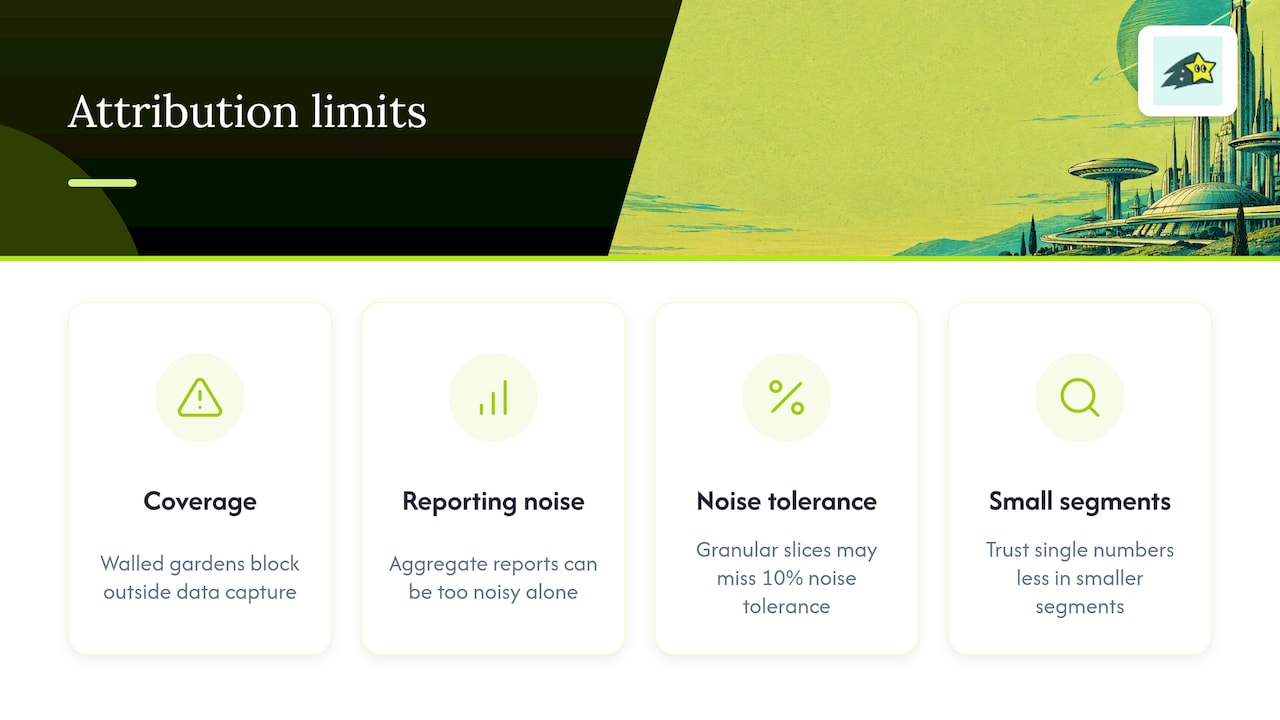
No attribution dataset is complete, with or without cookies. The IAB's attribution primer lists structural limits: walled gardens that block outside data capture, limited or inaccurate device graphs, partner-level data access problems, and time-based limits such as lookback windows and identifier churn. Those limits predate the cookie phase-out, and they are the reason attribution should guide decisions rather than settle them.
The same constraints on coverage, from restricted platform data to changing identifiers, are covered in this look at how analytics shapes marketing ROI.
Privacy-preserving reporting adds noise on purpose. Criteo's tests of Privacy Sandbox summary reporting found that the aggregated report alone was too noisy to be the only source for performance measurement, and that many campaigns' granular slices might miss a 10% noise tolerance. The lesson for a small team is not to slice results so thin that a handful of conversions drives decisions.
A useful rule: the smaller the segment, the less you should trust any single number. Look at channel-level trends over weeks, not keyword-level swings over a day.
How to set up cookieless attribution: a practical sequence
This sequence suits an ecommerce store, a SaaS site or an agency running several client sites.
- Audit what you can see today. List your channels, your conversion events and where each is recorded. Note which conversions happen off-site, by phone or in a marketplace, since they will not appear in site-level data.
- Standardize UTM parameters. Pick one naming convention for source, medium and campaign and write it down. Inconsistent tags are the most common reason channel reports look wrong.
- Record revenue at the source. Connect the system that actually takes payment so credit attaches to real orders and amounts, not clicks.
- Create deliberate identification moments. Give visitors a reason to log in or share an email, and ask for consent clearly. This is your deterministic backbone.
- Set up a consent-aware structure. Decide what you measure for people who opt in, and what you report in aggregate for people who do not. An implementation roadmap from one practitioner pairs server-side tracking for priority conversions with consent infrastructure and incrementality testing.
- Review weekly at channel level. Compare revenue by channel and landing page, and only drill into keywords once volume is high enough to mean something.
- Validate with a test. See the next section.
Check your numbers with an incrementality test
Attribution tells you who got credit. It does not tell you what would have happened without the ad. Incrementality testing addresses that by withholding ads from a randomly selected control group and comparing conversion rates between exposed and unexposed groups. A treatment versus control comparison measures causal lift rather than relying only on observed patterns.

You do not need an enterprise budget to try one. A simple version is to pause a campaign in a few comparable regions while keeping it live in others, then compare revenue after a few weeks. For planning guidance at small scale, this walkthrough on planning a small advertising test covers treatment and control groups.
When the test and your attribution report disagree, trust the test and adjust how you read the report. That is the point of running it.
Perspective
We built Cromojo around a simple belief: the number that matters most to a small business is revenue, and it should be traceable without asking visitors to be followed around the web.
That is why our tracking is cookieless and privacy-first, and why we connect directly to Stripe and Shopify. Revenue attribution by keyword, page and channel only helps if the revenue is real, so we start from the order and work backward to where the visit came from.cr
Our view is that most small teams do not need a complicated identity graph. They need clean channel data, honest handling of gaps, and a dashboard that shows what to fix next. Agents that monitor the site continuously, and surface specific conversion issues, save the hours teams would otherwise spend digging through reports.
If you take one thing from this article: measure revenue first, keep your tagging consistent, and treat every attribution number as a guide for decisions rather than a verdict.
Putting revenue attribution to work with Cromojo
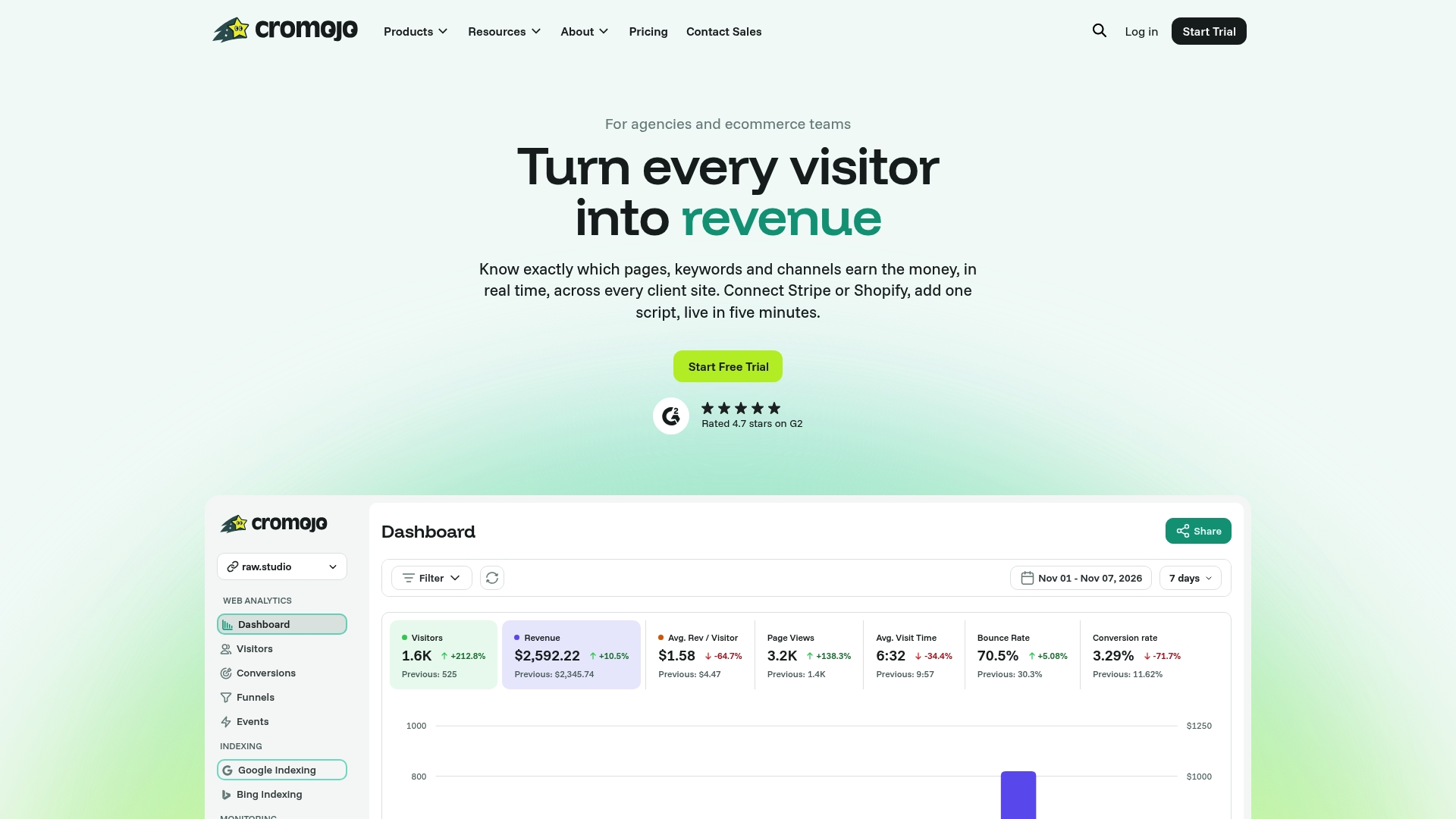
If you want cookieless revenue attribution without assembling it from separate tools, Cromojo's revenue analytics shows revenue by keyword, page and channel, with Stripe and Shopify integration and cookieless, privacy-first tracking. Our real-time analytics let you see changes as they happen, and email reports summarize what to act on.
Plans are tiered by pageviews and tracked sites. Starter is $19 per month, Pro is $49 per month, Business is $129 per month and Agency is $299 per month, and a free plan is also available. Overages are billed per 1,000 additional pageviews. See the pricing page for what each tier includes. Agencies managing several client sites can also look at our website monitoring for downtime, errors and SEO health.
What to do this week
You can make real progress in a few hours:
- Write down your UTM convention and fix the three most inconsistent campaigns.
- Confirm that every order, from every checkout path, reaches a system you can report from.
- Add one moment where visitors can identify themselves with clear consent, such as an account or a newsletter.
- Pick one channel to test with a holdout, and schedule it.
Then revisit the table above and choose the one extra method that fits your volume. For most small sites that is server-side order matching. For businesses with larger, multi-channel budgets, aggregate modeling becomes worth the effort.