


For ecommerce teams that need real-time revenue attribution and privacy-first tracking, Cromojo is the recommended pick. If your needs are different, here is how the major categories break down:
- Enterprise warehouse-native (Amplitude, Mixpanel, Adobe Analytics, Segment): precision event tracking, CDPs, and experimentation at scale
- Developer-first open-source (PostHog, Snowplow, Matomo): full data control, self-hosted options, higher ops overhead
- Session-replay and qualitative (FullStory, LogRocket, Glassbox, ContentSquare, Smartlook, Appsee): visual context for UX debugging
- Privacy-first lightweight (Plausible, Matomo/Piwik): cookieless, minimal setup, limited depth
- Product adoption and experimentation (Pendo, Gainsight PX, Optimizely, Kissmetrics, Factors.ai): feature adoption, NPS, A/B testing
Key Takeaways
The strongest Heap alternative for ecommerce teams is Cromojo, which delivers real-time revenue attribution by keyword, page, and channel with cookieless tracking and native Stripe and Shopify integrations out of the box.
| Point | Details |
|---|---|
| Ecommerce revenue attribution | Cromojo attributes real sales to specific pages, keywords, and channels, not just traffic. |
| Warehouse-native for scale | Choose Snowplow, Amplitude, or Segment when data governance and precision event schemas are the priority. |
| Open-source for control | PostHog or Matomo suit engineering-led teams that need full data ownership and can absorb ops overhead. |
| Privacy-first for compliance | Plausible or Matomo/Piwik work well when cookieless tracking and minimal data collection are non-negotiable. |
| Migration: parallel-track first | Run your new tool alongside Heap for two to four weeks and validate funnel parity before cutting over. |
Why teams look for Heap alternatives: the practical triggers
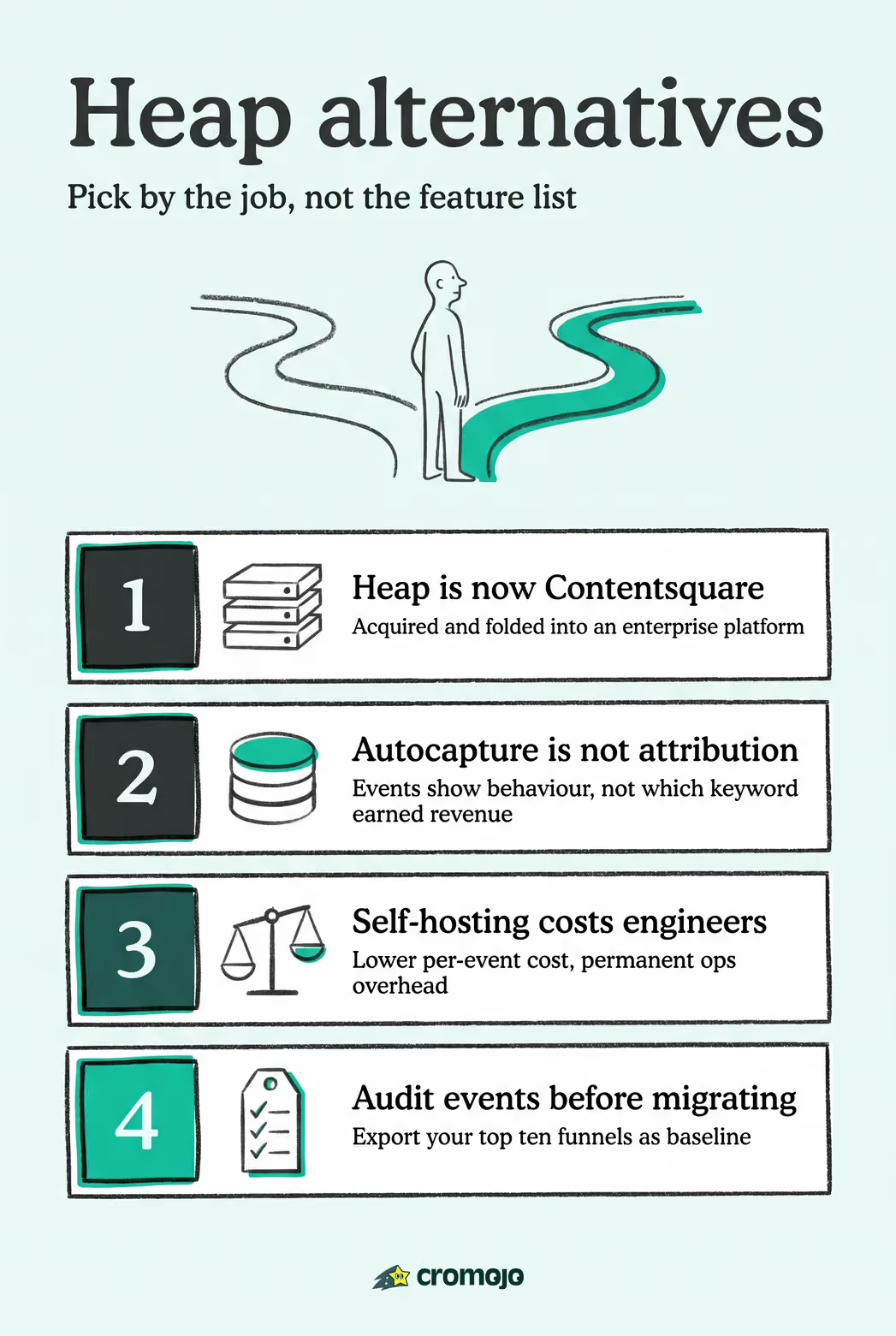
Heap's autocapture is genuinely convenient early on. You drop in a script, and it retroactively tracks every click, form fill, and page view without manual instrumentation. That convenience can be limited as teams grow and their needs evolve.
The most common migration triggers are:
- Pricing surprises at scale: Heap's event-volume pricing can jump sharply as traffic grows, and the jump often catches teams off guard after the first contract renewal
- Data ownership and export limits: teams that want to pipe raw event data into a warehouse (Snowflake, BigQuery, Redshift) often find Heap's export options restrictive or expensive at higher tiers
- Missing feature areas: Heap has no native feature flags, limited A/B testing, and session replay that lags behind dedicated tools like FullStory or LogRocket
- Governance burden from autocapture: as products scale, unmanaged autocapture generates noisy, high-volume datasets that inflate storage costs and complicate downstream analytics, a pattern practitioners describe consistently as a core reason to migrate
- Revenue attribution gaps: Heap tracks behavior well but does not connect user actions to actual revenue by keyword, page, or channel, a critical gap for ecommerce teams
Pro Tip: Ask any vendor you evaluate this question before signing: "What happens to my historical data if I downgrade or cancel?" The answer reveals both data portability and pricing leverage in a single exchange.
At-a-glance comparison: Heap alternatives by use case
The table below maps each platform to the dimensions that matter most when you are shortlisting. Cromojo leads as the publisher's recommended option for ecommerce revenue attribution.
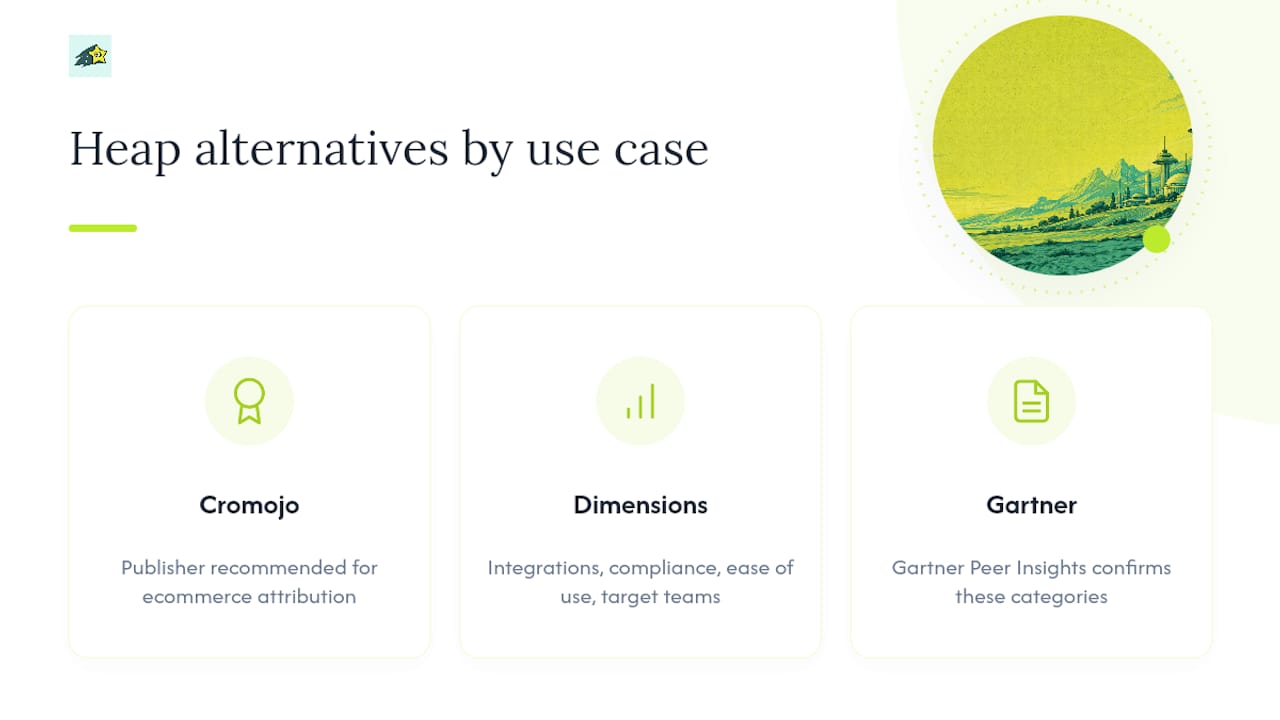
Gartner Peer Insights confirms that these platform categories are the ones buyers most frequently compare when evaluating Heap replacements.
Short profiles: what each alternative actually offers in practice
Understanding what a platform does in a sales deck versus what it does on day 30 of implementation are two different things. Here is a plain-language breakdown by category.
Cromojo connects your website traffic directly to revenue. You get real-time attribution by keyword, page, and channel, with native Stripe and Shopify integrations that pull actual transaction data rather than proxies. Setup is a single lightweight script. For ecommerce teams that want to know which blog post or paid keyword is generating sales, not just sessions, this is the most direct path.

Enterprise warehouse-native platforms (Amplitude, Mixpanel, Adobe Analytics, Segment) prioritize precision and scale. Amplitude and Mixpanel both offer strong self-serve product analytics with autocapture, but their real value shows up in experimentation, cohort analysis, and CDP capabilities. Adobe Analytics is the heaviest option, suited to large enterprises with dedicated analytics engineers. Segment sits upstream as a data router rather than a visualization layer, making it a foundation for a multi-tool stack rather than a standalone analytics platform. CB Insights catalogs the breadth of this competitive landscape well.
Developer-first open-source tools (PostHog, Snowplow) give engineering teams full control over their event schemas and data pipelines. PostHog bundles feature flags, session replay, and A/B testing alongside product analytics, which makes it attractive for teams that want one platform and are comfortable managing infrastructure. Snowplow is a data-engineering tool first: it produces clean, warehouse-ready behavioral data but requires significant ops investment. Neither is a good fit for a marketing team that needs answers by next Tuesday.
Session-replay and qualitative platforms (FullStory, LogRocket, Glassbox, ContentSquare / ClickTale, Smartlook, Appsee) answer the "why" behind quantitative funnels. FullStory and LogRocket are the most developer-friendly, with error tracking alongside replay. Glassbox and ContentSquare target enterprise compliance and journey analytics respectively. Smartlook is the most accessible entry point for smaller teams. The tradeoff across all of them: session storage and retention windows get expensive fast at high traffic volumes.
Privacy-first lightweight analytics (Plausible, Matomo/Piwik) are the right call when compliance simplicity and minimal data collection are the priority. Plausible is genuinely simple: traffic, goals, and basic funnels, with no cookies and a flat monthly fee. Matomo adds heatmaps, ecommerce tracking, and self-hosting. Neither replaces a revenue attribution layer. For a deeper look at cookieless analytics options, the tradeoffs between these tools are worth mapping against your compliance requirements.
Product adoption and experimentation suites (Pendo, Gainsight PX, Optimizely, Kissmetrics, Factors.ai) solve different jobs. Pendo and Gainsight PX are built for SaaS products that need in-app guidance and NPS alongside analytics. Optimizely is an experimentation platform that has absorbed analytics capabilities. Kissmetrics focuses on revenue cohorts and email-triggered campaigns. Factors.ai targets B2B teams that need account-level intent signals. Add these when you have a specific gap; switching your entire analytics stack to one of them rarely makes sense unless that gap is your primary problem.
Pricing shapes and deployment options explained
Pricing models in product analytics are genuinely confusing because vendors use different units, and the unit that looks cheapest at signup often becomes the most expensive at scale.

The four common pricing models include event-based pricing, MAU-based pricing, seat-based pricing, and pageview tiers, each with its own trade-offs related to volume, stability, and team size.
Deployment shapes the total cost of ownership as much as the pricing model does. SaaS means faster setup and no infrastructure overhead, but your data lives on the vendor's servers. Self-hosted (PostHog OSS, Snowplow, Matomo) gives you full data ownership and often lower per-event costs, but you absorb the engineering and maintenance burden. Warehouse-native tools (Snowplow, Segment) route data directly into your own Snowflake or BigQuery instance, which is ideal for teams with existing data infrastructure.
A practical cost reality: most platforms offer a free tier or trial that covers early-stage usage comfortably. Month 1 costs are rarely the issue. By month 12, as event volumes grow and you add integrations or seats, the bill often looks very different. Independent roundups consistently flag this gap between introductory and scaled pricing as a top buyer concern. Check the overage rate and the tier ceiling before you commit, not after.
How to pick the right alternative and migrate without losing data
The right platform depends on three things: what your team can actually operate, what data you need to own, and which feature gaps are blocking revenue decisions today.
Selection criteria
- Technical readiness: does your team have engineers who can maintain a self-hosted deployment, or do you need a no-code SaaS setup?
- Data governance: do compliance requirements (GDPR, HIPAA, financial regulations) demand self-hosted or cookieless tracking?
- Feature parity: list your must-haves (session replay, feature flags, revenue attribution, A/B testing) and non-negotiables separately
- Integrations: map your current stack (CRM, CDP, data warehouse, ecommerce platform) and confirm native connectors exist before shortlisting
- Buyer role: marketing teams need dashboards and channel attribution; product teams need funnels and retention; engineers need raw event access and SDKs
Vendor questions that reveal what you need to know
Ask these before signing any contract. Buying guides for 2026 specifically flag reverse ETL compatibility, identity resolution, SDK flexibility, and PII masking as the dimensions most teams forget to validate:
- What is the overage rate per 1,000 events/pageviews above my tier?
- Can I export raw event data to my warehouse on any paid plan, or only enterprise?
- What is your data retention policy if I cancel?
- How do you handle PII masking and consent mode?
Migration checklist
- Discovery: audit your current Heap events, funnels, and dashboards - document what you actually use versus what was auto-captured
- Proof of concept: run the shortlisted tool in parallel on one property for two to four weeks
- Parallel tracking: deploy both Heap and the new tool simultaneously to validate event parity
- Data validation: compare funnel conversion rates and key metrics between both tools before cutover
- Cutover: remove Heap's script only after two clean weeks of matching data
- Post-migration monitoring: set alerts for anomalies in your core metrics for the first 30 days
The most common migration pitfall is cutting over too early. Teams that skip parallel tracking often discover that autocapture event names in Heap do not map cleanly to manually instrumented events in the new tool, and they lose weeks of comparable data. Gainsight's guidance on platform consolidation reinforces that the transition from autocapture to precision tracking requires deliberate instrumentation planning, not just a script swap.
Pro Tip: Before migration, export your top 10 Heap funnels as CSVs and use them as your validation baseline.

Why Cromojo is a recommended Heap alternative for ecommerce teams
Most analytics platforms tell you how many people visited a page. Cromojo tells you how much revenue that page generated. For ecommerce teams, that distinction shapes every budget decision, every content investment, and every channel allocation.
Cromojo's core differentiators for ecommerce teams:
- Real-time revenue attribution: see which keywords, pages, and marketing channels are generating actual sales, not just sessions or clicks, via revenue attribution analytics
- Cookieless, privacy-first tracking: no consent banners required for core analytics; GDPR-friendly by default with a lightweight script that installs in minutes
- Native Stripe and Shopify integrations: transaction data flows directly into your analytics without custom pipelines or engineering work
- Google Search Console integration: connects organic search performance to revenue outcomes in a single dashboard
- Conversion funnels and visitor journey analysis: see where users drop off and which paths convert, with goal tracking and advanced segmentation built in
- Automated website indexing and monitoring: covers SEO health, downtime alerts, and re-indexing across Google, Bing, Yandex, and Baidu alongside analytics
For agencies managing multiple ecommerce clients, Cromojo's multi-site architecture and agency-focused analytics playbook make it practical to track revenue attribution across an entire portfolio from one account.
| Cromojo capability | What it replaces in a typical stack |
|---|---|
| Real-time revenue attribution | Heap + manual revenue tagging + BI tool |
| Cookieless tracking | Heap + consent management platform |
| Stripe / Shopify integration | Heap + custom webhook pipeline |
| Website monitoring and SEO health | Heap + separate uptime monitor + Search Console |
| Visitor journey and funnels | Heap behavioral funnels |
PeerSpot's buyer comparison data shows that revenue attribution and privacy compliance are among the most frequently cited gaps when buyers evaluate Heap replacements, which maps directly to what Cromojo addresses.
A note on what Cromojo is not
Cromojo is not a session-replay tool, a feature-flag platform, or a warehouse-native data pipeline. If those are your primary requirements, PostHog, FullStory, or Snowplow are more appropriate. Cromojo is purpose-built for ecommerce revenue clarity, and it does that job without requiring a data engineer or a six-week implementation.
What the author actually thinks
The analytics market has a habit of selling complexity as sophistication. Most ecommerce teams do not need a warehouse-native behavioral data pipeline or enterprise session intelligence. They need to know which channel is making them money and whether their site is healthy enough to convert traffic. The tools that answer those two questions directly, without requiring a dedicated analyst to interpret the output, are the ones that actually get used.
Cromojo fits that description for ecommerce. PostHog fits it for developer-led product teams. Plausible fits it for content sites that need compliance simplicity. The mistake most teams make is choosing the most feature-rich platform they can justify rather than the one that answers their actual question fastest.
Validate any shortlisted tool with a two-to-four-week proof of concept on real traffic before committing. Roadmap promises and pricing decks are not substitutes for seeing your own data in the platform.
Ready to see your revenue by channel, not just your traffic?
Heap shows you what users do. Cromojo shows you what those actions are worth. For ecommerce teams that have outgrown traffic metrics and need real-time revenue attribution by keyword, page, and channel, Cromojo is the faster, lower-friction path. Setup takes minutes via a lightweight script, with no cookies, no consent banners for core tracking, and native integrations for Stripe and Shopify already built in.
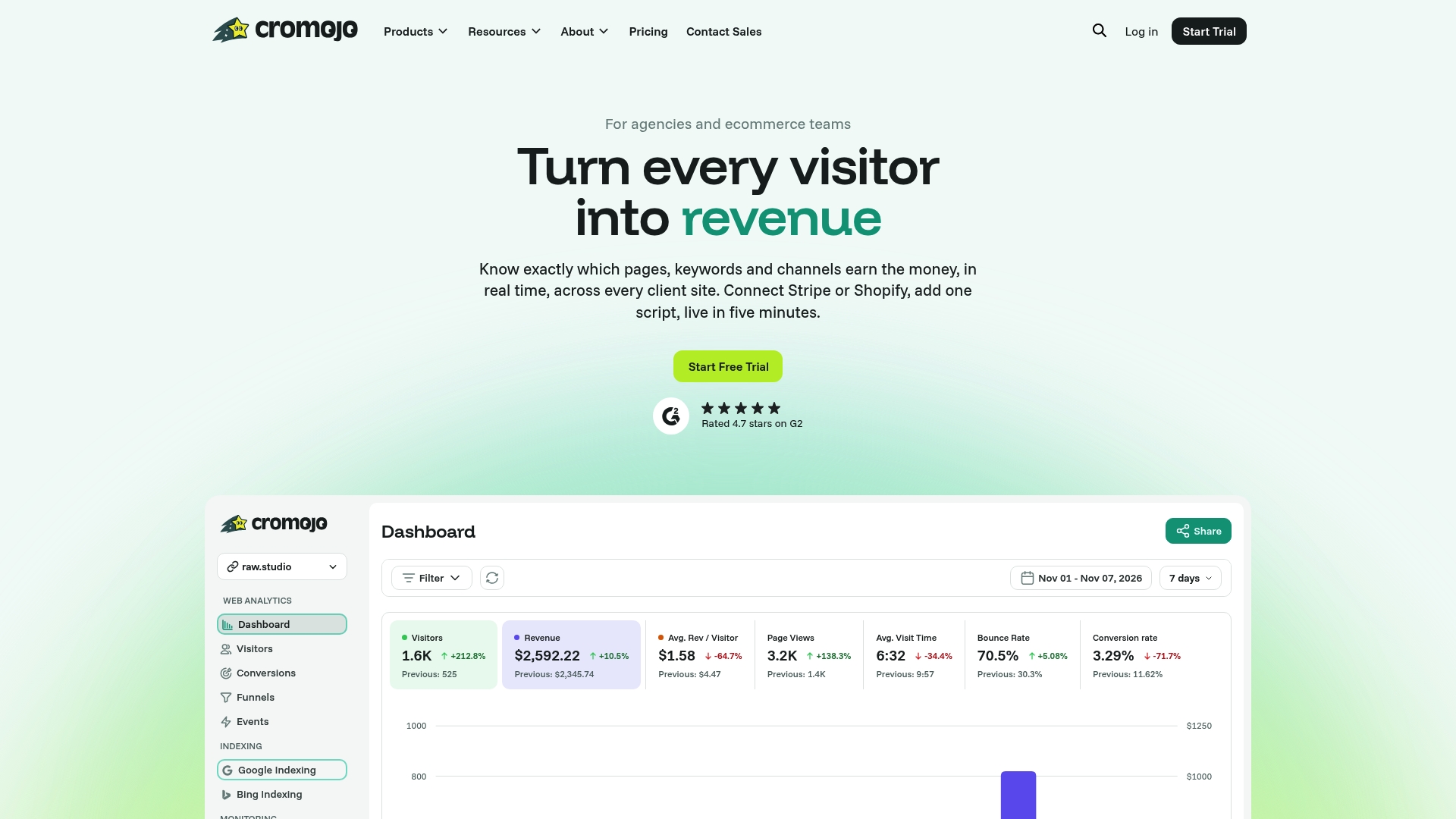
Start with Cromojo's revenue analytics to see attribution data on your own traffic, or explore real-time cookieless tracking if privacy compliance is your first priority.
Sources
The sources below were used for market context, buyer-comparison patterns, and feature validation throughout this article.
- Top Heap Competitors & Alternatives 2025 | Gartner Peer Insights - Web, Product and Digital Experience Analytics
- Product analytics tools | Gainsight - Essential guide to product management metrics
- Heap Alternatives: Top 10 Reviewed for 2026
For a broader look at web analytics tools in 2026, including free-tier options and marketing-specific use cases, Cromojo's analytics blog covers the category in depth. Teams evaluating customer insight platforms alongside behavioral analytics will also find practical guidance on combining these data sources.