

If you're evaluating GA4 alternatives, here's the short version: Cromojo is the strongest pick when revenue attribution and privacy-friendly tracking are the job, Plausible or Fathom Analytics fit if you just want simple, cookieless traffic reporting, and Matomo or PostHog make sense when data ownership or product analytics depth matter more than ecommerce revenue.
Each of these solves a different problem. Cromojo ties orders to the pages, keywords, and channels that actually produced them, using Stripe and Shopify integrations built for that purpose. Plausible and Fathom strip analytics down to a clean, cookie-free dashboard for teams who just want traffic without the compliance overhead. Matomo and PostHog trade some simplicity for control: self-hosting, raw data export, or product-level event tracking that GA4 was never built to handle well.
You don't have to pick just one. Plenty of teams keep GA4 running for ad platform attribution while layering in a privacy-first tool as a more reliable baseline, a pattern PostHog's own comparison of GA4 alternatives describes as increasingly common.
- Ecommerce brands and agencies: Cromojo, for order-level revenue attribution
- Content sites and small teams: Plausible or Fathom Analytics, for cookieless simplicity
- Data ownership or compliance needs: Matomo or Piwik PRO, for self-hosting and residency control
- Product and engineering teams: PostHog, Mixpanel, or Amplitude, for event depth and session replay
Key Takeaways
Ecommerce and agency teams get the most value from a GA4 alternative built around revenue attribution, while content sites and regulated organizations are better served by simplicity or data ownership, respectively.
Which GA4 Alternatives Should You Actually Consider?
Here are the ten tools worth putting on your shortlist, starting with the one built specifically for revenue attribution.
Cromojo ties real-time revenue to the exact pages, keywords, and campaigns that generated it, using direct integrations with Stripe and Shopify. It's cookieless by default, so you don't need a consent banner to see which channels actually drive sales, and it bundles in automated site indexing and uptime monitoring so ecommerce teams aren't juggling three separate dashboards. Hosting is cloud-based with no self-hosting option, and it's the clearest fit for merchants and agencies whose main question is "which marketing dollar produced this order," not "how many people visited page X."
Plausible is built around a single idea: analytics shouldn't require a consent banner or a computer science degree to read. The script weighs a few kilobytes, the dashboard fits on one screen, and Plausible markets itself directly as a cookie-free alternative to Google Analytics used by a large base of content sites and small marketing teams. It's a poor fit if you need funnel-level ecommerce attribution, but a great fit if your main goal is knowing where traffic comes from without a privacy headache.
Matomo is the go-to when data ownership isn't optional. You can self-host it on your own servers, keep every byte of visitor data inside your own infrastructure, and configure consent and retention rules to match strict regulatory requirements. Startupik's comparison of Matomo, GA4, and Plausible points to Matomo as the pick for regulated organizations that need governance controls GA4 simply doesn't offer.
PostHog treats web analytics as one feature inside a broader product suite that also includes session replay, feature flags, and A/B testing. If your team already thinks in terms of user cohorts and product events rather than pageviews, PostHog's all-in-one framing (as it positions itself in its own alternatives roundup) will feel more natural than bolting a separate tool onto GA4.
Fathom Analytics covers similar ground to Plausible: a lightweight, privacy-first dashboard with no cookies and a quick setup. It's aimed at teams who want a trustworthy at-a-glance view of traffic and referrers without wading into event configuration.
Simple Analytics takes a specific angle: it's designed to run alongside GA4, not necessarily replace it, capturing the visits that cookie consent rejections and ad blockers cause GA4 to miss. Simple Analytics documents this cookieless recovery approach as a way to see your true traffic total, not just the portion that accepted a cookie prompt.
Mixpanel is an event-first platform built for behavioral analysis: funnels, retention curves, and cohort breakdowns that go well beyond what a marketing team typically needs but that a growth team relies on daily.
Amplitude scales the same event-based approach up to enterprise size, with more infrastructure for large product organizations running complex experimentation programs.
Piwik PRO pairs analytics with consent management and customer data platform features, aimed at regulated industries that need both measurement and compliance tooling in one contract.
Counter sits at the opposite end of the spectrum from Piwik PRO: a free, minimal analytics tool for personal projects and indie developers who just want a basic visit count without any setup overhead.
A handful of others round out the broader category worth knowing by name: Adobe Analytics for large enterprise marketing stacks, Crazy Egg for heatmap and behavior visualization, Pirsch and Umami as lightweight self-hosted options, Clicky for real-time visitor logs, HockeyStack for B2B revenue attribution, Vercel Web Analytics for teams already deployed on Vercel, WP Statistics and Jetpack Stats and Slimstat Analytics for WordPress sites specifically, Heap for auto-captured product events, Kissmetrics for customer-level behavior tracking, TelemetryDeck for privacy-first mobile app analytics, and Celebrus for enterprise customer data integration.
How Do These GA4 Alternatives Compare on the Features That Matter?
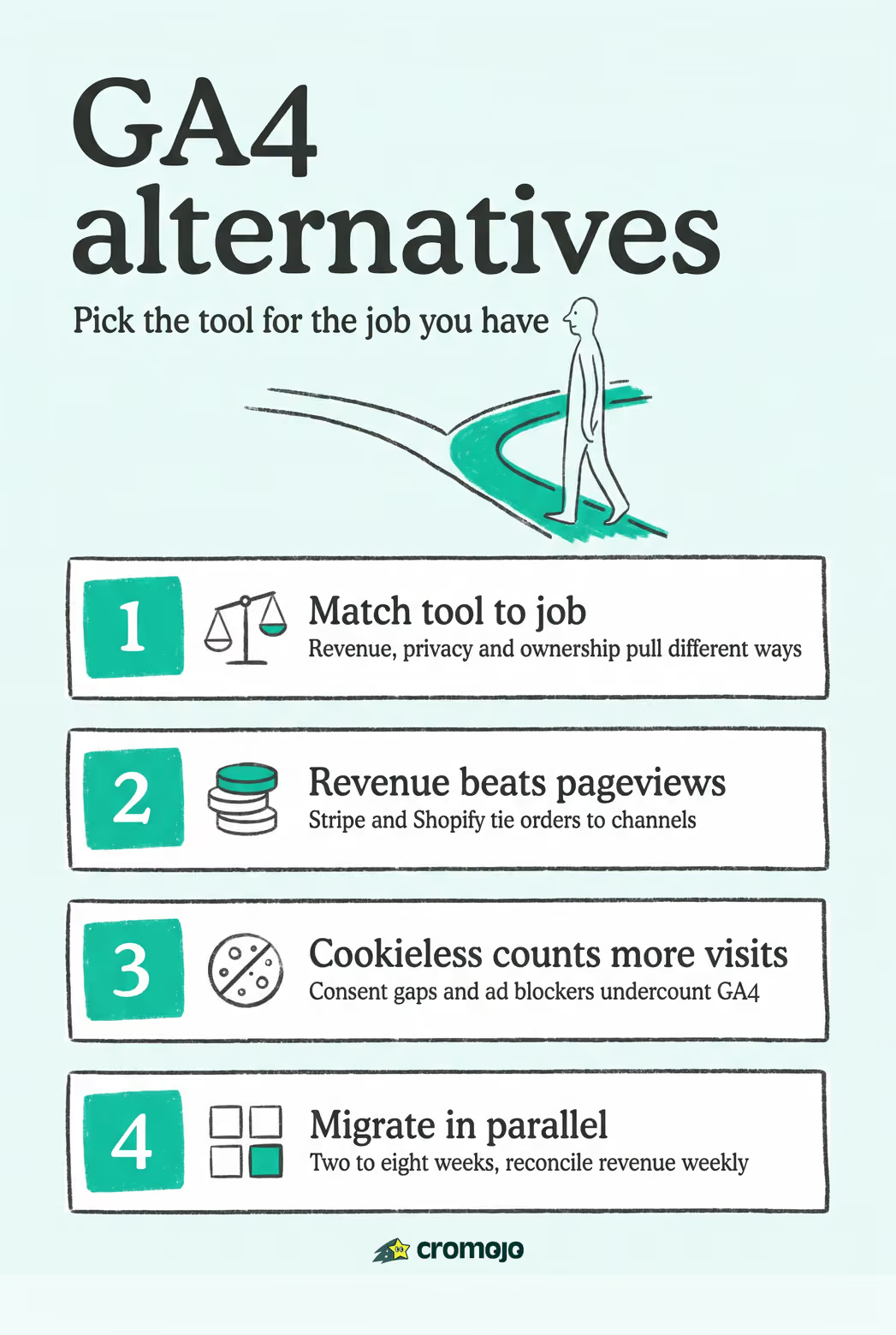
The right tool depends entirely on what "the job" is. Revenue attribution, data ownership, and product depth pull in three different directions, and no single platform does all three equally well.
Ecommerce teams should read this table with one question in mind: does the tool tell me which channel produced revenue, or just which channel produced traffic? Most of these platforms answer the second question well. Only a handful, Cromojo chief among them, are built to answer the first.
Ownership versus convenience is the biggest trade-off in this table. Self-hosting Matomo or PostHog puts you in full control of your data, but it also puts your team in charge of servers, updates, and security patches. Cloud-hosted tools like Cromojo, Plausible, and Fathom Analytics remove that burden entirely, at the cost of not having your own infrastructure to point to during a compliance audit.
Depth versus simplicity shows up just as clearly. Mixpanel and Amplitude will show you retention curves and cohort splits that a small marketing team has no use for. Plausible and Fathom Analytics deliberately avoid that complexity, and Cromojo sits in between: deep enough on revenue and funnel data to answer real ecommerce questions, without requiring an analyst to configure custom events for weeks before it becomes useful.
For ecommerce specifically, three features separate the tools that will actually help you from the ones that just look similar to GA4:
- Native Stripe and Shopify integrations, so purchase events don't require custom tracking code
- Purchase-event fidelity that deduplicates orders and maps them to order IDs, not just session counts
- Channel-level revenue attribution, not just traffic-level attribution
A platform that maps order IDs and reconciles duplicate events gives you a far more trustworthy revenue-by-channel report than one that just counts sessions and hopes the correlation holds.
What Should You Ask Before Switching Analytics Tools?
Start with what you actually need answered, not with a feature checklist copied from a review site. GA4 tries to be everything to everyone, which is part of why so many teams end up frustrated with it. A good replacement should be narrower and better at the specific job you have.
Work through these criteria before you commit to a trial:
- Integration depth: Does it connect natively to Stripe and Shopify, or will you need custom API work to get purchase data flowing?
- Revenue attribution: Can it tie a specific order back to the channel, keyword, or landing page that drove it, or does it stop at session-level traffic?
- Event and funnel depth: Do you need granular product events and cohort analysis, or is pageview-and-conversion tracking enough?
- Export options: Can you pull raw data out in a usable format, or are you locked into the vendor's own dashboard?
- Retention limits: How long does the tool keep your historical data before archiving or deleting it?
- Pricing predictability: Is the model based on pageviews, events, or sessions, and does it scale in a way your traffic growth won't blow up?
- Hosting and residency: Does the vendor offer regional hosting if compliance requires it?
When you talk to a vendor, ask direct, specific questions rather than accepting a marketing page at face value. "Can I export raw events in newline-delimited JSON?" is a good litmus test. So is "What happens to my historical data if I cancel?" and "Does your consent flow require a cookie banner in the EU?" A vendor that can't answer clearly is telling you something.
Pro Tip:Before you shortlist anything, spend a week auditing which GA4 events and reports your team actually opens. Most teams configure dozens of events they never look at again, then overbuy analytics platforms trying to replicate all of them. Match tools to the five or six reports people genuinely check.
Watch for red flags during a trial: vague answers about data retention, pricing pages that hide overage costs, or a sales team that can't explain how purchase events get deduplicated. Those gaps tend to surface at the worst possible time, usually during a Black Friday traffic spike.

How Do You Migrate From GA4 Without Losing Data?
You don't need to rip GA4 out on day one. Most teams run a parallel setup first, then decide what to keep.
- Map your current GA4 events to the equivalent events in the new tool, including custom conversions and ecommerce purchase events.
- Align naming conventions across both platforms so a "checkout_complete" event in GA4 matches whatever the new tool calls it.
- Run both tools side by side for two to eight weeks, long enough to cover at least one full sales cycle if your traffic has weekly or monthly patterns.
- Reconcile revenue numbers weekly, comparing total attributed revenue in each tool and investigating any gap larger than a few percentage points.
- Monitor for discrepancies caused by sampling or consent-mode differences, since GA4 samples data on high-volume queries and applies consent-based modeling that can undercount sessions.
- Cut over fully or keep a hybrid setup, depending on whether your ad platforms still require GA4's specific integration for audience building.
The most common pitfall is comparing numbers too early, before either tool has stabilized its own event definitions. Give it at least two full weeks before drawing conclusions, and expect some permanent gap between a cookie-based tool and a cookieless one. That gap isn't a bug. It reflects the visits GA4 was undercounting to begin with, a pattern Simple Analytics documents as a routine outcome of cookieless measurement.
For agencies managing this across multiple client sites, it helps to standardize the reconciliation process once and reuse it, rather than reinventing the checklist for every migration. Our guide to keeping GA4 running for ad attribution while adding a privacy-first baseline walks through exactly this hybrid pattern.

Where Does Cromojo Fit for Ecommerce and Agency Teams?
Cromojo was built around one specific gap in most analytics tools: knowing that a page got traffic tells you almost nothing about whether that traffic produced revenue. The platform closes that gap directly.
- Order-level revenue attribution ties real-time sales back to the specific page, keyword, and channel that generated them.
- Native Stripe and Shopify integrations mean purchase data flows in without custom event configuration.
- Cookieless tracking removes the need for a consent banner while still capturing accurate visitor and revenue data.
- Automated indexing and site monitoring cover SEO health, uptime, and search visibility across Google, Bing, and other engines, so ecommerce teams aren't stitching together separate tools for measurement and technical health.
- Conversion funnels and visitor journey mapping show where buyers drop off, not just where they land.
Cromojo is the direct pick when your core question is "which marketing spend actually produces revenue." If your priority is instead pure data ownership under strict regulatory requirements, Matomo's self-hosting model may serve you better. If you just want a clean, simple traffic dashboard with zero ecommerce complexity, Plausible or Fathom Analytics will get you there faster. Our comparison of Cromojo against Plausible, Fathom, and Simple Analytics breaks down exactly where each tool earns its keep.
Why Are So Many Teams Leaving GA4?
Privacy compliance sits near the top of most lists. Consent banners cut into tracked traffic, and GA4's own architecture assumes a level of cookie consent that a growing share of visitors simply won't give. Combine that with ad blockers, and many teams are working from a dataset that undercounts real visits before analysis even starts.
Sampling is the second complaint you'll hear constantly. GA4 samples data on larger queries, which means the numbers you see for high-traffic sites aren't always the full picture, just a statistically adjusted estimate of it.
Retention limits round out the frustration. GA4's default free-tier retention caps out well short of what many teams expect from an analytics platform, a constraint PostHog's alternatives guide flags as one of the most common reasons teams start shopping for a replacement.
Then there's the interface itself. GA4's redesign moved away from the older Universal Analytics model toward an event-based structure that many marketers still find genuinely hard to navigate, months or years after adoption. Reports that used to take two clicks now take custom exploration setups. For a team that just wants to know which channel drove sales this week, that complexity is a real cost, not a minor inconvenience.
What the Data Actually Tells Us About Switching
The conventional advice on GA4 alternatives treats this as a single decision: pick one tool and migrate wholesale. That framing doesn't hold up once you look at what teams actually need. A content site chasing simplicity and an ecommerce brand chasing revenue attribution aren't solving the same problem, and no single platform, GA4 included, was ever going to serve both equally well.
What gets underestimated is how much the hybrid approach actually works in practice. Keeping GA4 for ad platform integration while running a privacy-first tool for your real baseline isn't a compromise; it's often the more rational setup, especially for agencies juggling multiple client accounts with different compliance requirements.
The mistake I see most often is teams choosing a tool based on feature lists rather than the specific question they need answered. If that question is "which channel produced revenue," most general-purpose analytics platforms, GA4 included, were never built to answer it precisely. That's the gap worth solving first, before worrying about session counts or dashboard aesthetics.
A Different Kind of Analytics for the Question That Actually Matters
Plausible, Fathom Analytics, and Matomo all solve real problems: cookieless simplicity, or full data ownership. None of them were built to answer the question ecommerce teams actually lose sleep over, which is which page, keyword, or campaign turned into an order. Cromojo is built around exactly that question.
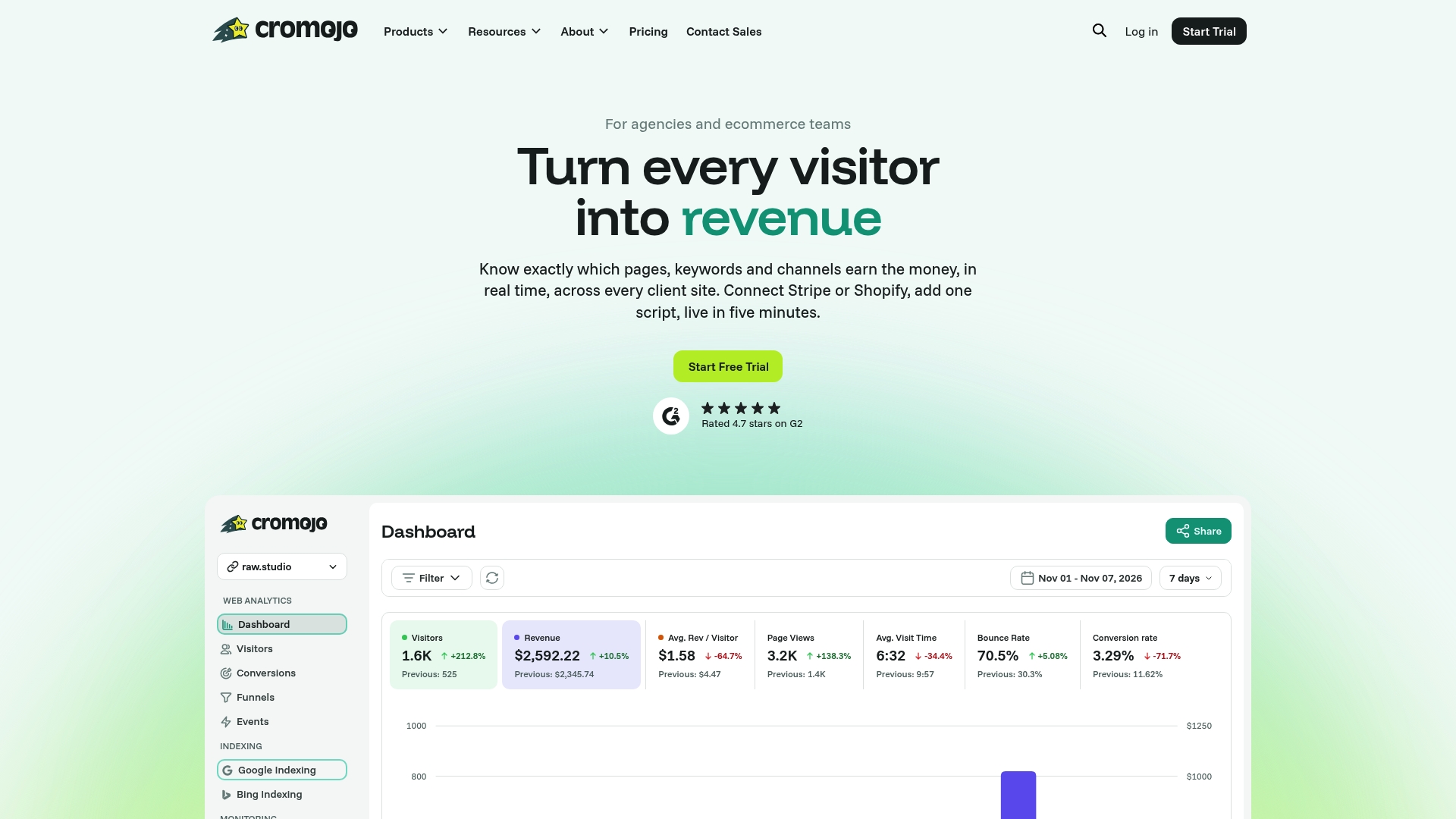
Instead of piecing together a traffic dashboard and a separate revenue report, Cromojo connects directly to Stripe and Shopify so every sale maps back to its source in real time, with no cookies required and no consent banner slowing down your data. It bundles in site monitoring and automated indexing too, so agencies managing multiple client sites get one dashboard instead of three subscriptions.
If your team's core question is "which marketing dollar is actually working," start a trial and connect your store to see revenue attribution running against your real traffic within minutes. For a side-by-side look at how Cromojo stacks up against cookie-free competitors specifically, the cookie-free Google Analytics alternative comparison breaks down the differences in plain terms.