

The best AI search optimization setup does two jobs: it shows whether ChatGPT, Perplexity and Google's AI features mention your brand, and it shows whether that visibility turns into revenue. Most tools on the market handle the first job. Cromojo is built around the second: it attributes revenue to keywords, pages and channels, and it automates indexing so your pages can be found by Google, Bing, Yandex, Baidu and AI search. Below, we compare the main options by what they measure, what they cost and who they suit.

What AI search optimization tools actually do
AI search optimization, often called generative engine optimization (GEO) or answer engine optimization (AEO), is the practice of making your content more likely to be quoted in answers from tools like ChatGPT, Perplexity, Gemini and Google AI Overviews. Instead of fighting for a spot in ten blue links, you want a mention (your brand named) or a citation (your page linked).
The tools in this space generally combine three functions, as LeanLabs describes them: they monitor how assistants answer questions in your market, they analyze why some sources are cited and others are not, and they recommend fixes such as clearer structure, schema markup and missing answers to buyer questions.
That gives you three kinds of products:
- AI visibility trackers send a fixed set of buyer questions (prompts) to AI engines and record whether you are named, in what position and next to which competitors.
- Content optimization tools score and draft pages against what ranks and what gets cited.
- Revenue and indexing platforms show which pages and keywords earn money and make sure search engines can find new and updated pages quickly.
Most buying guides focus on the first two. For a store owner or an agency, the third decides whether the work pays for itself.
How we compared the tools
We looked at four things a small business, ecommerce team or agency cares about:
- What it measures: AI mentions, citations, rankings, revenue or a mix.
- Which engines it covers: ChatGPT is documented by all 35 tools in the GeoSalience dataset, and 30 document Google AI Mode, but coverage thins out beyond that. Only 19 document Microsoft Copilot, 15 Grok and 9 Meta AI (GeoSalience, October 2026).
- What it costs: published monthly entry prices, and what the entry plan limits (prompts, domains, engines).
- Who it fits: a single store, a marketing team, or an agency with many client sites.
The tools side by side
Prices below are published entry prices for the period shown in the sources. They change often, so confirm on each vendor's pricing page before you buy.
The Semrush, Ahrefs, Surfer and Profound figures come from the same Searchbloom comparison, which re-verified prices in September 2026.
Where Cromojo comes first
If you run an ecommerce site, a small business or a client portfolio, the question behind "AI search optimization" is rarely "how many times did a chatbot say our name?" It is "which pages and keywords bring revenue, and are the right pages being found?" Cromojo is designed around that question.
Its Revenue Analytics connects with Stripe and Shopify and attributes revenue by keyword, page and channel in real time. SEO Revenue and the Google Search Console integration put search performance next to sales. Automated Indexing submits and re-submits URLs, in bulk if you need it, to Google, Bing, Yandex, Baidu and AI search, with instant notifications. Website Monitoring watches downtime, errors and SEO health. Tracking is cookieless and privacy-first, so there is no consent banner to configure just to see your numbers.
For most small teams that combination covers the work an AI visibility tracker cannot do alone.
Prices: what to expect
The price spread is the first thing to understand. GeoSalience found that among the 17 tools publishing a flat plan for 50 prompts on ChatGPT, Perplexity and Google AI Overviews checked weekly, prices ran from $50 to $599 per month, with a median of $129. None of the 35 published a price for 500 prompts on eight engines checked daily across three countries. Once you want heavy volume, you are in custom-quote territory.
SearchMention-style segmentation helps here: most small business budgets for a single brand sit between $0 and $200 per month, while enterprise tools start in the thousands. A plan at the top of that range buys a few dozen prompts, not a full picture of the market.
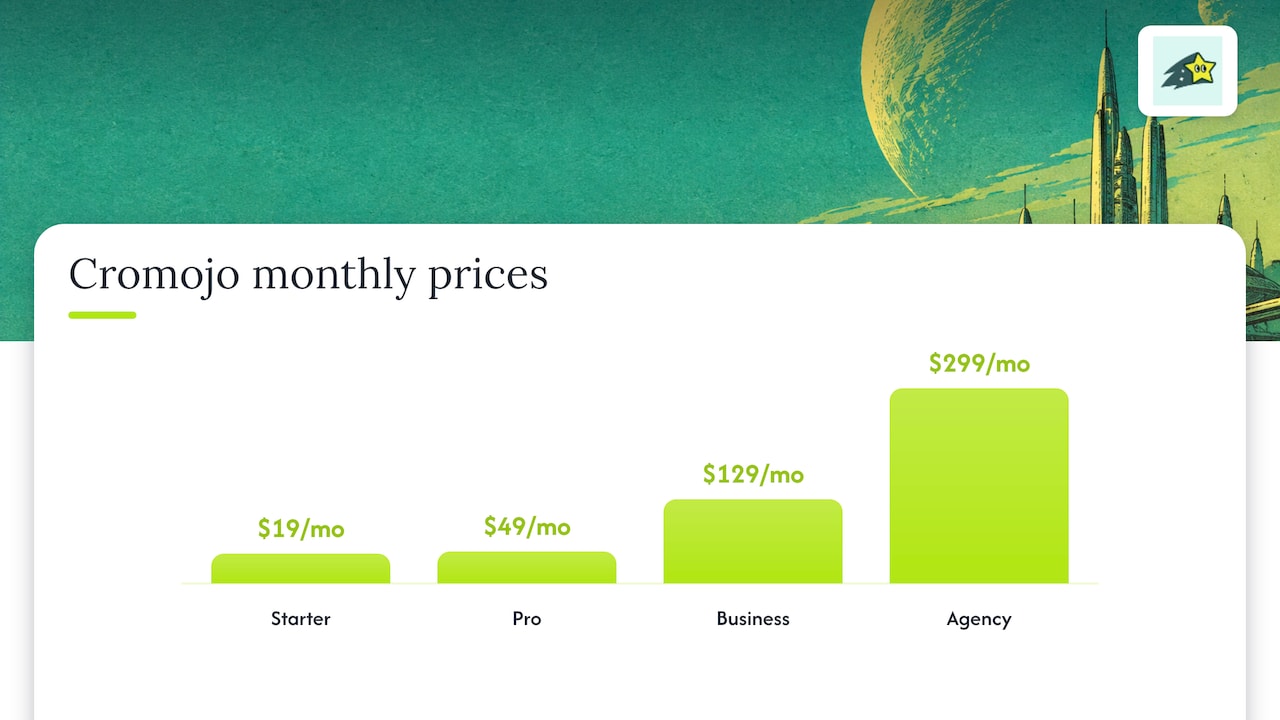
Cromojo's pricing is simpler because it is tiered by pageviews and tracked sites, with overages billed per 1,000 additional pageviews:
There is also a Free Plan, and paid plans start with a free trial. See the full plan details for the limits on each tier. The Agency plan is the one for people managing multiple client sites.
Which tool for which reader
Small business owners and stores
You need to know what brings sales and keep your site healthy, not run a research program. Start with Cromojo's Starter or Pro plan: see revenue by keyword and page, get alerts when something breaks, and keep new product pages indexed. Add a low-cost tracker later if you want to watch mentions.
Marketing teams tracking ROI
Your finance lead will ask what the AI work returned. Attribution is the hard part, and it is where a revenue-first platform helps. Funnels, Goals and User Journeys show what visitors do after they land, and Smart Insights uses agents that monitor the site and point to conversion gaps without a manual data dig.
Ecommerce agencies
Multiple clients mean multiple sites, reports and indexing queues. Cromojo's Agency plan at $299 per month, bulk URL submissions and actionable email reports are built for that workload. Trackers that price per brand or per project can multiply quickly as your client list grows.
Digital marketers and website owners focused on visibility
If your goal is better search visibility, indexing is the foundation. Google says there is no special markup needed to appear in AI Overviews or AI Mode beyond being indexed and eligible to show a snippet, as GeoGen notes. Unindexed pages cannot be cited anywhere, so automated indexing is the first lever to pull.
How to check a tool before you commit
Use these criteria for any tool, including the ones in the table.
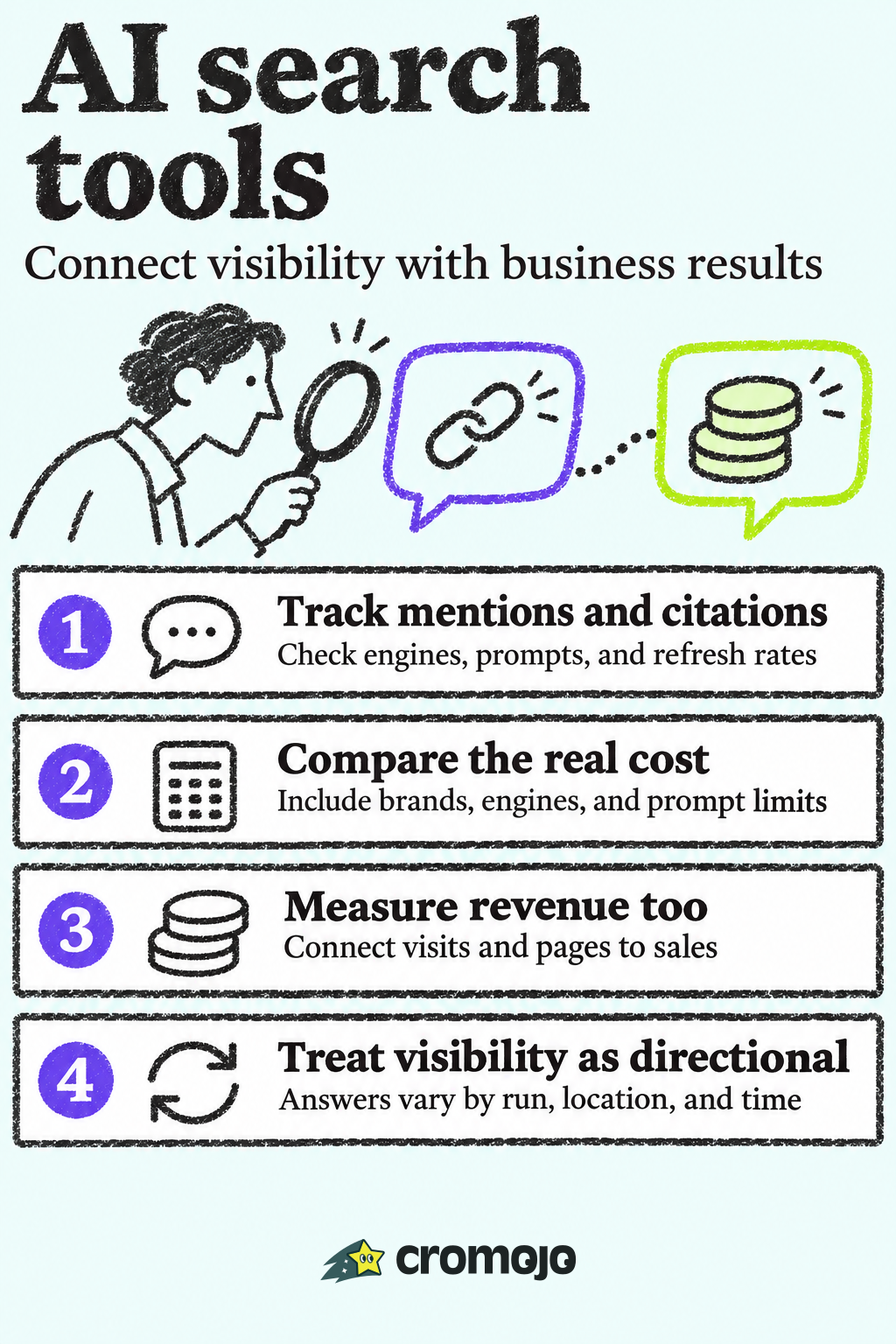
- Engines covered. ChatGPT is near-universal. Check whether the engines your customers use are included, and whether extra engines cost extra.
- How answers are collected. In the GeoSalience dataset, 11 tools capture the consumer interface, 3 use official APIs and 10 do not disclose their method. Searchbloom explains that API sampling is cheaper but one step removed from what a user sees. Know the method before you compare numbers.
- Prompt volume and refresh rate. Fifty prompts checked weekly gives a very different picture from fifty checked daily.
- Integrations and reporting. Can it connect to your store, Search Console and email reports, so results reach the people who need them?
- Connection to revenue. Mentions matched to no revenue page are what Directive Consulting calls vanity metrics. Pick a stack where the page and keyword data sits next to sales.

Measuring whether it works
The industry has begun to standardize its vocabulary. The IAB's August 2026 framework defines mention rate, citation rate and share of voice: the share of responses containing a brand mention, the share containing a linked or named reference, and your mentions as a proportion of all mentions in a defined competitive category. It also notes a gap between a high mention rate and a low citation rate is a signal in itself.
Two habits keep the numbers honest:
- Sample enough. Search Engine Land's Paul DeMott describes a polling-style approach: a sample of 250 to 500 high-intent queries run daily or weekly, with the output treated as directional. A single run proves little.
- Pair visibility with business metrics. DeMott also recommends layering referral traffic and branded search in Search Console. In Cromojo, you can follow those visits through to purchases with revenue attribution and funnels.
A practical routine for a small team: fix a list of 25 to 50 real buying questions, record mentions monthly, and compare against revenue by page and channel in your analytics. If the pages that earn citations are also the pages that earn money, you know where to put the next article.
The content still has to be good
No tool writes the answer an AI wants to quote. Trackers show where you are missing, and LeanLabs is clear that closing the gap comes down to publishing useful, experience-backed content structured so machines can read it. For content planning and publishing in the AI era, see why optimize for ChatGPT for a walk-through of the reasoning behind visibility in answer engines.
One caution on content-only tools: MarketMuse, for example, is strongest in content strategy and editorial workflows rather than AI-answer monitoring or technical site auditing. Match the tool to the job.
Our perspective
We think the AI search conversation has focused too much on being mentioned and too little on being paid. A brand name in a chatbot answer is a good sign. A sale is the result.
That is why we built Cromojo to put revenue first. When you can see revenue by keyword, page and channel, you can tell which content deserves more investment, whether it was written for Google or for an AI assistant. Our agents watch your site continuously and surface conversion gaps so you do not have to hunt for them in a pile of reports.
The second half of the answer is being found at all. Our automated indexing sends new and updated pages to Google, Bing, Yandex, Baidu and AI search, so the pages you work hard on are not waiting in a queue.
If you do one thing this quarter, connect your store, see what earns revenue, and make sure those pages are indexed. Everything else in AI search optimization builds on that.
Try Cromojo for revenue and indexing
If you want one dashboard that links search visibility to revenue, start with Cromojo. Connect Stripe or Shopify, see which keywords and pages drive sales, and let automated indexing and monitoring handle the routine checks.
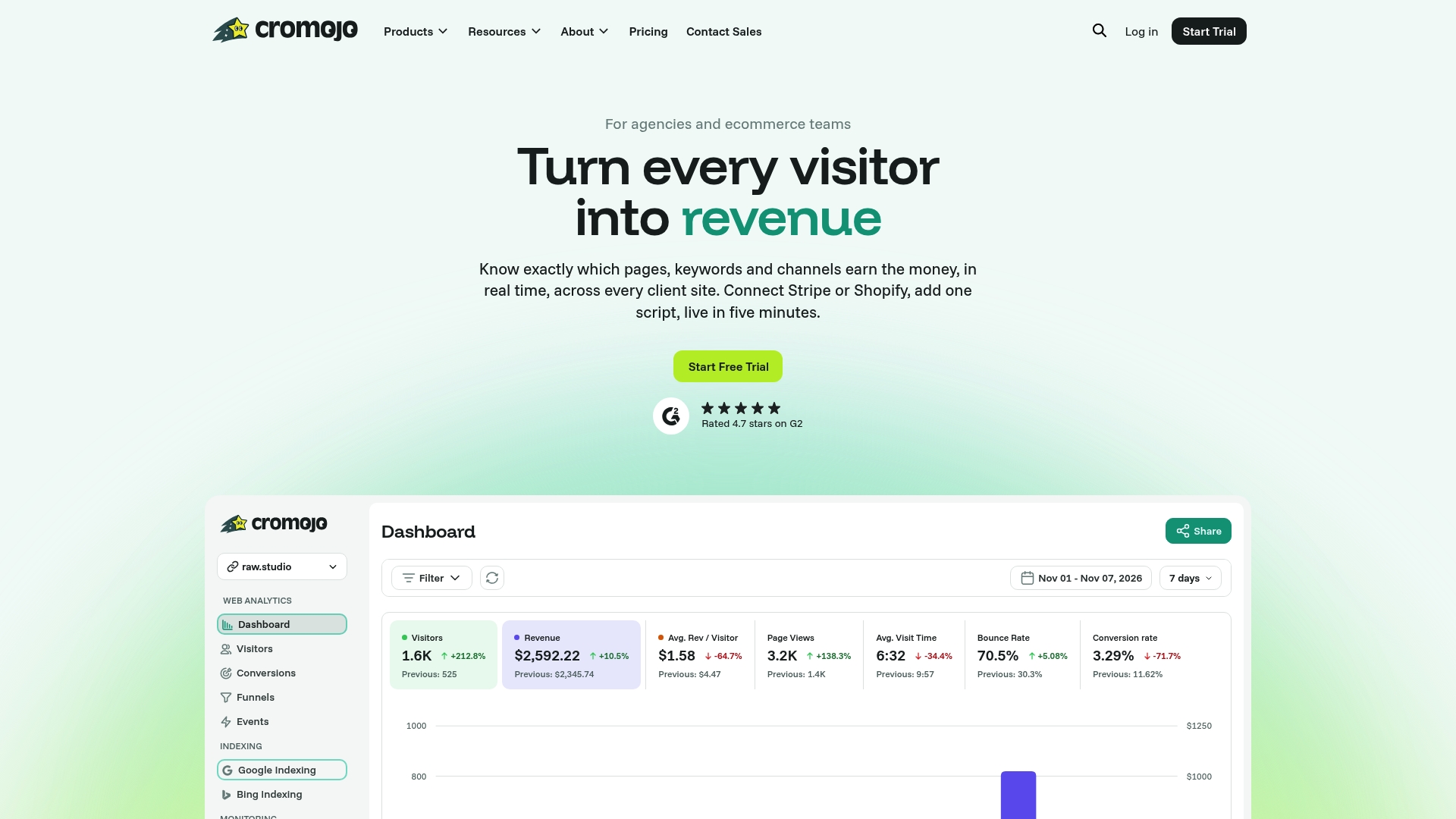
Plans run from $19 per month, with a Free Plan and a free trial on paid tiers. Compare them on the Cromojo pricing page.
Sources
- GeoSalience: AI Visibility Tools Compared, 35 Platforms
- Searchbloom: The Best AI SEO Tools for 2026
- Piperocket: 10 Best AI Visibility and AEO Tools
- IAB: Measuring Visibility in the AI Era, Executive Summary
- Search Engine Land: LLM optimization tracking and visibility
- LeanLabs: What are AI search optimization tools
- GeoGen: How AI search optimization tools work
- Reviews.vc: MarketMuse review