


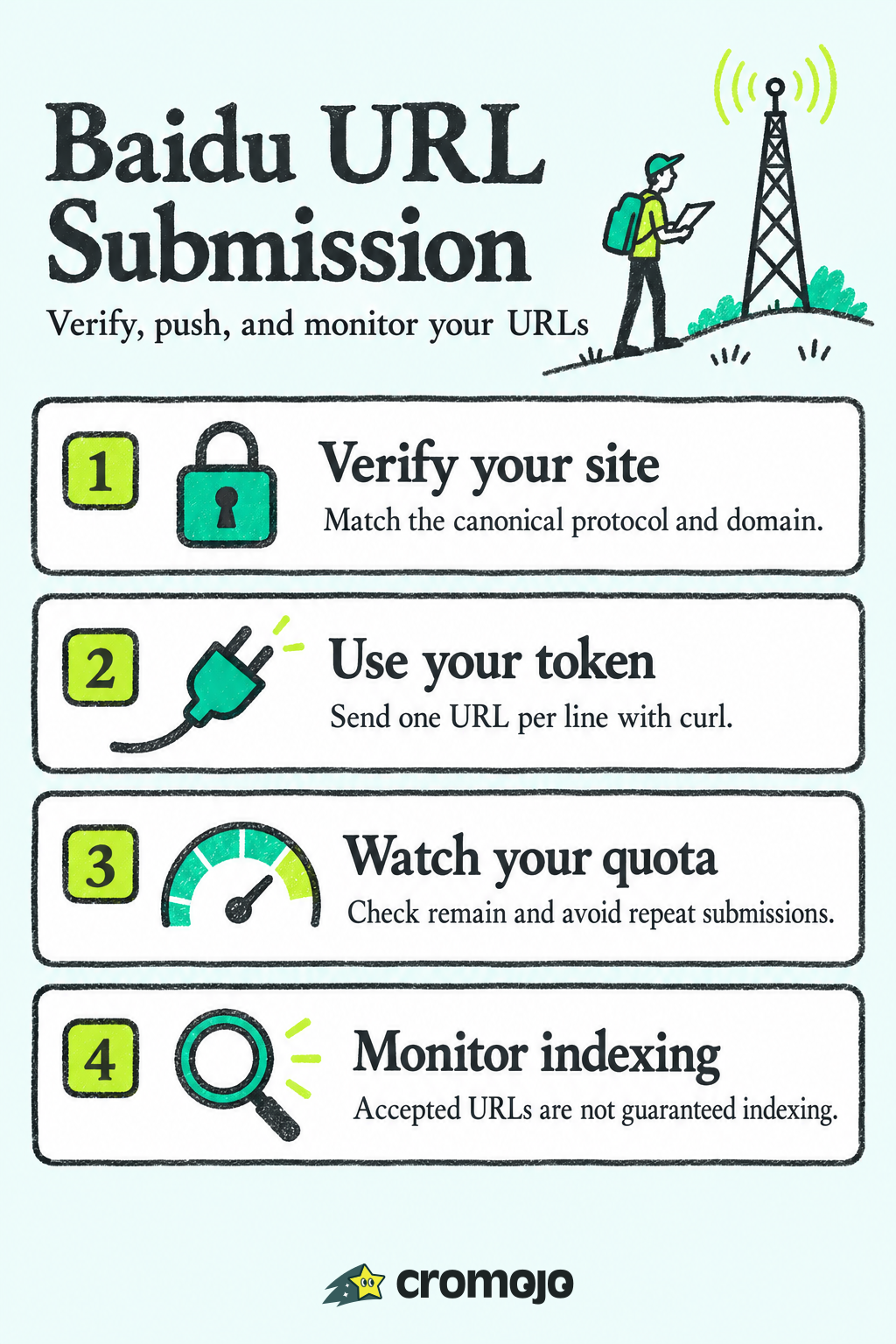
Use Baidu Search Resource Platform for manual and sitemap submits, and use the data.zz.baidu.com API to push URLs automatically. Manual submission suits single priority pages, sitemap submission works best for large sites, and the API fits automation and frequent publishing. Submission speeds up discovery, but it never guarantees that Baidu will index a page.

Verify your site in Baidu Search Resource Platform
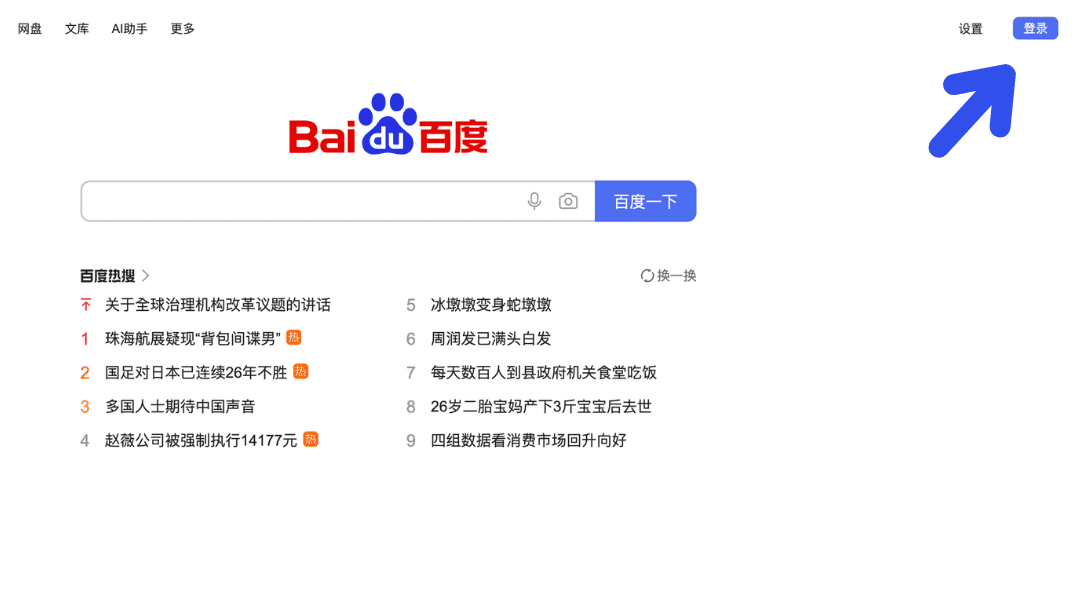
Before you can submit a single URL, you need a verified property in Baidu Search Resource Platform. This is the control panel for every submission method covered in this guide, and verification is what unlocks it.
- Sign in with a Baidu account and add your site using the exact canonical form you intend to rank: https or http, with or without www.
- Choose a verification method: upload the provided HTML file to your site's root directory, or add the meta verification tag to your homepage's head section.
- Confirm verification inside the platform once the file or tag is live.
The canonical URL you register matters more than it looks. If you verify https://example.com but publish pages under https://www.example.com, Baidu treats these as different properties and your submissions will not apply. Get this consistent early, because it affects regular submission, sitemap submission, and API access in the Resource Platform, the same way verifying a property in Google or Bing tools does. If you have already gone through this process for another engine, the steps in our Bing Webmaster Tools setup guide follow a similar logic.
Manual submission through the regular index tool
Once your site is verified, manual submission (often labeled "sitesubmit" in older documentation) is the fastest way to hand Baidu a single, important URL. Inside the Resource Platform, navigate to Resource submission, then the standard or regular index section, then manual submit.
Paste the full page URL exactly as it appears in your browser address bar, protocol and trailing slash included, and submit. This method works well for:
- A newly published landing page or product listing you want discovered quickly.
- A homepage or category hub after a significant content update.
- A key commercial page tied to a time-sensitive campaign.
Manual submission has real limits. Regular submission helps Baidu discover priority pages faster but does not guarantee indexing, so treat it as a discovery nudge, not a ranking lever. Avoid resubmitting the same URL repeatedly within a short window, and never submit pages that are not yet live or that carry a noindex directive. Submission only confirms Baidu received the request, nothing more.
Sitemap submission for larger sites
Sitemap submission lives in the Sitemap area of Baidu Search Resource Platform, and it is the more practical choice once your site grows past a handful of priority pages. Rather than pasting URLs one by one, you point Baidu to a single file that lists everything you want crawled.
A Baidu-friendly sitemap follows the same discipline as any other search engine's version:
- Use canonical URLs only, matching the verified property exactly.
- Keep
lastmoddates accurate so Baidu can prioritize recently changed pages. - Split large sites into multiple sitemap files referenced by a sitemap index, rather than one oversized file.
Sites with catalogs that change daily benefit from dynamic sitemap generation rather than a static file rebuilt by hand. If sitemap submission is not available on your account tier, fall back to manual submission for your most important pages or move to the API push described next.
Pushing URLs automatically with the data.zz.baidu.com API
For sites that publish often, or for agencies managing many client domains, the data.zz.baidu.com endpoint is the only method that scales. It accepts a plain-text list of URLs over HTTP POST and returns a structured response telling you exactly what happened to each one.
- Get your push token from the "Link Submission" section of Baidu Search Resource Platform, tied to your verified site.
- Build a request with your site URL and token as query parameters, and the URL list as the POST body, one URL per line.
- Send the request with curl, a server-side script, or any language that can issue an HTTP POST.
A typical curl command looks like this:
In PHP, the same request is a simple cURL call with the URL list read from a file and passed as the request body, with the token and site parameters appended to the endpoint URL.
Baidu's API returns structured fields in every response: success (how many URLs were accepted), remain (your remaining daily quota), and arrays for the not_same_site and not_valid URLs that failed validation. Common errors include an invalid token, exceeding your daily quota, and submitting more than 2,000 URLs in a single call, which the API rejects outright.
Statistic: Baidu allows a maximum of 2,000 URLs per API call, and submitting old or already-indexed links can reduce your future quota rather than protect it.
The practical rule: push new, valuable URLs the moment you publish them, and resist the urge to resubmit pages you already know are indexed.
What to check when pages stay unindexed
Submission is a request, not a promise, so some pages will stay out of Baidu's index for a while, or indefinitely. Start by searching site:your-domain.com on Baidu itself, alongside whatever monitoring your platform provides, to confirm what is actually indexed versus what you merely submitted.
Work through this checklist before assuming the API or sitemap is broken:
- Confirm the submitted URL matches your canonical form exactly, protocol and www included.
- Check that the page returns a 200 status and loads without requiring a login.
- Look for a stray noindex tag or a robots.txt rule blocking the path.
- Check for redirect chains or server errors that Baidu's crawler may be hitting.
- Rule out duplicate or thin content that gives Baidu little reason to index the page over an existing one.
When the API itself throws errors, re-verify your site, double-check the token and payload format, and confirm you are within your daily quota before contacting Baidu support.
Pro Tip:Give a newly submitted page at least a few days before troubleshooting; submission speeds discovery but indexing itself is never guaranteed, so treat slow results as normal unless your checklist turns up a real blocker.
For a broader diagnostic approach that applies beyond Baidu, our piece on why pages aren't getting indexed covers the same categories of problems across search engines.
Publisher perspective: cutting failed submissions with monitoring
Submission tools only work if the pages behind them are actually healthy, and that is where monitoring earns its keep. We built automated indexing and site monitoring into our own platform because catching a server error or a stray noindex tag before you push a URL saves quota you cannot easily get back.
Automated indexing in our Automated Indexing feature consolidates successful pushes across Google, Bing, Yandex, and Baidu, while SEO health checks flag accessibility problems ahead of submission rather than after. Pairing push automation with ongoing status monitoring is the difference between submitting once with confidence and resubmitting out of guesswork.
How often to submit URLs without risking your quota
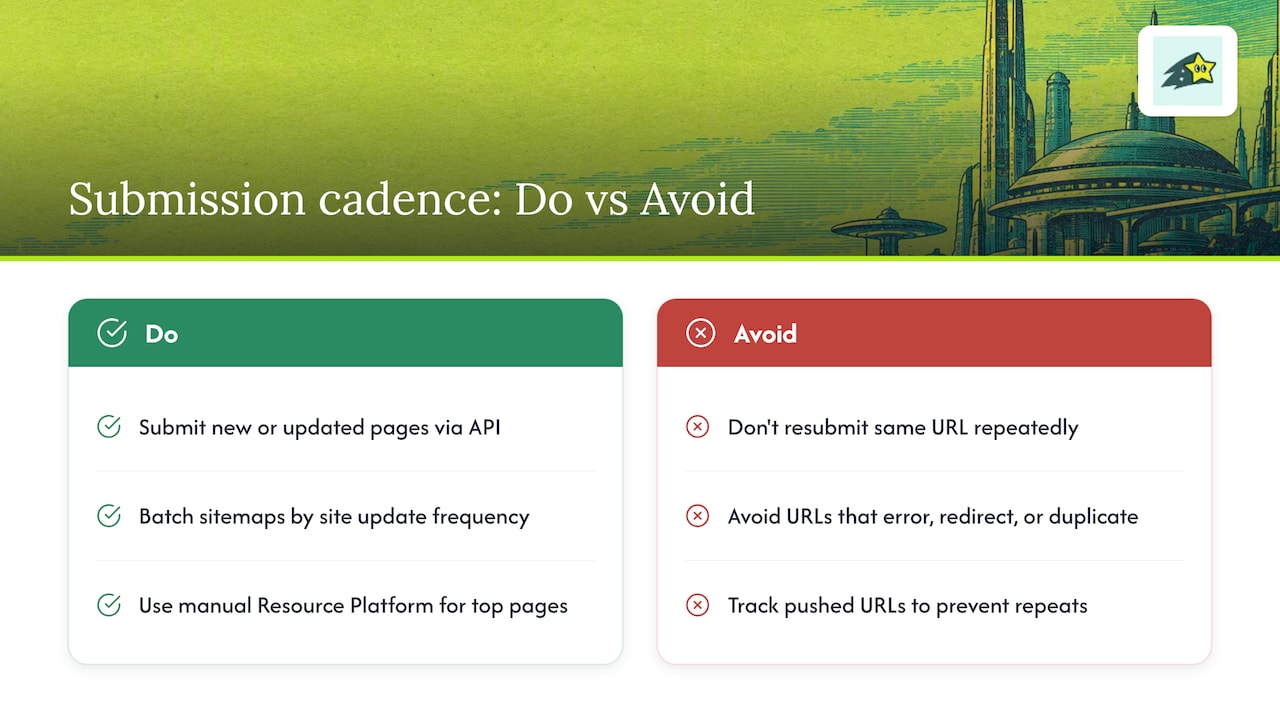
Submission frequency is governed more by judgment than by a fixed rule, and Baidu adjusts your API quota based on the quality of what you send. Push a URL once, right after it goes live, and let it sit. Resubmitting the same link repeatedly within days signals low-quality usage and can shrink your allowance over time rather than protect it.
A sensible cadence looks like this: submit new or substantially updated pages immediately through the API, batch sitemap updates on a schedule that matches how often your content actually changes (daily for a news site, weekly for most ecommerce catalogs), and reserve manual submission in the Resource Platform for the occasional high-priority page that needs a nudge outside your normal flow.
Avoid submitting URLs that return errors, redirect elsewhere, or duplicate existing indexed pages. Baidu's systems read a pattern of low-value submissions as noise, and that pattern is exactly what erodes your quota. If you manage multiple sites or a large catalog, track what you have already pushed successfully so you are not resubmitting indexed URLs out of habit. The goal is a steady, predictable stream of genuinely new or changed URLs, not a burst of resubmissions every time you check the index.
How indexing and ranking relate to submission
Submitting a URL gets it in front of Baidu's crawler faster, but submission has no direct influence on where that page ranks once indexed. Ranking depends on the usual factors: content relevance, site authority, page speed, and mobile usability, none of which the submission APIs touch.
What submission does influence is discovery speed. A page sitting on a site Baidu already crawls regularly may get indexed without any manual push, while a page on a new or rarely-crawled site can sit undiscovered for a long stretch without one. The API and sitemap tools shrink that gap, they do not substitute for the content and technical quality decisions that drive indexing persistence and ranking afterward.
This is also why resubmitting an already-indexed page does nothing for its ranking. If a page is not performing well in Baidu's results, the fix is almost always on the page itself: thinner content, slower load times, or a lack of the structured signals Baidu's crawler relies on, not a missing submission.
Regional and language factors to account for
Baidu's user base is overwhelmingly mainland Chinese, and for sites targeting that audience, Baidu is the dominant search engine worth prioritizing for discoverability. That context shapes how you should think about submission, not just the mechanics of it.
Simplified Chinese content tends to perform better in Baidu's index than English or other languages, so if you are building or translating pages specifically for Baidu, simplified Chinese is the expected baseline. Server location matters too: sites hosted outside mainland China, or without an ICP filing where required, can see slower or less consistent crawling regardless of how diligently you submit URLs.
None of this changes the submission mechanics themselves. Resource Platform verification, manual submission, sitemap submission, and the API push all work the same way whether your site targets a global audience or specifically mainland China. What changes is your expectation: a site with little Chinese-language content or infrastructure inside China will generally see slower, less thorough indexing than one built with that audience in mind from the start, no matter how often you submit.
Tracking submission status and indexing progress
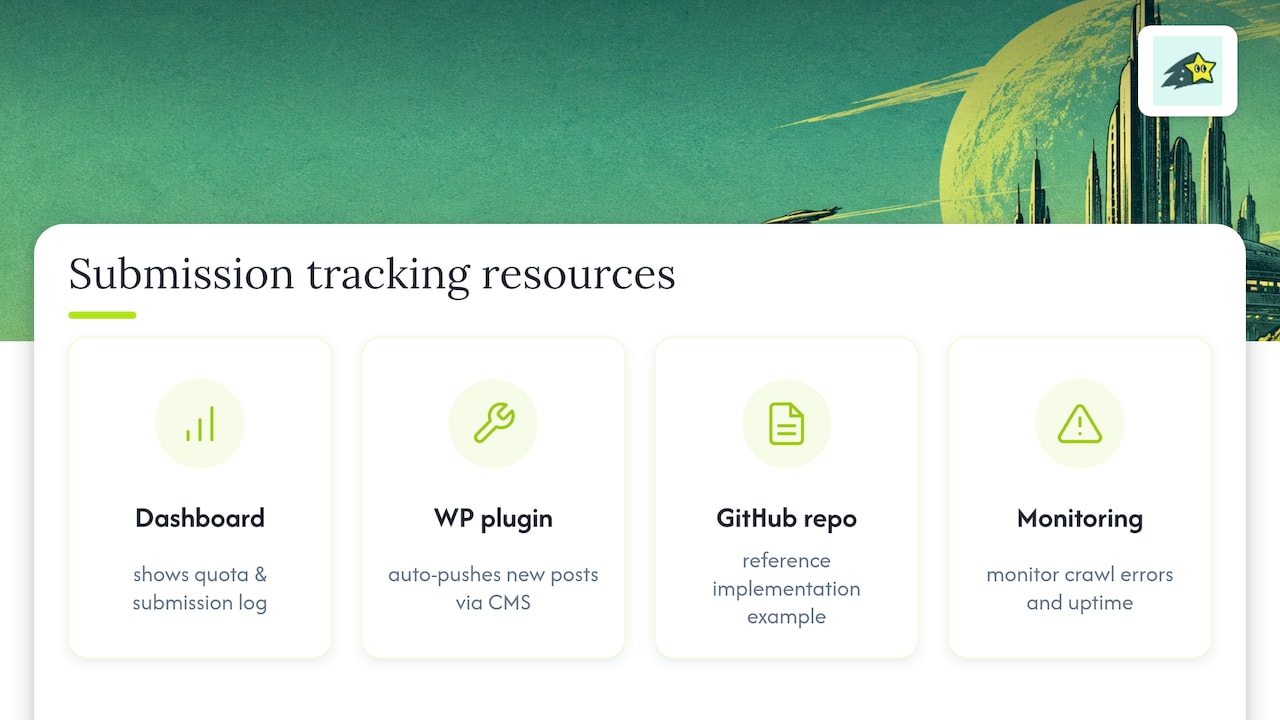
Beyond the site:your-domain.com search and the response fields returned by the API itself, a few other resources help confirm whether your submissions are translating into actual indexing. The Resource Platform's own dashboard shows your remaining daily quota and a log of recent submissions, which is the first place to check when something looks off.
For WordPress sites, the Zhanzhangb Indexing Submission for Baidu plugin wraps the API into your publishing workflow, pushing new posts automatically and handling the request and response format for you. It reflects a common pattern: sites that publish frequently benefit from submission tied directly to their CMS rather than a manual step a team has to remember.
Developers managing custom stacks can look to open source reference implementations like the Baidu link submission tool on GitHub for a working example of the request and response handling described earlier in this guide. Beyond Baidu's own tools, ongoing monitoring of crawl errors, server uptime, and page accessibility matters just as much as the submission call itself, since a page that fails intermittently will keep showing up in your "not indexed" checks no matter how many times you push it.
Our take: submission is the easy part
The mechanics of Baidu URL submission are not where most sites lose ground. Verifying a property, pasting a URL, or running a curl command takes minutes. What actually determines whether a page gets indexed and stays indexed is everything submission cannot touch: page accessibility, content quality, and whether your site is crawlable in the first place.
The conventional advice treats submission almost like a ranking trick, something to repeat often for better results. That is backwards. Repeated submission of the same URL wastes quota and signals low-quality usage rather than urgency. The better habit is quieter: submit once, promptly, after publishing something genuinely new, and spend the rest of your effort on making sure that page is worth indexing.
If we had to prioritize one thing for readers working through this guide, it would be fixing accessibility and content issues before touching the API at all. A perfectly executed submission to a page with a stray noindex tag accomplishes nothing. Get the fundamentals right first, then let submission do the smaller job it is actually built for: speeding up discovery, not fixing weak pages.
, Philippe
Cromojo: automated indexing and monitoring for ecommerce teams
Running manual submissions, sitemap checks, and API pushes by hand across Google, Bing, Yandex, and Baidu adds up fast, especially for agencies juggling several client sites. We built our platform to take that repetitive work off your plate while keeping you in control of what gets submitted and when.
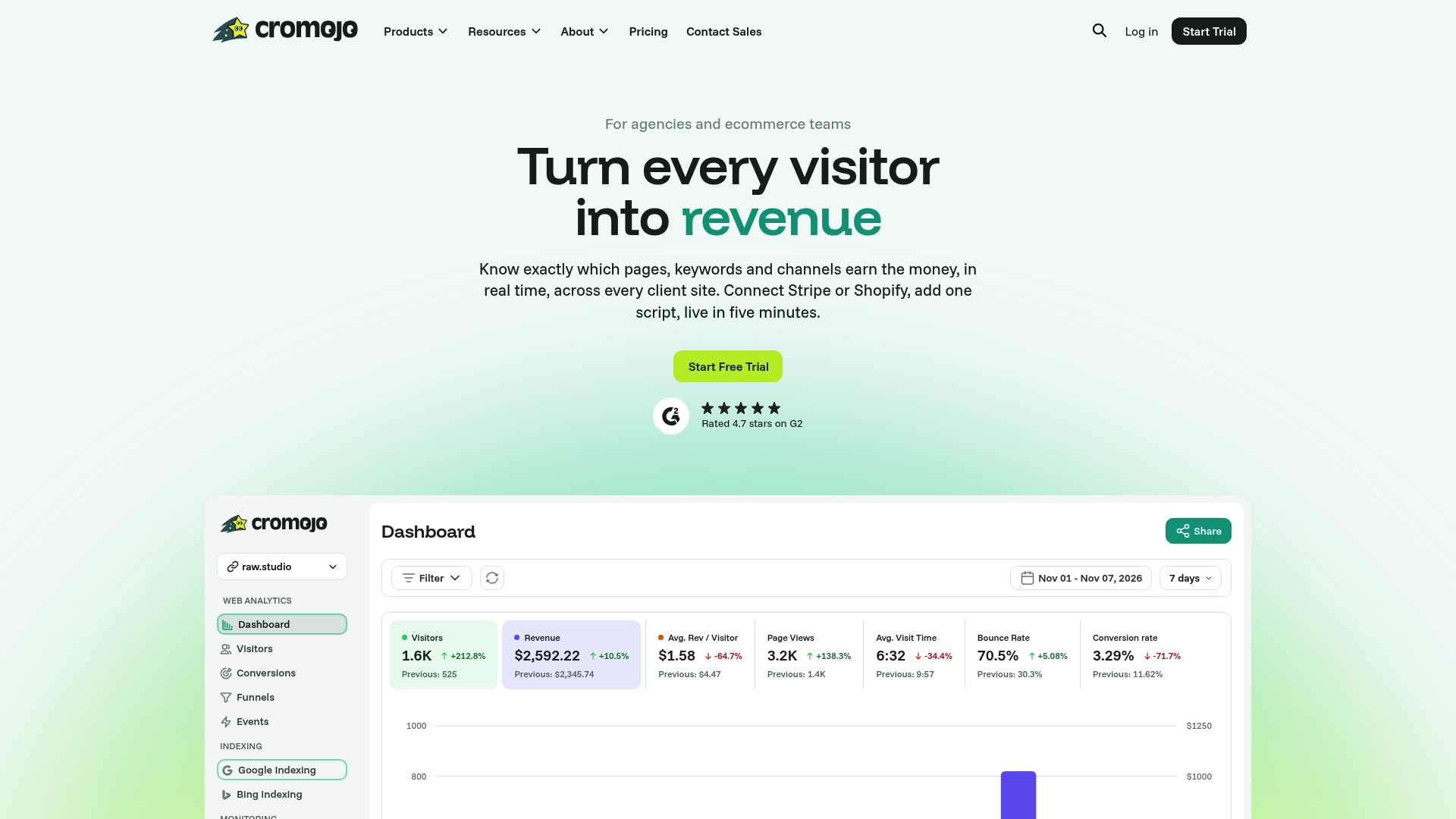
With our Automated Indexing feature, we handle automated URL pushes across major search engines as new pages go live, site monitoring that flags downtime, server errors, and SEO health issues before they waste your submission quota, plus instant indexing notifications and reporting so you know what got indexed without checking each platform separately.
If your current workflow already involves bulk URL submissions across multiple sites, our tools are built to handle that volume without extra manual steps. Check our pricing page to find the plan that fits your site count and traffic.