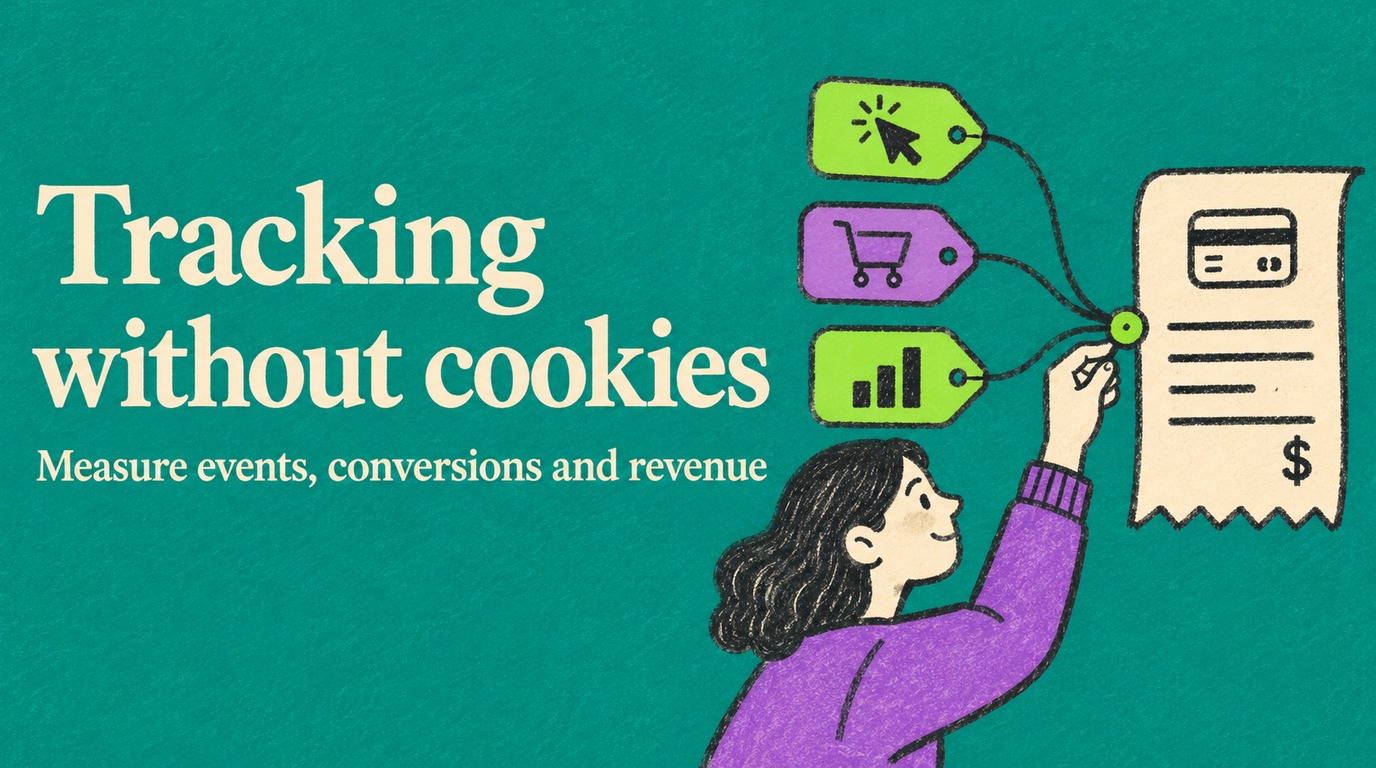

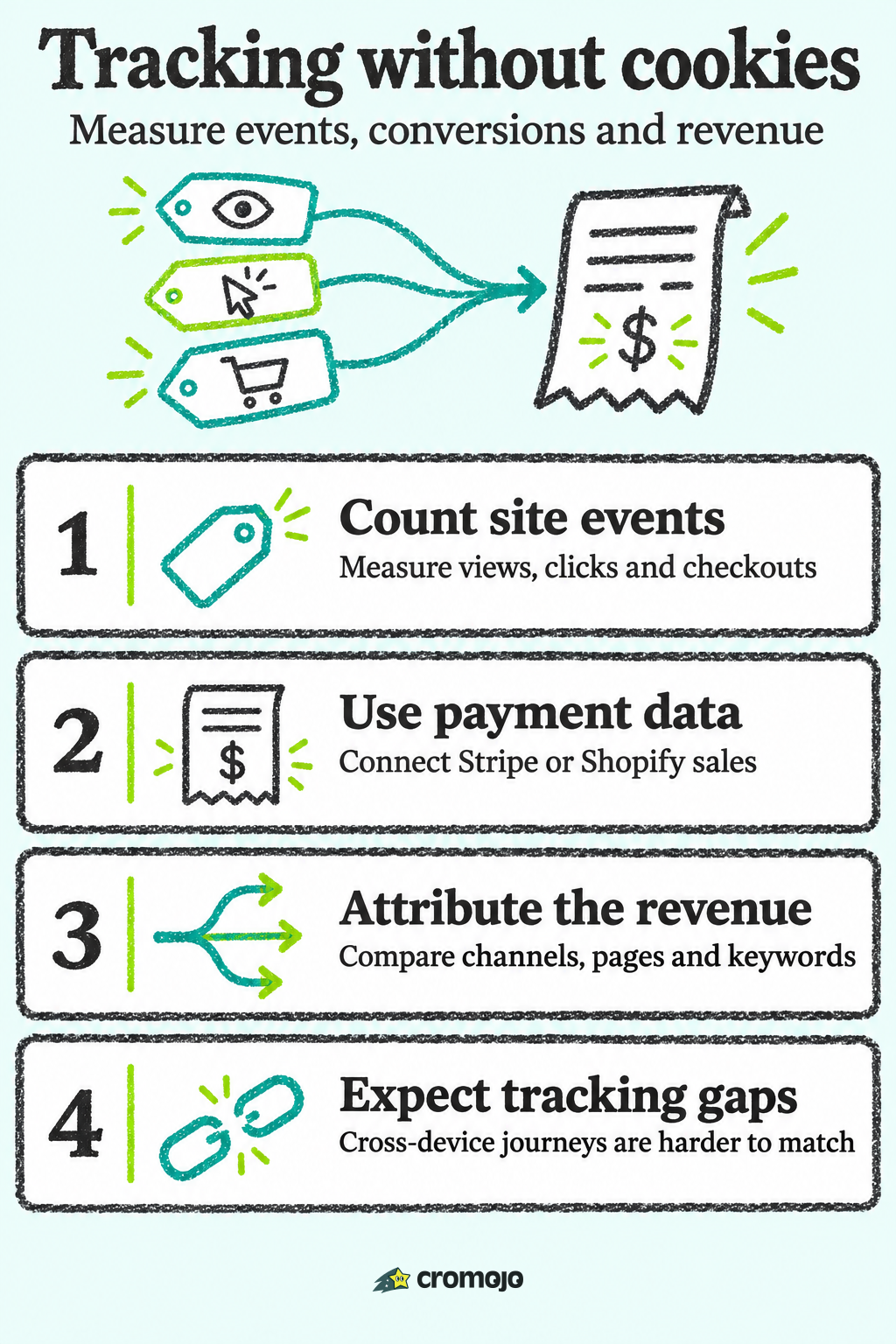
You can track without cookies, and you can still see which pages, channels and keywords produce revenue. The method is to measure events (page views, clicks, checkouts) on your own site and tie them to payments, instead of following individual people around the web. Cromojo, our analytics platform, is built this way: cookieless, privacy-first tracking that attributes revenue to keyword, page and channel, with Stripe and Shopify connected directly.
This guide covers what cookieless tracking is, which methods exist, how to track conversions without cookies, what gaps to expect, and how to choose a tool.
What tracking without cookies actually means
A cookie is a small file a website stores in a visitor’s browser. Traditional analytics uses it to recognize the same browser on the next page, the next visit, sometimes the next site. Cookieless tracking means understanding user behavior and web traffic without relying on those browser cookies that store data on a user’s device. Shopify’s overview lists server-side, probabilistic and browser or fingerprint-based approaches as the main families.
Two clarifications save a lot of confusion
- Cookieless does not mean data-free. You still count visits, see top pages, watch funnels and attribute sales. What you give up is a persistent profile of each individual.
- Cookieless does not always mean zero cookies. A first-party cookie can still be used for things like sessions, carts and consent choices. The aim is to stop depending on third-party and consent-requiring trackers for analytics.
If you run a shop, that distinction matters. Your cart needs to work. Your analytics should not need to follow shoppers across the internet to tell you what is working.
Why people are moving away from cookie-based analytics
Three pressures push in the same direction.
- Consent banners cost data. Every visitor who declines is invisible to a cookie-based tool. Your reports then describe only the people who clicked accept.
- Browsers restrict cookies. Safari and Firefox already limit cross-site tracking, and ad blockers cut more. Your numbers drift lower than reality.
- Trust. Small businesses increasingly want to tell customers, plainly, that they are not building profiles of them.
The result is a practical goal for most site owners: reliable numbers on what drives revenue, with the least personal data collected.
The main ways to measure without cookies
Each method trades privacy against precision. Here is how to think about them.
For analytics, the first two are the sensible foundation for a business that wants clean data and a clean conscience. Fingerprinting gets the same legal scrutiny as cookies because it also reads information from the device, so it is a poor fit for anyone adopting cookieless tracking for privacy reasons.
What strict no-storage setups can and cannot tell you
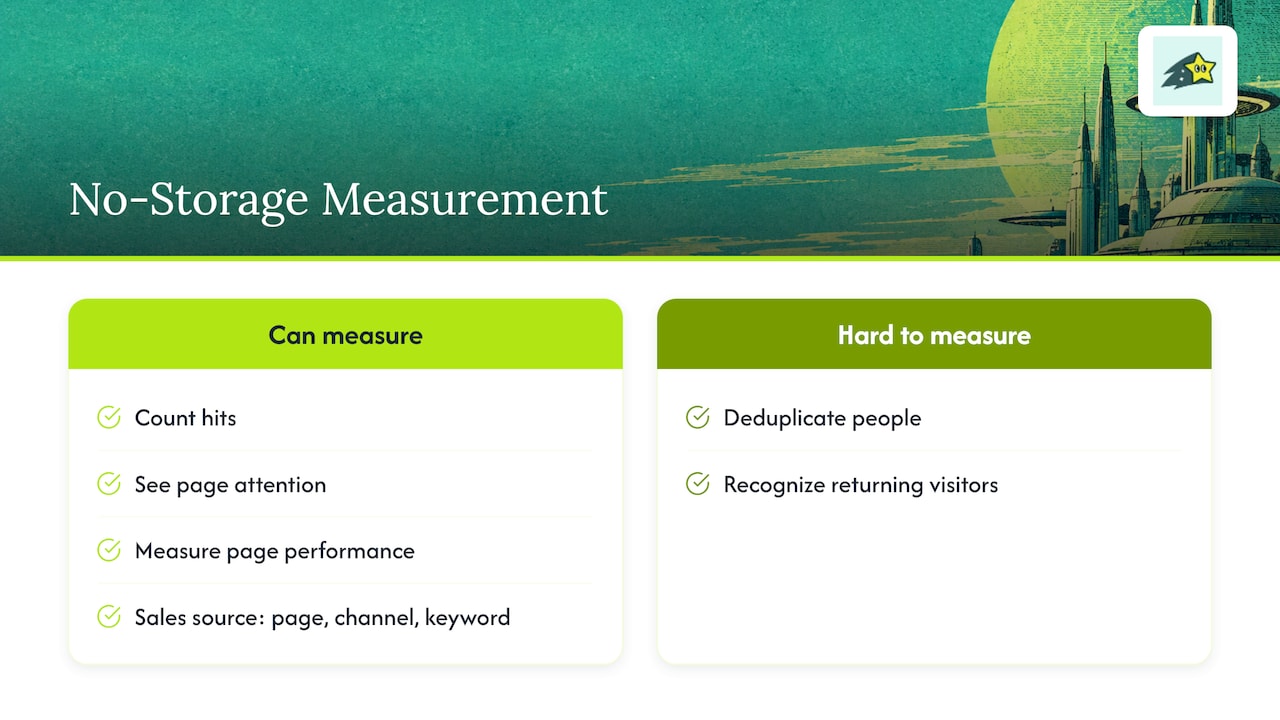
When nothing at all is stored on the device, you can still count hits, see which pages get attention, and measure how pages perform as a whole. What gets hard is deduplicating people. Without a session identifier, two page loads by the same person can look like two separate events, and a returning visitor looks new.
That is why serious cookieless tools focus on what the business needs to decide: which page, channel or keyword leads to money, not who exactly each visitor was.
How to track conversions without cookies
Conversion tracking is where cookieless setups are often misunderstood. The old model was: drop a cookie, wait for the visitor to come back, match them to a purchase. The cookieless model starts from the other end: the purchase is the fact, and you work backward to the visit that caused it.
Here is a practical routine.
Step 1: Define the conversions that matter
Pick a short list: a completed checkout, a subscription started, a lead form submitted. Fewer, better-defined goals beat a dashboard of twenty vanity events. Where it goes wrong: tracking every click as a goal, which hides the three that pay your bills.
Step 2: Anchor revenue to your payment system
Your payment processor already knows what was sold, for how much and when. Connecting it to your analytics means revenue is not an estimate from a browser pixel that may have been blocked. In Cromojo, Stripe and Shopify connect directly, so sales appear next to the traffic that produced them. This is the step that does the heavy lifting, and it is also the one most DIY setups skip because it means stitching data together by hand.
Step 3: Attribute to the source, page and keyword
Once revenue sits alongside visits, you can ask the questions that change budgets:
- Which channel produced the most revenue this month, not just the most visits?
- Which landing page converts best for paid traffic versus organic?
- Which search keywords lead to purchases?
Cromojo reports real-time revenue attribution by keyword, page and channel, and connects with Google Search Console so organic queries can be read alongside revenue. If you have ever seen a keyword with thousands of impressions and no sales, you know why this matters.
Step 4: Read funnels and visitor journeys
A funnel shows where people drop between landing page, product page, cart and checkout. A visitor journey view shows the sequence of pages leading to a conversion. Cromojo includes conversion funnels, visitor journey analysis and goal tracking, so the drop-off point is visible without exporting spreadsheets.
Step 5: Segment, then act
Split results by channel, device, country or landing page. A conversion rate of 2% overall can hide a 5% segment worth doubling down on and a 0.4% segment worth fixing. Cromojo supports advanced segmentation for exactly this, and email reports bring the findings to you on a schedule.
What data gaps to expect
Honest planning beats surprise. With cookieless measurement, expect the following.
- Returning visitors are harder to recognize. Without a persistent identifier, "new versus returning" is less precise.
- Long, multi-device journeys are less visible. If someone browses on a phone Monday and buys on a laptop Friday, the two visits may not connect.
- No individual-level retargeting lists. That is the trade for not profiling people.
- Unique visitor counts are approximations. Treat them as a trend line, not an audit figure.
None of these affect the question most owners are really asking: what produced revenue? Because the sale is recorded by your payment system, revenue totals stay solid even when visitor counts are approximate. Look at revenue per channel, revenue per page and conversion rate by segment, and watch the trends over weeks rather than single-day swings.
Advertising without profiles
If you run campaigns, the same logic applies: target by context and intent rather than by personal history. Approaches such as privacy-friendly audience targeting shift the question from who a person is to what they are looking at and searching for. Then you measure results at the campaign, page and keyword level, which a cookieless revenue view supports directly.
Does cookieless tracking need consent?
Not automatically either way, and the answer depends on where your visitors are.
In the EU, the ePrivacy rules cover storing or accessing information on a visitor’s device, not only cookies. So removing the cookie does not remove the question: the test is whether a tool reads or writes on the device and whether it can identify someone. localStorage and fingerprinting fall under the same logic. Because the client serves readers worldwide, remember that rules differ by country and state: the US has no single federal consent rule for analytics, but several states have their own privacy laws, and EU and UK visitors are covered by their own regimes.
Practical guidance for any business:
- Check what your analytics tool stores on the device and what it can identify.
- Describe it accurately in your privacy policy.
- If you sell into the EU, UK or a US state with a privacy statute, confirm requirements with a qualified privacy lawyer or your data protection adviser before you remove a banner.
A tool that collects less personal data by design makes that conversation shorter. Cromojo’s tracking is cookieless and privacy-first, which is why many teams choose it as their starting point.
How to choose a cookieless analytics tool
Use these criteria, in this order.
- Does it answer revenue questions? Page views are not the goal. Look for revenue by channel, page and keyword.
- Does it connect to your sales data? Direct Stripe or Shopify integration beats manual imports.
- How much setup does it need? Minimal setup across your tech stack means fewer broken tags and fewer developer hours.
- Does it show the whole conversion path? Funnels, journeys and goals in one place.
- Does it help with search visibility too? Organic traffic is only useful if pages are indexed. Indexing and SEO health checks in the same tool save you from running separate products.
- Is pricing predictable? Look at how plans scale with pageviews and tracked sites, and what overage costs.
Cromojo covers each of these in one platform. Beyond analytics, it includes automated indexing for Google, Bing, Yandex, Baidu and AI search, with bulk URL submissions and instant notifications, plus website monitoring for downtime, errors and SEO health. The point is less technical overhead: one dashboard instead of four subscriptions.
Our perspective
Most analytics advice treats privacy and performance as a trade. We don’t. When we built Cromojo, the question was simple: what does a founder or marketer need to decide on Monday morning? Almost always, it is which channels, pages and keywords make money, and where visitors fall out of the path to a sale.
You do not need a profile of every visitor to answer that. You need revenue connected to traffic, in real time, with the least friction. That is why our tracking is cookieless and privacy-first, why Stripe and Shopify connect directly, and why attribution goes down to the keyword.
Our agents watch your site continuously and surface the specific issues and opportunities that may be hurting conversions, so you are not left to dig through charts. If you are small and busy, that is the difference between owning data and acting on it.
Put cookieless revenue tracking to work
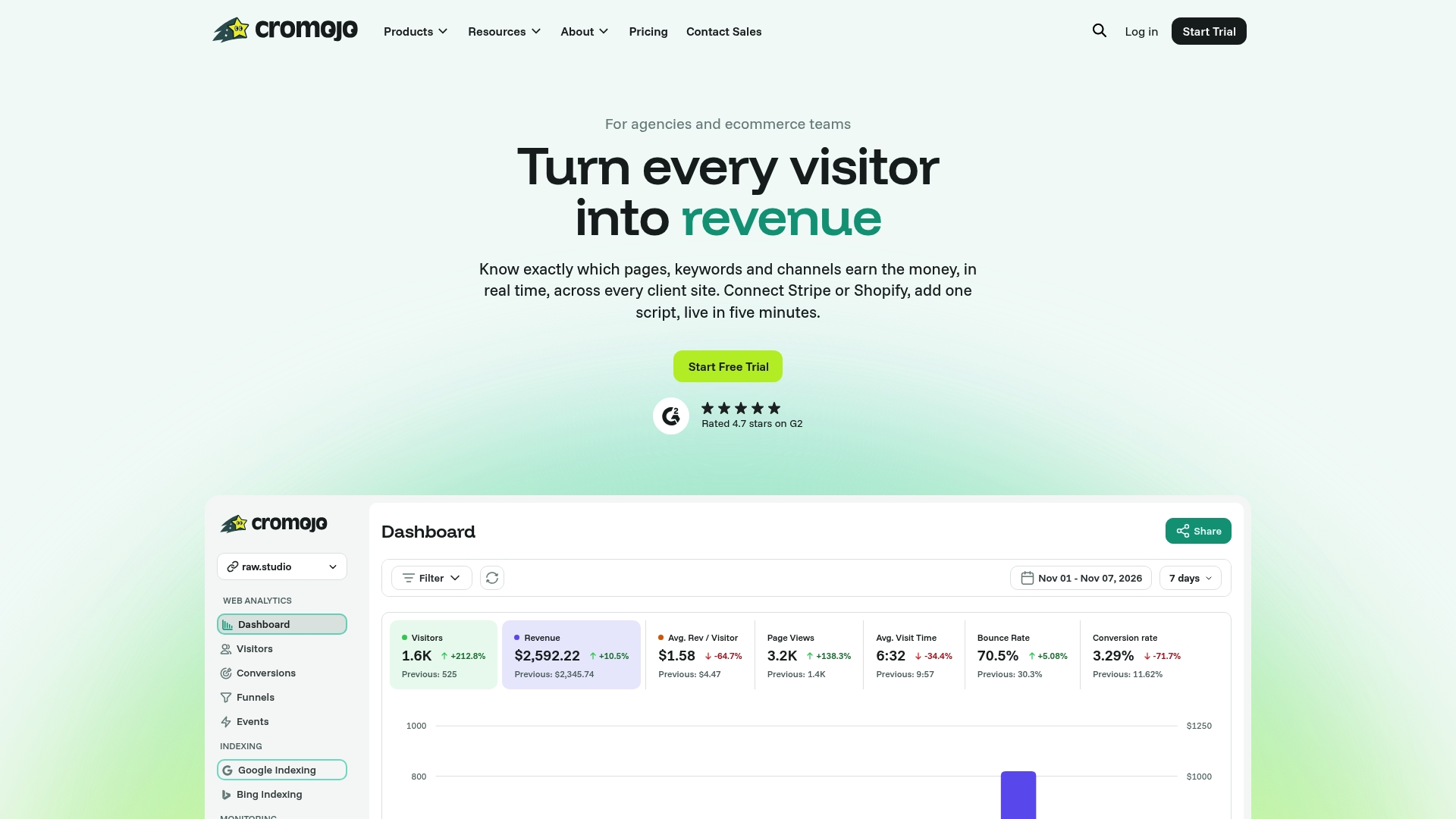
If you want revenue attribution without cookie banners driving your reporting, start with Cromojo’s revenue analytics. It shows revenue by keyword, page and channel, with funnels, journeys and goals alongside. Paid plans start at $19 per month for Starter, with Pro at $49, Business at $129 and Agency at $299 per month, and there is also a Free Plan. Plans are tiered by pageviews and tracked sites; see the pricing page for current limits.
If you manage many client sites, the Agency plan is built for multiple sites. If you would rather have specialists improve the pages themselves, our Conversion Optimization Services start from $3,800 per month.
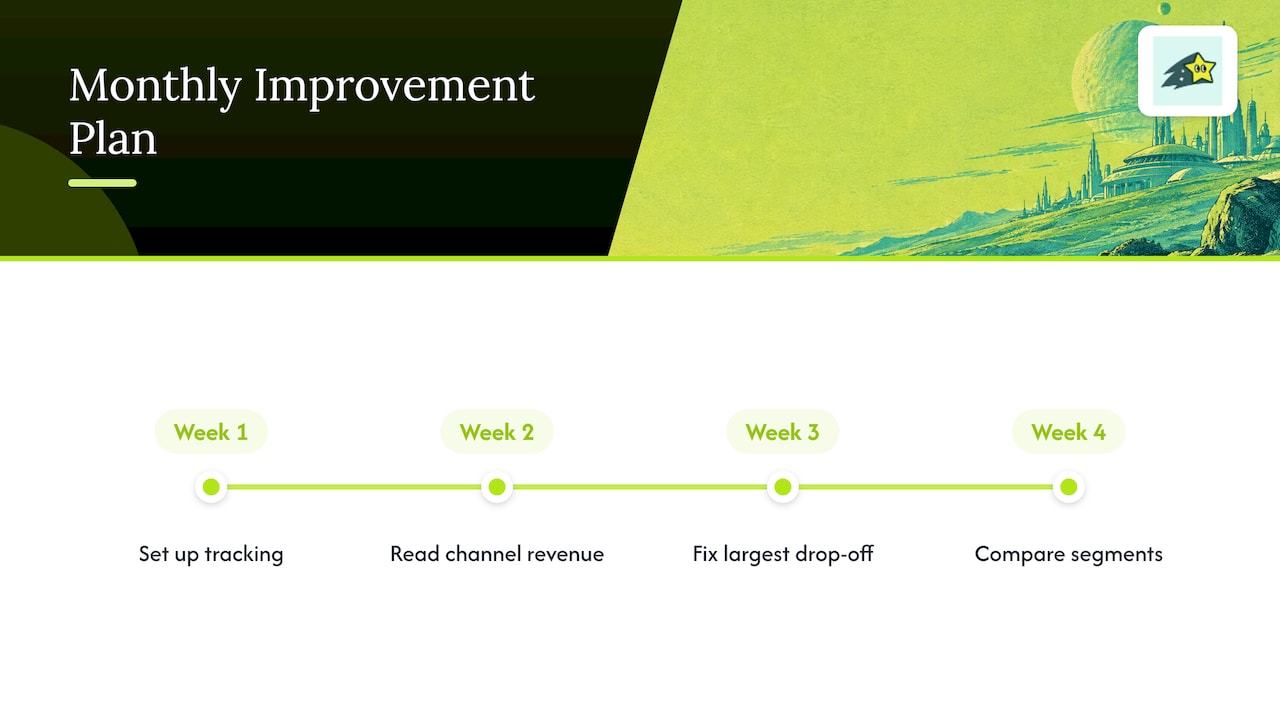
A simple 30-day plan
Week 1. List your three most valuable conversions. Install tracking and connect Stripe or Shopify and Search Console.
Week 2. Read revenue by channel. Note the top and bottom performers, and look at the keywords tied to sales.
Week 3. Open your funnel and find the largest drop-off. Fix one page or step, not five.
Week 4. Compare conversion rate by segment before and after your change. Keep what worked and pick the next drop-off.
Repeating this monthly gives you a steady improvement loop that does not depend on following individual people.