
LLM SEO is the practice of shaping your content, site and brand so that AI tools such as ChatGPT Search, Google’s AI Overviews and Perplexity mention, cite and recommend you in their answers. Most of the work is classic SEO done with more care: pages that are indexed, crawlable, clear and genuinely useful. The new parts are writing in self-contained passages, being present beyond your own site, and measuring visibility by citations as well as rankings.
This guide explains how it works, what to change first, and how to tell whether any of it pays off.
What LLM SEO actually means
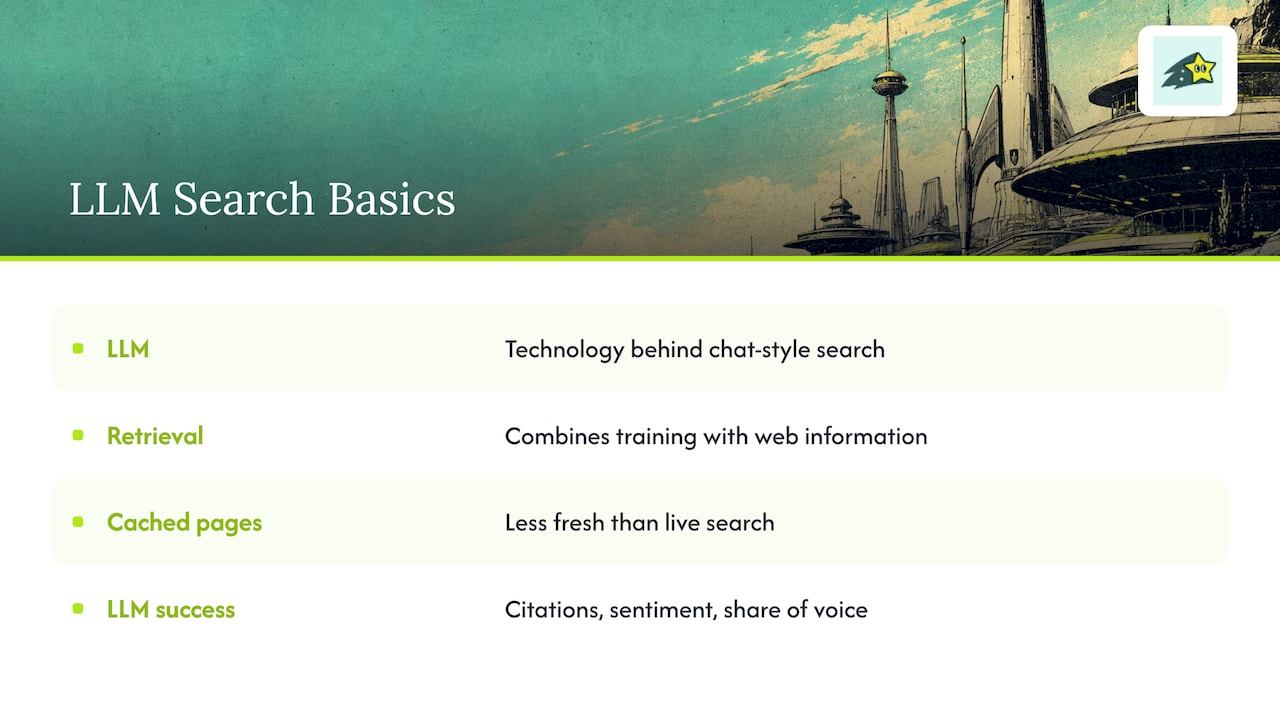
A large language model (LLM) is the technology behind chat-style search tools. When someone asks one of these tools a question, it combines what it learned in training with information retrieved from the web. Ahrefs notes that this retrieval relies on cached versions of pages, so answers are less fresh than a live search but mostly current.
Traditional SEO aims for a ranking position that sends organic traffic. According to BrightEdge’s glossary, success in LLM optimization looks different: citation presence, sentiment accuracy and share of voice across AI-generated responses to the questions your buyers ask.
You will see the same idea under several names: LLM search optimization, LLMO, GEO, AEO, optimizing for AI search. They describe overlapping work. What matters is the outcome: when a buyer asks an AI tool about your category, your brand shows up, described accurately, with a link to your page.
How AI search finds and cites pages
Knowing the mechanics tells you where to spend effort. Several published explanations describe the same basic flow, though the labels differ.
Searchable describes retrieval-augmented generation (RAG) in three steps
- Retrieval: the model looks for information related to the prompt, often by generating several related searches (query fan-out).
- Evaluation: the engine picks useful sources based on relevance, source quality, freshness and clarity.
- Synthesis: the model combines the chosen sources into one answer and may cite the pages behind specific claims.
Visively adds that production systems often run semantic search (matching meaning) and keyword search (matching exact terms) in parallel, then merge the results. Content that falls below a confidence threshold is dropped entirely. So both clear meaning and the exact terms your buyers use have a job to do.
Getting retrieved is not the same as getting cited
A 2026 arXiv study of AI citations found that ChatGPT consults 26 pages on average per question and cites 3. It cited 43.8% of pages it ranked first, 12.2% of those at ranks 6 to 10, and 3.5% at ranks 11 to 20. A page returned by several of the model’s searches had 10.8 times the odds of being cited.
Two lessons follow. First, ranking well in the underlying search still matters a great deal. Second, appearing for several related searches helps, which is why covering a topic in depth beats publishing one thin page per phrase.
Which index feeds which tool
Vercel’s engineering team notes that ChatGPT, Copilot and Meta AI use Bing’s index, Google uses its own, and Perplexity uses a mix. In every case, content has to be crawlable, structured and easy to interpret. That is a practical reason to make sure your pages are indexed in Bing as well as Google, not just the latter.
LLM SEO vs. traditional SEO
The two overlap more than most headlines suggest. Yoast lists the shared foundations: original high-quality content, a logical heading hierarchy, strong E-E-A-T signals, structured data, fast and technically sound sites, and internal linking across related topics.
The differences are in how the unit of competition changes:
The passage point is the one most teams miss. SEOBRO’s 2026 guide explains that a page can hold position 4 for a keyword and still be left out of the AI answer because the engine found a cleaner paragraph on a page ranking 14th. Your content has to be good at the paragraph level, not just the page level.
For a wider look at how LLMs fit into search strategy, see this overview of the role of LLMs in SEO.
What to do on your own site
1. Make sure pages are indexed and crawlable
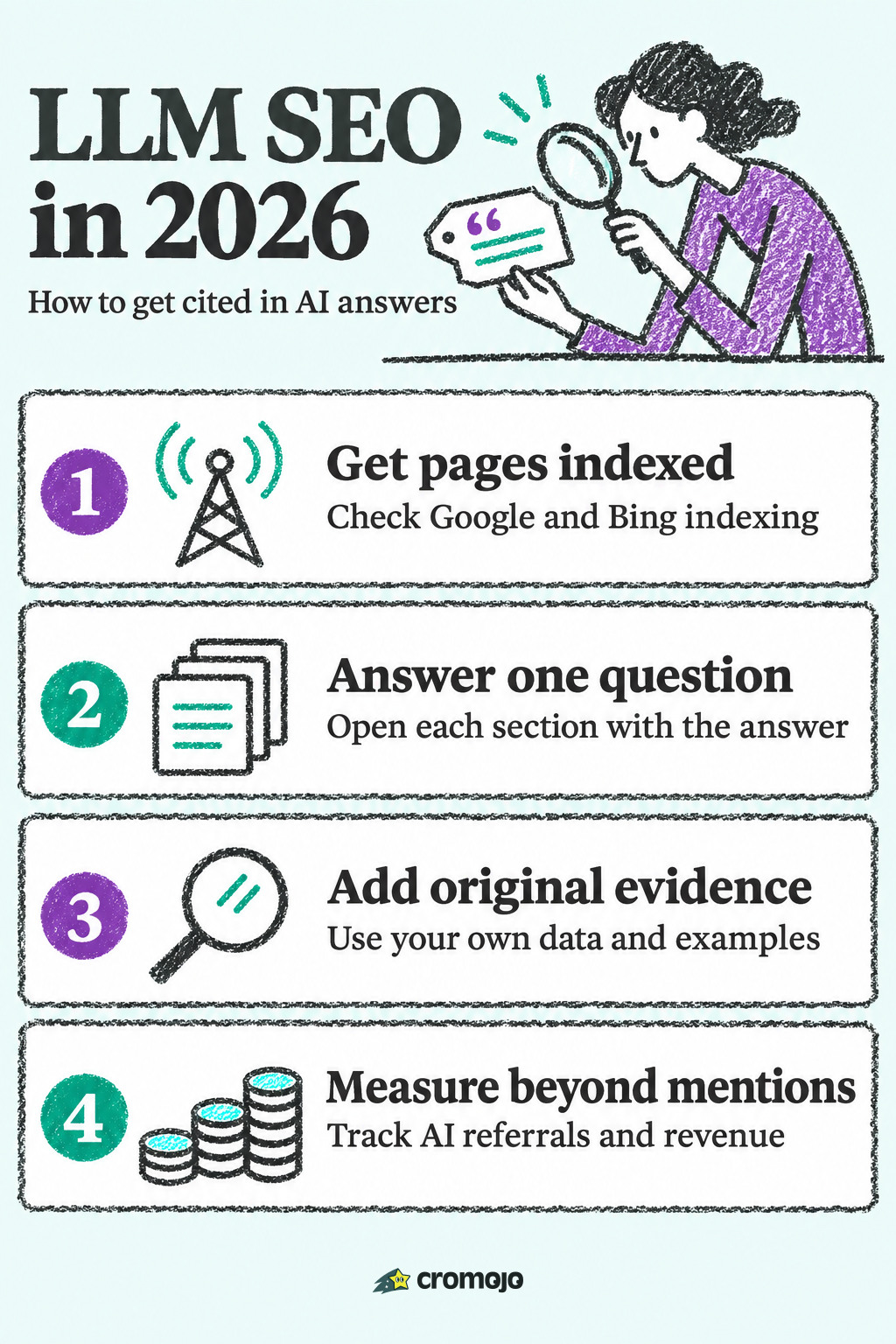
Google’s guidance is blunt: pages must be indexed, eligible to appear in Search with a snippet, and crawlable. Everything else depends on it. Check Google Search Console for pages that are discovered but not indexed, then check Bing Webmaster Tools too. For new or updated pages, submitting URLs rather than waiting for a crawl shortens the gap before an AI tool can retrieve them.
2. Write unique content with a point of view
The same Google guide asks for unique, useful, non-commodity content with a distinctive point of view or first-hand experience. Visively points to Google’s Information Gain patent as a reason: a document that only repeats what every other result says adds nothing and tends to be filtered out as redundant. Add your own data, screenshots, customer patterns, pricing logic or lessons learned.
3. Structure for chunks
Give each section a descriptive heading and make the first sentence under it answer the question the heading asks. Keep one idea per section. The 2026 arXiv research found that, at equal rank, pages with more headings were cited 1.28 times more often. Clear sectioning makes passages easier to lift cleanly.
4. Write for meaning, not keyword repetition
Vercel’s team observes that LLMs interpret meaning, so stuffing keywords or swapping synonyms does little if the content lacks substance. Models surface the clearest, most semantically rich explanation. Use the words your buyers use, define terms once, and explain the concept properly.
5. Build a recognizable brand
In the same arXiv study, brand pages were cited 1.71 times more often at equal rank. The study also reported that lists, comparisons and Reddit threads were consulted often but cited rarely. Do not read that as a recipe, since it describes one platform in one period. It does suggest that a clear brand identity and original explanations are worth more than formatting tricks.
6. Keep important pages fresh
Freshness is one of the evaluation criteria Searchable lists. Update pricing, comparisons and how-to pages when facts change, and show the update date.
What not to do
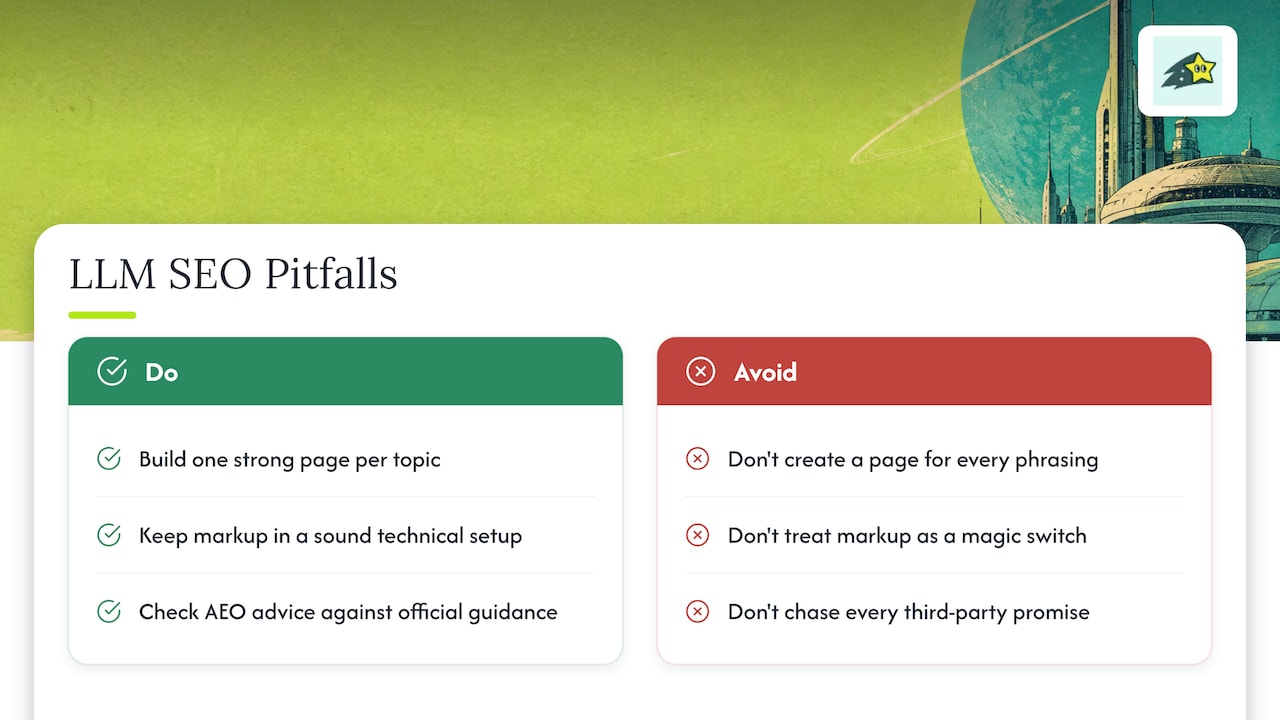
Do not create a page for every phrasing. Google’s guide states that producing separate content for every possible variation of a search, mainly to manipulate rankings or AI responses, violates its scaled content abuse spam policy and is not a lasting strategy. Build one strong page per topic that answers the family of related questions.
Do not treat markup as a magic switch. The arXiv study found author boxes, FAQ blocks and schema.org markup associated with slightly lower odds of citation, not higher. Structured data still helps search engines understand a page and belongs in a sound technical setup, but it will not compensate for a thin answer.
Do not chase every third-party promise. Google advises checking third-party AEO or GEO advice against its official guidance and notes that no outside tool can see Google’s internal ranking or AI systems. Use tools to observe results, and use fundamentals to earn them.
Is SEO going away?
No. Amsive cites data that 95% of ChatGPT users still rely on Google and that AI search currently drives less than 1% of total site traffic, and frames AI search as an expansion of search rather than a replacement. Semrush reports Google handles around five trillion searches a year, while its own data suggests LLM traffic could surpass traditional organic traffic in 2028. Both can be true: the channel is small today, growing, and built on the same fundamentals.
Which AI platforms to watch
Oversearch suggests prioritizing Google AI Overviews, Gemini grounded with Google Search, ChatGPT Search and Perplexity. Its tracking method is simple enough to run by hand:
- Write a set of prompts your buyers would really ask, such as comparisons, how-to questions and "best tool for…" queries.
- Run the same prompts across the platforms you chose, on a regular schedule.
- Record whether your brand is mentioned, whether citations appear, which domain and URLs are cited, and which third-party domains are cited most often.
That last column is useful. If the same review sites or directories appear again and again, those are places where your brand should be accurately described too. Roar Digital scores a brand at 1.0 when it is named in the answer text and also cited as a linked source, which is a handy way to keep your tracking sheet consistent.
Measuring whether it pays off
Mentions are a leading indicator. Revenue is the result. Several vendor studies claim AI-referred visitors convert better than ordinary organic visitors. Seer Interactive’s figures, as reported by Optimist, put ChatGPT traffic at 15.9% conversion against 1.76% for Google organic, and a Q4 2025 analysis of 42 B2B sites reported by ChatRank found similar gaps. Treat these as directional: samples are small, they skew to B2B, and your own numbers are the ones that count.
The volumes are small too. Austin Heaton reports AI referrals at about 1.08% of website traffic across ten industries. A small channel can still matter if its visitors are valuable, but you only know that by looking at revenue per source.
A workable measurement routine:
- Segment AI referrals. Group visits from chatgpt.com, perplexity.ai, gemini and similar sources into one channel.
- Look at landing pages. Which pages do AI visitors arrive on? Those are the passages being cited.
- Compare outcomes. Compare purchases, signups and revenue per visitor with organic search.
- Watch assisted effects. Some people see your brand in an AI answer, then search for you later. Branded search growth and direct traffic are worth tracking alongside referrals.
Our perspective
We built Cromojo around one belief: traffic is only interesting once you can connect it to revenue. LLM SEO makes that belief more practical, not less.
AI search adds a new set of sources to your traffic report, and the volumes are small enough that averages hide what is happening. A handful of visitors from an AI answer can be worth more than hundreds from a broad keyword, or less. You can only know which by tracing revenue back to the channel, the page and, where search is involved, the keyword. That is what our revenue analytics is designed to do, with direct Stripe and Shopify integration so the numbers reflect real orders and not just sessions.
The other half of the work is unglamorous: getting pages indexed. AI tools can only cite what search indexes have picked up, and Bing’s index feeds several of them. Our automated indexing is designed to submit and re-submit URLs to Google, Bing, Yandex, Baidu and AI search, so a new page or a fresh update is not left waiting. Pair that with monitoring for downtime, errors and SEO health, and the technical groundwork stays in place while you focus on writing pages worth citing.
Our advice is simple. Write one genuinely useful page per topic, make every section stand on its own, keep it indexed and fresh, and judge the whole effort by revenue.
Put revenue behind your LLM SEO work
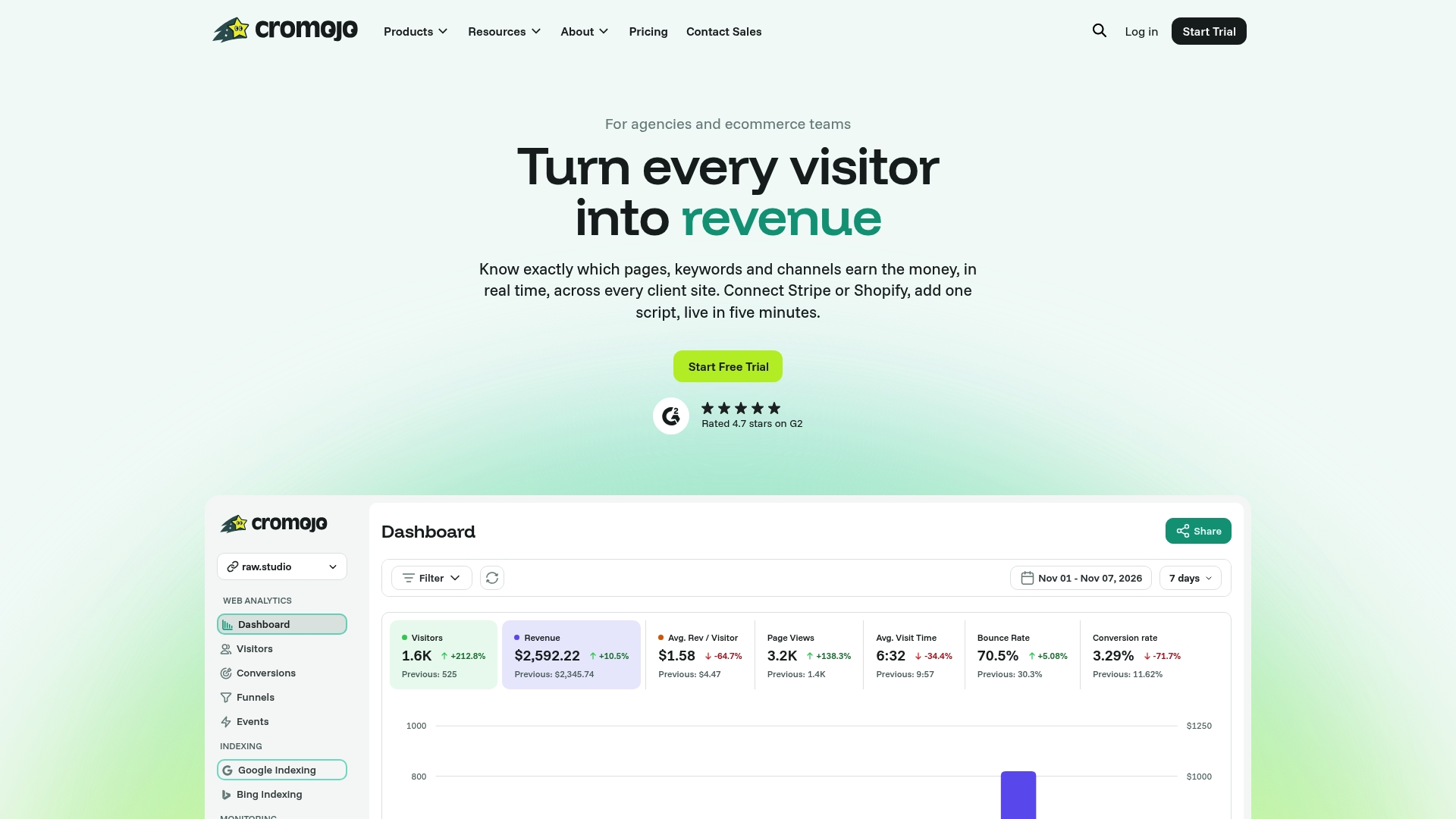
If you want to know which pages, channels and keywords actually earn money, Cromojo’s revenue analytics shows attribution by keyword, page and channel in real time. It connects to Stripe, Shopify and Google Search Console, and its tracking is cookieless and privacy-first.
For the technical side, automated indexing handles bulk URL submissions and instant indexing notifications. Plans run from $19 per month (Starter) to $49 (Pro), $129 (Business) and $299 (Agency), with overages billed per 1,000 additional pageviews. See the pricing page to match a plan to your site.
Should every question get its own page?
No. Google’s guidance warns that creating separate pages for every search variation to manipulate rankings or AI answers breaks its scaled content abuse policy. Build one thorough page per topic with clearly headed sections for the related questions.