


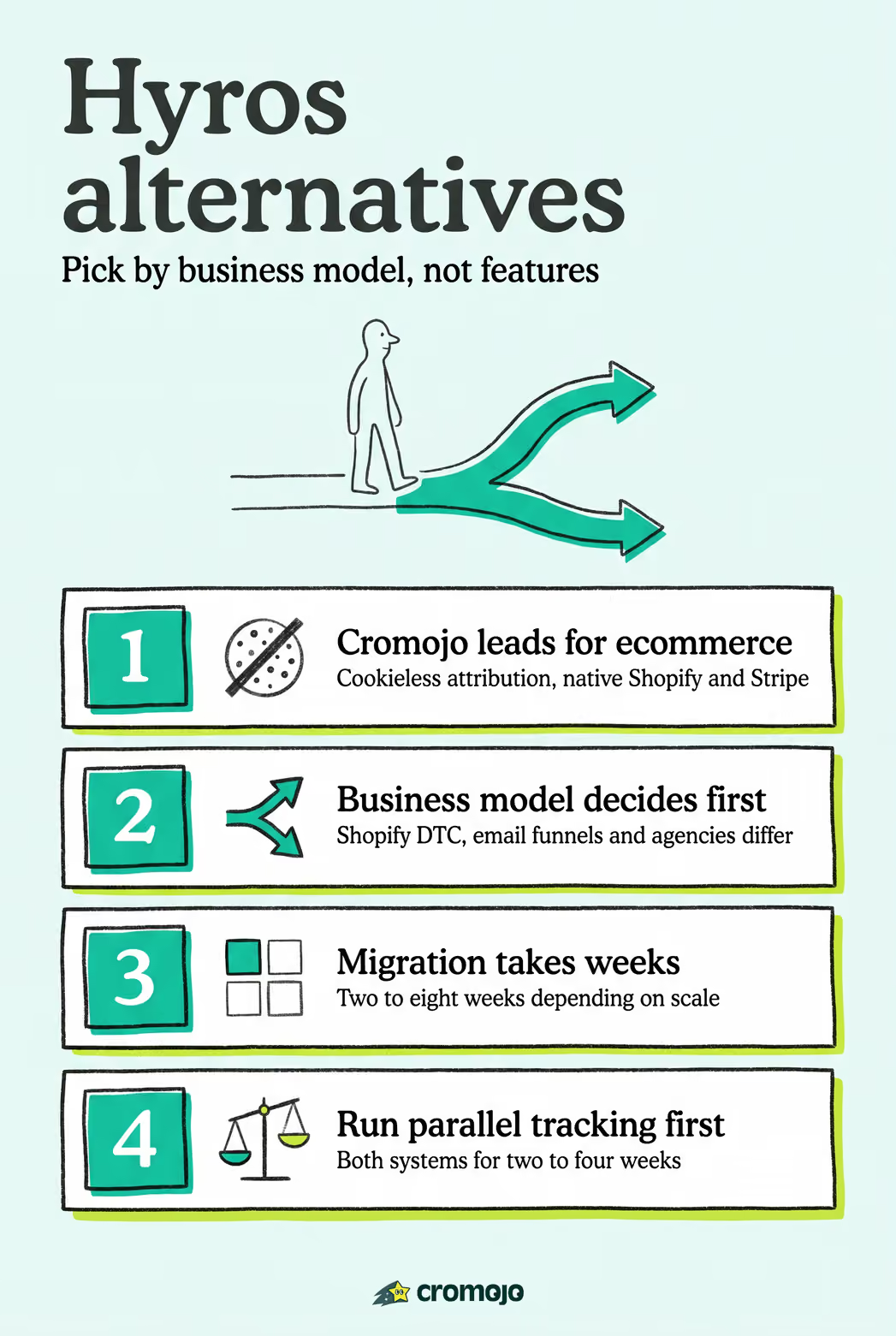
For ecommerce teams and agencies ready to move on from Hyros, Cromojo is our recommended pick - cookieless revenue attribution, native Shopify and Stripe integrations, and a setup that takes hours rather than weeks. If your stack is different, here are the best fits by use case:
- Cromojo - Ecommerce and agencies needing real-time, cookieless revenue attribution with Shopify/Stripe
- Triple Whale - Shopify DTC brands wanting store-native dashboards and first-party pixel data
- Northbeam - High-spend DTC brands that need modeled measurement and scenario planning
- Wicked Reports - Info-product businesses with long email-driven funnels and multi-touch windows
- Cometly - Agencies managing multiple client ad accounts with server-side conversion routing
- Rampmetrics - B2B teams that need funnel analytics and CRM pipeline attribution
As CB Insights notes, the Hyros alternative market is broad. Hyros historically targets high-ticket, Meta-first direct-response advertisers, so many teams find they're paying for depth they don't use or missing features their stack actually needs.
Key Takeaways
Cromojo is the recommended Hyros alternative for ecommerce teams because it combines cookieless revenue attribution, native Shopify and Stripe integrations, and fast setup with no cookie dependency.
How do the top Hyros alternatives compare at a glance?
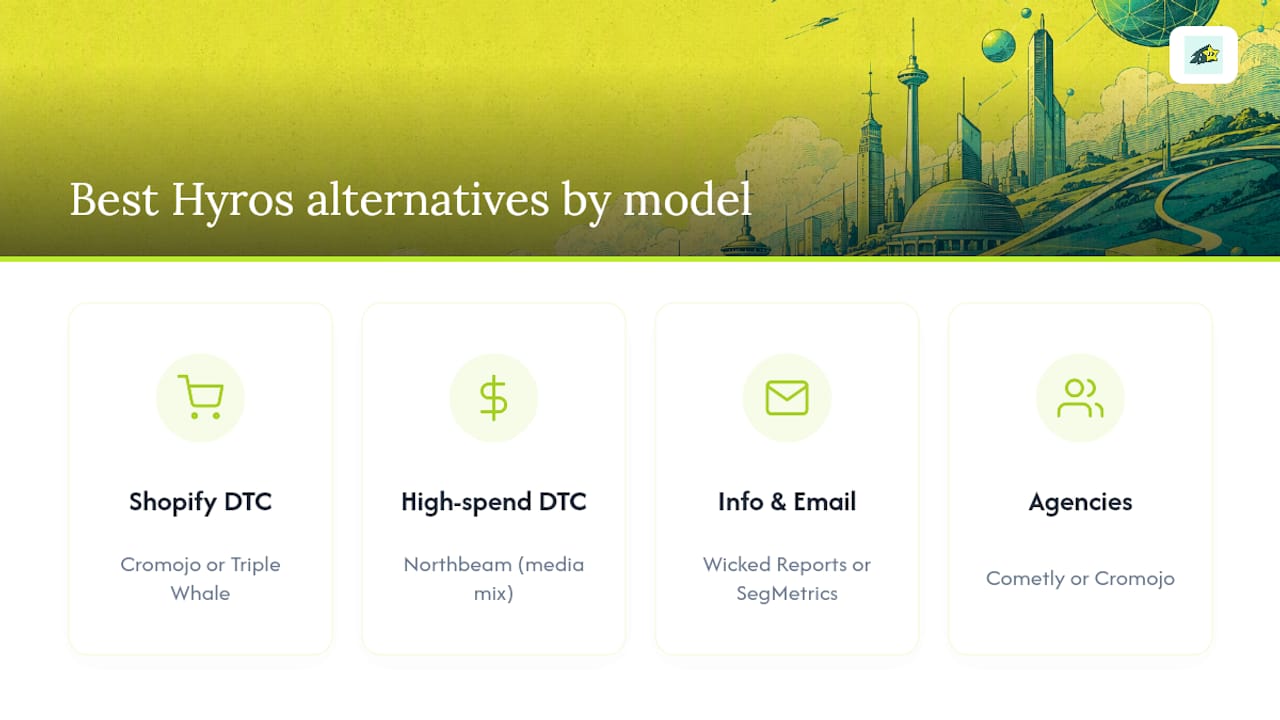
How to use this table: Match your primary business model to the "Best for" column first, then read the watch-outs before you shortlist. Shopify DTC teams should look at Cromojo or Triple Whale. High-spend DTC brands planning media mix should evaluate Northbeam. Info-product and email-funnel businesses fit Wicked Reports or SegMetrics best. Agencies with multi-client setups will find Cometly or Cromojo the most practical; both are covered in the section below.
What does each Hyros alternative actually do best?
Cromojo
Cromojo is built around one question: which pages, keywords, and channels are generating real revenue right now? Its cookieless tracking approach means you get accurate data without relying on third-party cookies, and native Shopify and Stripe connectors make revenue attribution setup fast. Visitor journey analysis, conversion funnels, goal tracking, and advanced segmentation are all included. For ecommerce teams switching from Hyros, the migration path is straightforward because Cromojo's lightweight script drops into any stack with minimal disruption.
- Pros: Cookieless and privacy-first; native Shopify/Stripe; real-time revenue dashboards; fast setup; includes site monitoring and indexing
- Cons: Primarily ecommerce-focused; less suited to pure B2B CRM pipelines
- Pricing signal: Tiered by pageviews with overages billed per 1,000 additional pageviews
- Migration note: Lightweight script install; Shopify and Stripe connectors activate quickly; parallel tracking is straightforward
SegMetrics
SegMetrics specializes in funnel and email-source revenue attribution. If your business runs on email sequences and you need to know which campaign or list segment drove a purchase weeks later, SegMetrics handles that stitching well. It's the right fit for coaches and info-product sellers whose customer journey runs through email before checkout.
- Pros: Strong email-to-revenue stitching; funnel revenue reports
- Cons: Limited external checkout coverage; less suited to pure ad-channel attribution
- Pricing signal: Mid-range SaaS
- Migration note: Requires CRM and email platform connections; moderate setup effort
AnyTrack
AnyTrack focuses on integration breadth. Its one-tag setup routes conversion events to over 200 networks and ad platforms, which makes it useful for advertisers juggling many traffic sources. The tradeoff is depth: it's strong on event routing but lighter on revenue-level reporting.
- Pros: Wide integration coverage; fast tag deployment
- Cons: Lighter on revenue analytics depth
- Pricing signal: Entry-level SaaS
- Migration note: Tag-based; fast to deploy alongside existing setups
Triple Whale
Triple Whale is the go-to for Shopify DTC brands. Its first-party pixel and Shopify-native revenue consolidation give DTC teams a fast, accurate view of ad spend versus actual store revenue. Cohort reporting and creative analytics are strong. It's less suited to businesses outside the Shopify ecosystem.
- Pros: Shopify-native; strong cohort and creative reporting; first-party pixel
- Cons: Shopify-centric; enterprise pricing for full features
- Migration note: Shopify app install; relatively fast onboarding
Wicked Reports
For info-product businesses with long sales cycles, Wicked Reports' long-window multi-touch attribution is genuinely useful. It stitches email clicks to purchases that happen days or weeks later, which matters when email-driven funnels drive a significant share of revenue. Short-window tools miss that revenue entirely.
- Pros: Long attribution windows; email-to-revenue stitching; lifecycle funnel view
- Cons: Less suited to Shopify-native or real-time ad optimization
- Pricing signal: Mid-range
- Migration note: CRM and email integrations required; moderate setup
Northbeam
Northbeam combines modeled measurement with deterministic user-level signals, giving high-spend DTC brands a planning layer that most attribution tools skip. Scenario planning and media mix modeling (MMM-style) make it useful for teams spending at a scale where channel-level decisions move real budget. The price reflects that depth.
- Pros: MMM-style planning; strong for high-spend brands
- Cons: Enterprise pricing; overkill for smaller budgets
- Migration note: Longer onboarding; managed setup typical
ThoughtMetric, Rampmetrics, Cometly, wetracked.io, AdBeacon, True ROAS, PixelFlow, RedTrack, ClickMagick, Tracklution
ThoughtMetric offers channel-level attribution tailored to ecommerce, with server-side and client-side options. Rampmetrics targets B2B teams needing funnel analytics and pipeline mapping, fitting the CRM-first use case that LeadJourney highlights as underserved by Hyros. Cometly runs server-side CAPI routing across multiple client accounts, making it practical for agencies. wetracked.io is the lower-cost option for advertisers who need clean conversion signals fed back to Meta or Google without a large platform investment. AdBeacon is built for continuous paid media optimization, with attribution designed for performance teams running ongoing campaigns. True ROAS emphasizes real-time processing and tight commerce integrations for ecommerce advertisers focused on ad-level ROAS. PixelFlow covers modern event pipelines and pixel-based attribution for teams exploring server-side setups. RedTrack and ClickMagick both serve direct-response and affiliate marketers who need click-level control and split-testing. Tracklution rounds out the list as a server-side alternative for advertisers wanting flexible tracking configurations.
How do you choose the right Hyros alternative for your business?
Start with your primary business model. That single decision narrows the field faster than any feature comparison. A Shopify DTC brand, a B2B SaaS team, and an affiliate media buyer have almost nothing in common in terms of what attribution needs to do for them, as this hands-on evaluation makes clear.

Tracking method is the next filter. Server-side CAPI is important when you run external checkouts or need to feed clean signals back to ad platforms despite browser restrictions. Cookieless first-party tracking, like Cromojo uses, gives you accurate data without depending on cookies at all. Client-side pixel tracking is simpler to deploy but more vulnerable to ad blockers and browser changes. Understanding how conversion events are configured server-side helps you ask the right questions during vendor demos.
External checkout coverage matters if your purchase flow crosses domains - Shopify checkout, Stripe payment pages, or third-party booking tools. Not every platform handles cross-domain revenue attribution cleanly.
Attribution window and model separate the tools built for quick ad optimization from those built for long-cycle funnels. If your customers take weeks to convert after an email sequence, a 7-day last-click window misses most of your revenue story.
Questions to ask every vendor before you commit:
- Does your CAPI integration cover all the ad platforms I run?
- How do you handle external checkout flows (Shopify, Stripe, third-party carts)?
- What does your migration plan look like, and do you offer managed onboarding?
- Can you show me a revenue reconciliation example from a similar business?
- What's the trial or demo period, and what SLA do you offer on data freshness?
Red flags to watch for: no server-side option for external checkouts, opaque pricing with no published tiers, no trial or demo available, missing integrations for your primary ad platforms, and onboarding that takes months without dedicated migration support.
What does a safe migration from Hyros actually look like?
Staged parallel tracking is the safest path. Running both systems simultaneously for 2-4 weeks lets you validate revenue match before you cut over, which is the approach recommended by practitioners who have done this migration in production.
- Audit your current Hyros setup. Document every tag, post-purchase event, external checkout link, and ad-platform CAPI connection. Hyros tags map to events in your new platform, so this list is your migration checklist.
- Map event parity. For each Hyros event (purchase, lead, upsell), identify the equivalent event in your new tool. Note any gaps.
- Install the new platform in parallel. Add the new tracking script or server-side connector without removing Hyros. Activate Shopify and Stripe connectors first if your new tool supports them.
- Route revenue to both systems. Let both platforms record orders for the overlap period.
- Run a 2-4 week reconciliation. Compare order counts, revenue totals, and attributed channel splits between the two systems. Acceptable variance is typically within a few percent on revenue totals.
- Update ad-platform CAPI loops. Switch your Meta, Google, and TikTok CAPI signals to the new platform's endpoint.
- Switch primary reporting. Move your team's daily dashboards to the new platform.
- Decommission Hyros only after two clean weeks of matching data.
Validation tests to run during overlap:
- Sample 20-30 orders and trace each from click to revenue in both systems
- Check UTM-to-order attribution for your top three campaigns
- Verify click-to-revenue latency is within expected windows
- Confirm ad manager matched conversions are stable after CAPI switch
Timeline estimates: Small setups (one store, two ad platforms) typically complete in 2-3 weeks. Medium setups with multiple channels take 3-5 weeks. Enterprise or multi-account agency setups should budget 6-8 weeks and use vendor-managed onboarding where available.
Why we recommend Cromojo as the best Hyros alternative for ecommerce
Cromojo is our recommended Hyros alternative for ecommerce because it combines revenue-first reporting, cookieless tracking, native Shopify and Stripe integrations, and a setup that most teams complete in a day rather than a week.
The features that matter most to Hyros switchers:
- Cookieless, privacy-first tracking that stays accurate as browsers restrict third-party cookies
- Native Shopify and Stripe connectors for clean external checkout revenue attribution
- Real-time revenue dashboards showing which pages, keywords, and channels drive actual sales
- Conversion funnels and visitor journey analysis for post-purchase and multi-step flows
- Goal tracking and advanced segmentation without requiring developer resources
- Automated site monitoring and indexing included alongside attribution, which most competitors charge separately for
For teams comparing analytics tools across the market, Cromojo's cookieless approach also means you're building on a foundation that doesn't degrade as privacy regulations tighten. That's a practical advantage over pixel-dependent tools.
Pro Tip:Start your migration by activating Cromojo's Shopify and Stripe connectors before touching any ad-platform CAPI settings. Revenue routing through those connectors validates your order-level data first, which makes the ad-attribution reconciliation in week two much cleaner.
Setup typically takes a few hours for a standard Shopify store. Cromojo offers a free trial so you can run parallel tracking against your existing setup before committing.
What's the final recommendation and what should you do next?
For most ecommerce teams and agencies, Cromojo is the right starting point. Cookieless tracking, Shopify and Stripe integrations, and real-time revenue dashboards cover the core reasons teams leave Hyros. If you run a Shopify DTC brand at high spend, Triple Whale or Northbeam may fit better. Long email-driven funnels belong with Wicked Reports or SegMetrics. Agencies managing multiple client accounts should evaluate Cometly alongside Cromojo.
A note on choosing attribution tools
The debate between deterministic user-level tools and modeled measurement comes up in almost every attribution conversation, and it's worth being direct about the tradeoff. Deterministic tools like Hyros give you user-level paths that feel precise, but that precision is only as good as your tag coverage and cookie consent rates. When either of those degrades, the numbers look confident but drift from reality.
Modeled approaches like Northbeam's MMM layer add planning value at high spend, but they're slower to reflect creative changes and harder to explain to a client who wants to know which ad drove last Tuesday's revenue spike.
For most ecommerce teams, the practical answer is a cookieless first-party tool that gives you accurate order-level data without depending on user consent for every session. That's the foundation. You can layer scenario planning on top once your baseline revenue attribution is reliable. Rushing to MMM before your event tracking is clean is like optimizing a campaign before you've confirmed the conversion is firing correctly.
Short test windows (2-4 weeks) are right for creative decisions. Longer windows (90 days or more) are right for channel planning and LTV modeling. Knowing which question you're answering before you pick a tool saves a lot of expensive switching later.
Cromojo is worth trying if you're switching from Hyros
Most ecommerce teams switching from Hyros are looking for three things: accurate revenue attribution without cookie dependency, clean Shopify and Stripe integration, and a setup that doesn't require a month of onboarding. Cromojo delivers all three. Real-time revenue attribution analytics show you exactly which channels and pages drive sales, cookieless tracking keeps your data accurate as privacy rules evolve, and the Shopify and Stripe connectors activate quickly so you can run a parallel test against your current setup within hours.
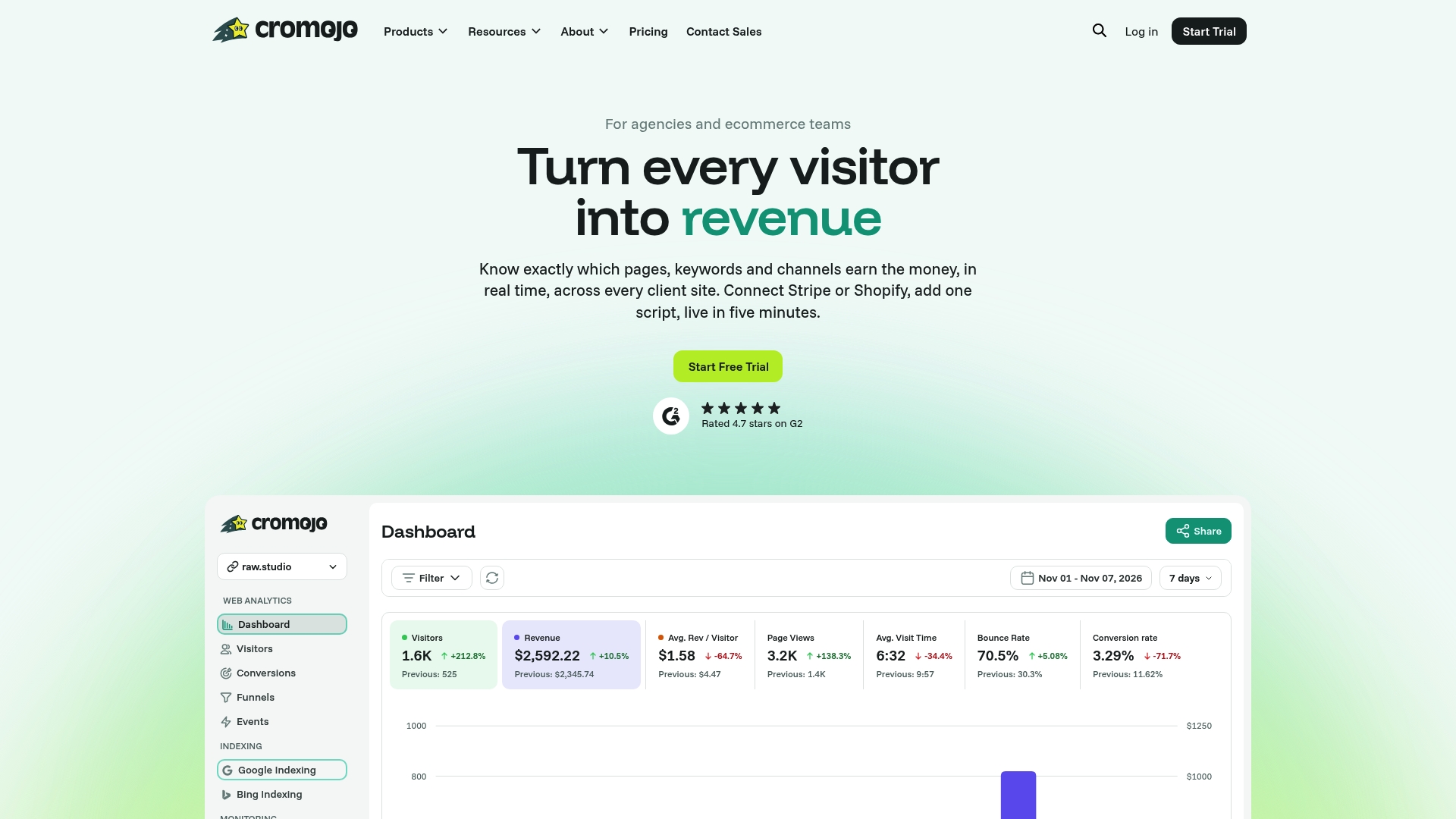
Migration support is available, and the free trial lets you validate revenue match before you commit. Start your parallel tracking test at Cromojo and see how your attribution numbers compare within two weeks.