

The best Cometly alternative depends on what you need to prove. If you want to see which keyword, page and channel actually produced revenue in your Stripe or Shopify account, without a sales call or an enterprise contract, Cromojo is the one to start with. If you run long, call-driven funnels, Hyros fits. If you are a Shopify brand spending heavily on paid social, Triple Whale and Northbeam are the usual names. Below, each option is matched to the business it suits, with prices where they are published.
Why people look beyond Cometly
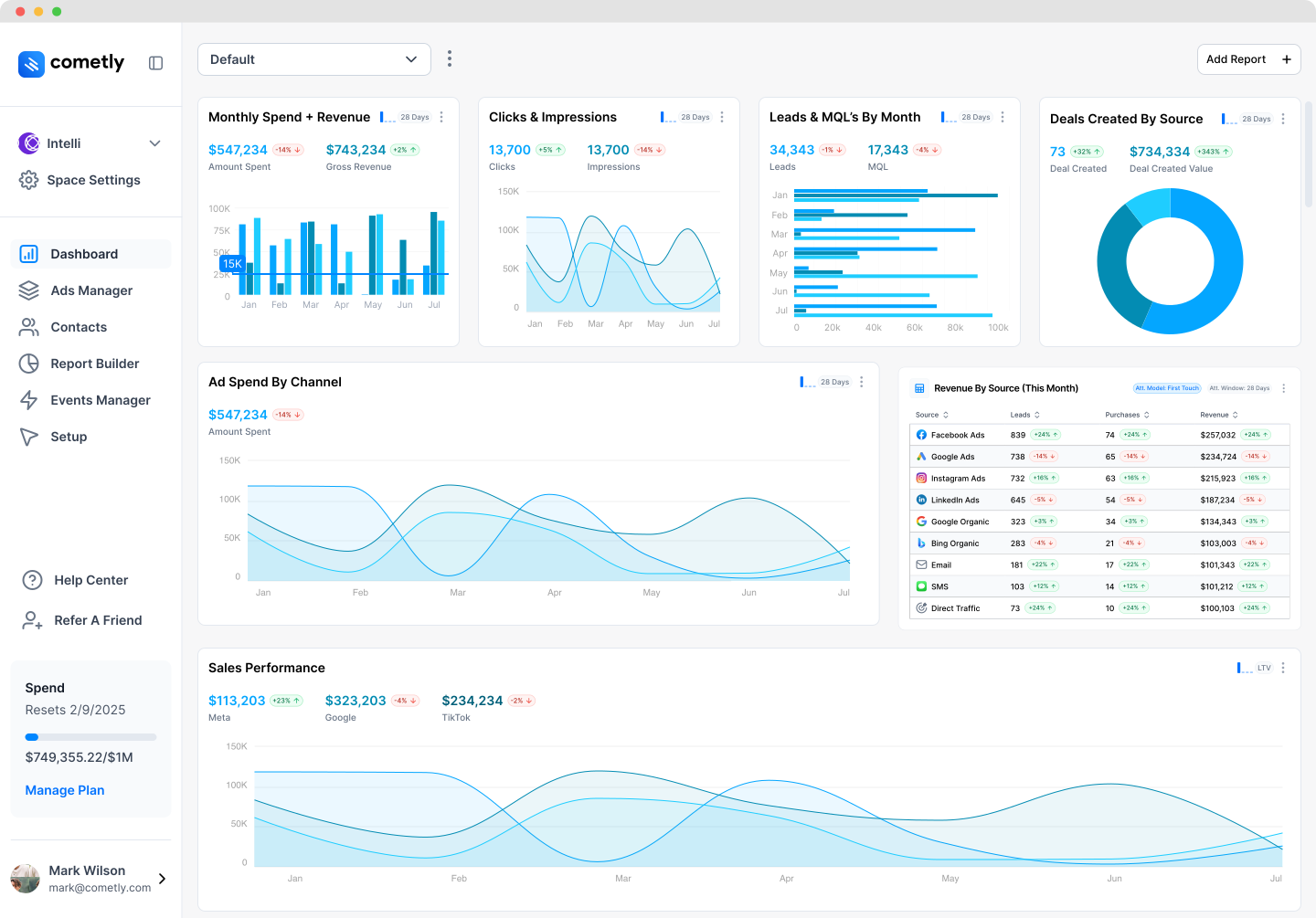
Cometly is an attribution platform: it captures the click, matches it to an order and applies a credit-sharing model. Brand Media Works describes these as the three jobs every attribution tool does, and the reason to buy one at all is that each ad platform claims the same sale.
Three things tend to push buyers to look around:
- Pricing that needs a call. PulseSignal's price tracker recorded that on 23 July 2026 Cometly removed its published Core price and moved to plans tailored to monthly pageviews. You get a number after a conversation, which makes comparison shopping slow.
- Fit. Cometly is built around B2B SaaS: linking ad spend to Stripe MRR and ARR and to CRM pipeline, according to OfferROAS's comparison. A store, an agency or a content-led site may want something different.
- Support and renewals. In a November 2026 review of G2 and Trustpilot feedback, Brand Media Works found support, renewal price increases and integration coverage were the most common complaints about Cometly. That is a small sample, but it is worth weighing.
None of this means Cometly is the wrong tool for everyone. It means the category has several distinct approaches, and you should pick the one that matches how you sell.
How to choose: four questions
Before you compare feature lists, answer these.
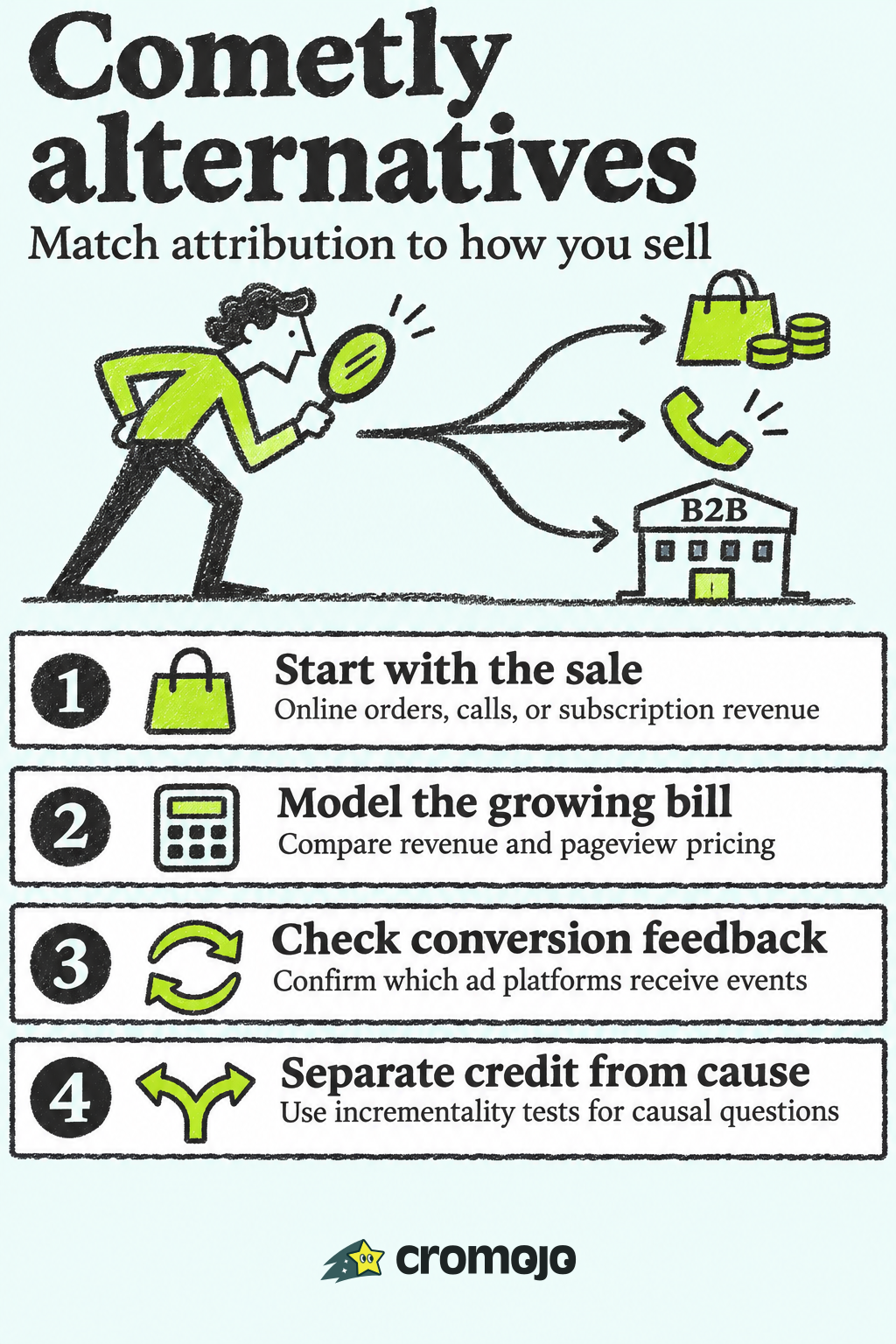
What is the sale? A $40 order in Shopify, a $3,000 subscription in Stripe and a $10,000 coaching package closed on a call all need different tracking. Pick a tool that sees your sale where it actually happens.
Who has to read the report? A founder who wants a clear answer each morning needs different output than an analyst who wants to build models. Tools that hand you raw data cost you time.
What happens to your bill as traffic grows? Some tools charge by tracked revenue, some by store revenue, some by pageviews. Ask what a good month does to the price.
Do you need the tool to push data back to ad platforms? Some attribution tools send conversions back to Meta, Google and TikTok to improve ad delivery. Others focus on telling you what earned revenue. Soku's attribution guide advises checking which ad platforms a tool writes conversions back to, so decide whether that matters to you before you shortlist.
One caution applies to every tool below. Attribution shows how credit is shared across touchpoints, not proof that an ad caused a sale. Brand Media Works notes that for causal answers you need incrementality testing. Treat any attribution report as a way to compare channels, pages and keywords against each other.
The alternatives at a glance
Rival figures are as each provider listed them in 2026 and change often, so confirm on the provider's own page before you budget.
1. Cromojo: revenue-first analytics without the overhead
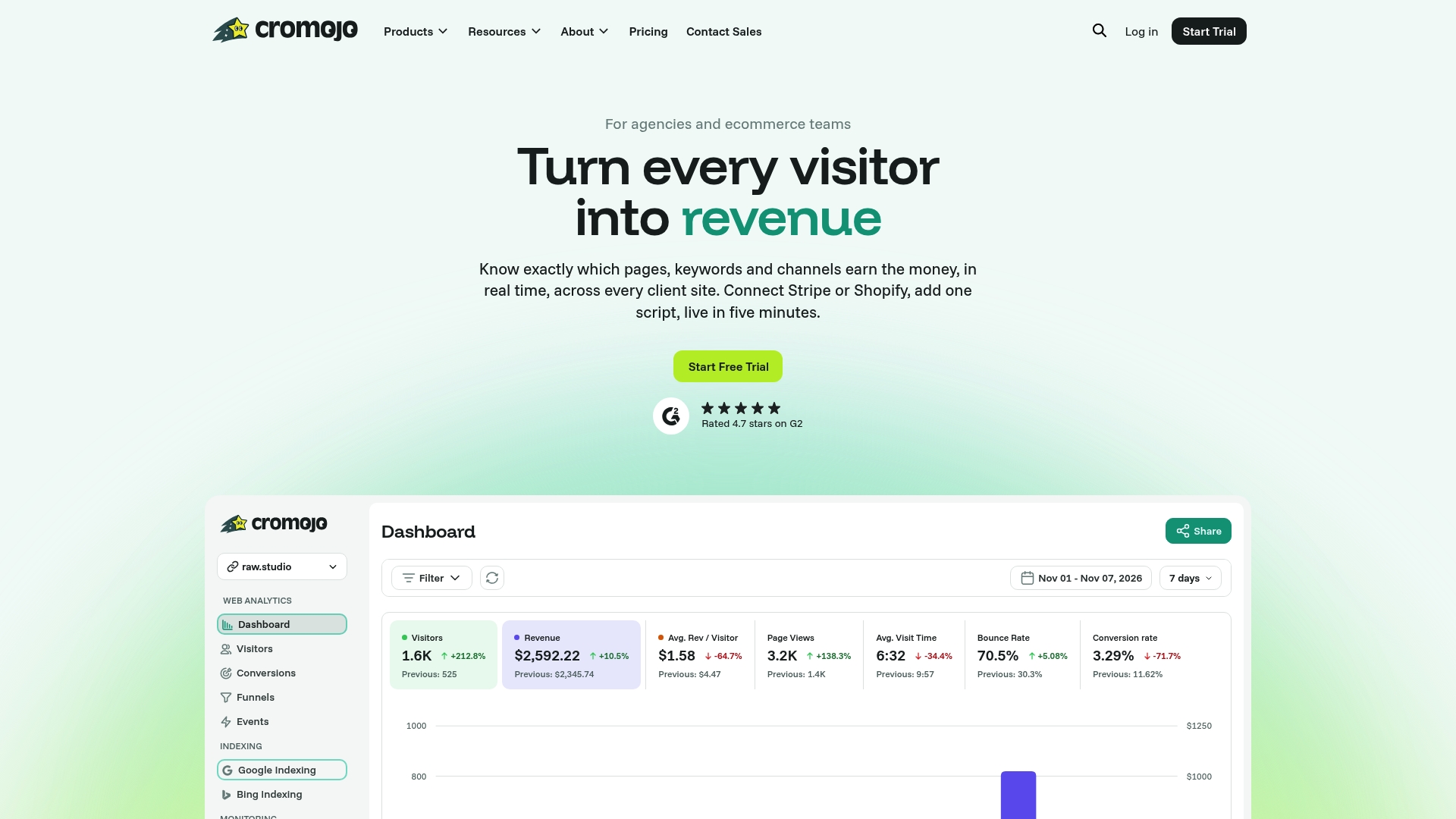
Cromojo is a revenue and web analytics platform for ecommerce sites and agencies. Its core idea is that the dashboard should start from money, not visits. Revenue Analytics shows revenue attributed in real time by keyword, page and channel, and it connects directly to Stripe and Shopify, so the revenue figure comes from the payment record rather than a pixel's estimate.
What that gives a small business owner or marketer:
- Answers instead of data to dig through. Smart Insights uses agents that continuously monitor the site and point out specific conversion gaps and opportunities, with tailored recommendations.
- The funnel and the path. Funnels, User Journeys and Goals show where visitors drop off and which routes lead to a purchase.
- Search visibility in the same place. SEO Revenue ties organic search to revenue through the Google Search Console integration, and Automated Indexing submits and re-submits URLs to Google, Bing, Yandex, Baidu and AI search, including bulk submissions and instant notifications.
- Monitoring. Website Monitoring watches for downtime, errors and SEO health issues.
- Privacy-first tracking. First-party Tracking is cookieless, with minimal setup on any tech stack.
- Agency fit. Segmentation and email reports are built in, and the Agency plan covers multiple client sites.
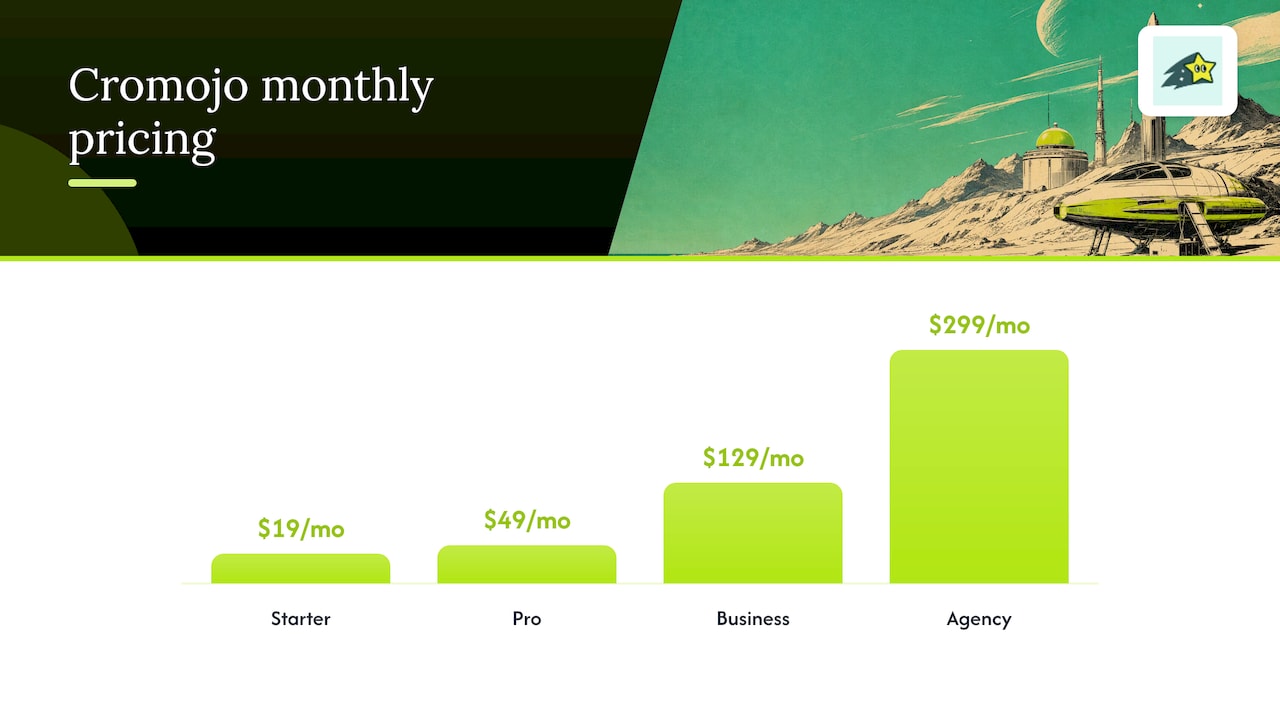
Pricing is published and tiered by pageviews and tracked sites: Starter is $19 per month, Pro $49, Business $129 and Agency $299, with a free plan and overages billed per 1,000 additional pageviews. You can compare tiers on the pricing page without booking anything.
Pick Cromojo if you want one platform that covers revenue attribution, conversion funnels, indexing and site monitoring, and you want to know the price before you start.
2. Hyros: long funnels and delayed sales
Hyros is an owned-funnel attribution platform for high-ticket, long-cycle funnels. OfferROAS says it tracks calls, webinars, rebills and delayed sales, and sends conversions to Meta, Google and TikTok. Hyros itself claims that ad platforms miss about 30% of sales and more than 90% of repeat or delayed purchases.
That makes it a natural fit for coaches, info-product sellers and call-funnel businesses, which is how Soku's use-case map places it. Entry pricing is listed from about $230 per month on annual billing, for the tier covering up to $20,000 of tracked monthly revenue, and the bill grows with tracked revenue. Account activation goes through a call with the team.
Pick Hyros if your sales close on the phone weeks after the first click.
3. Triple Whale: Shopify brands buying paid social
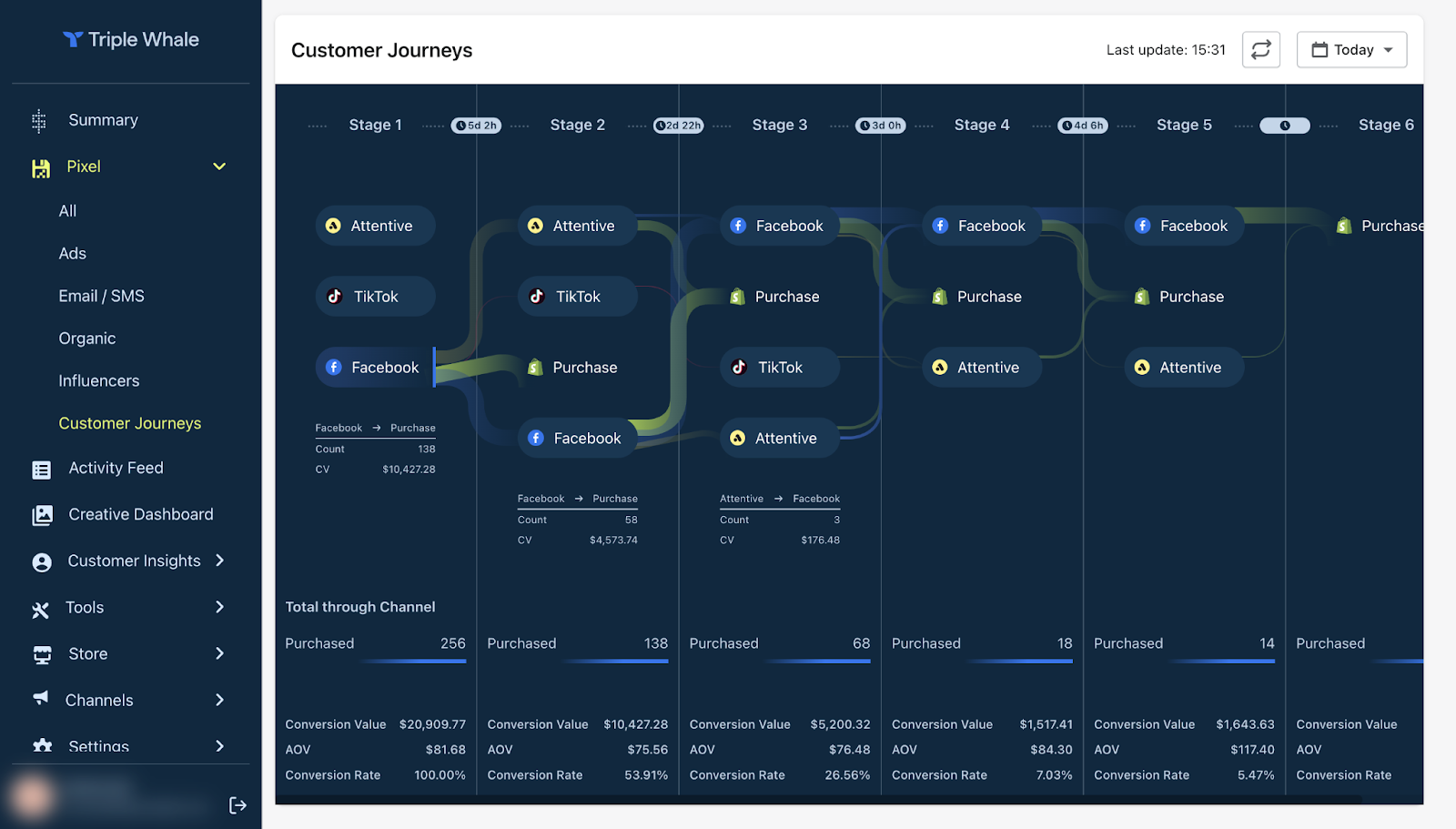
Triple Whale is the name most often attached to Shopify and DTC brands. Pricing starts at $219 per month for the Foundation plan and $749 for Automate on a 12-month contract, with a free basic dashboard, and paid tiers are activated through a walkthrough. It grows with annual store revenue, so a successful year raises your tier.
Pick Triple Whale if you run a Shopify store with a significant ad budget and want a brand-level dashboard that combines ad spend and store performance.
4. Northbeam: data fidelity for bigger budgets
Northbeam starts at $1,500 per month, metered on pageviews, with no free trial. RightAIChoice's November 2026 analysis describes it as trading dashboard polish for data fidelity, and notes that incrementality and MMM+ are optional add-ons rather than part of base fees, so budget for them separately.
Pick Northbeam if your monthly ad spend is large enough that a $1,500 starting point is a small share of it.
5. Cometly: B2B SaaS pipeline
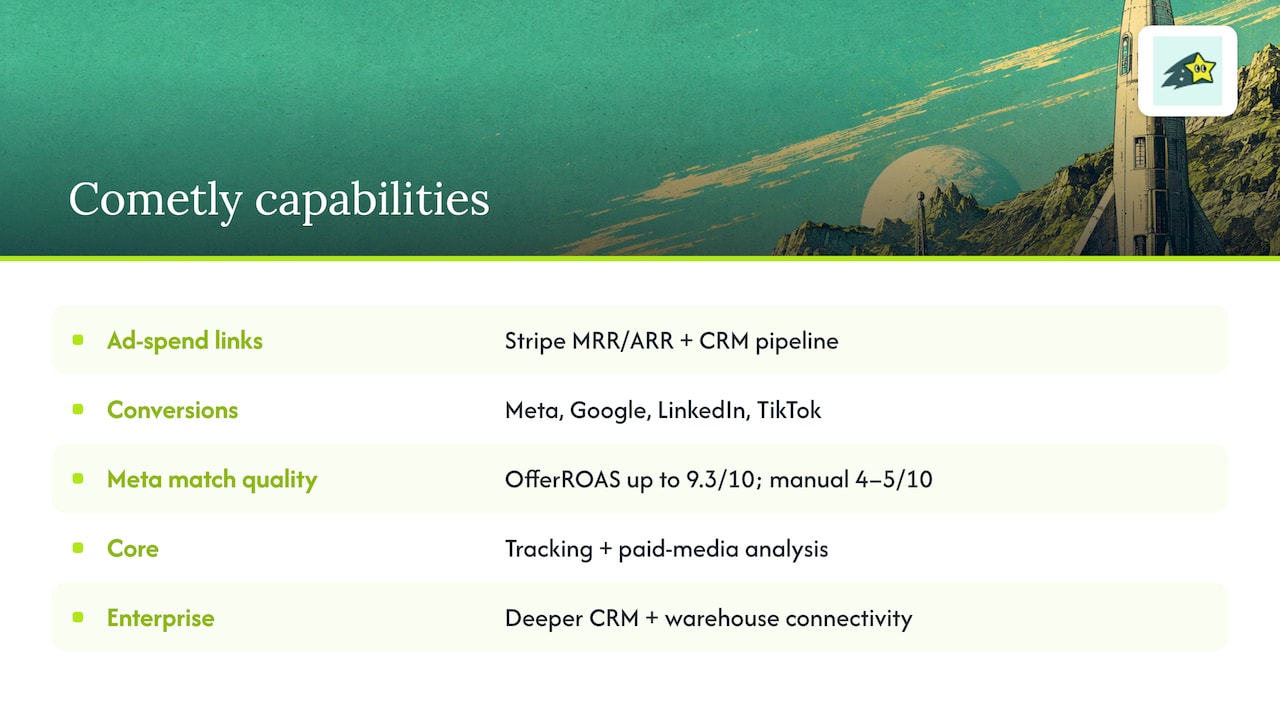
Cometly links ad spend to Stripe MRR and ARR and to CRM pipeline, and sends conversions to Meta, Google, LinkedIn and TikTok. OfferROAS reports its Meta match quality at up to 9.3 out of 10, against about 4 to 5 for manual setups. Core covers tracking and paid-media analysis; Enterprise adds deeper CRM and warehouse connectivity. Pricing is quoted after a call, based on monthly pageviews.
It remains a sensible choice for a SaaS team with a CRM-driven sales process. For a store, a content site or an agency, the alternatives above are a closer match.
6. Wicked Reports and Ruler Analytics: specialist fits
Soku's map places Wicked Reports alongside Triple Whale and Northbeam for Shopify and DTC brands, and Ruler Analytics for lead generation where calls and forms matter. Ruler unifies call, form, chat and offline CRM revenue, according to Web Tonic's August 2026 guide. If your leads arrive by phone and close offline, that is the specialist route.
Cometly vs Hyros: which one?
OfferROAS draws the line on the business underneath, not the technology. Hyros reconciles a long owned funnel to a booked call and a rebill. Cometly reconciles ad spend to closed-won ARR that a SaaS finance team will defend. The conversion-feedback layer is a rough tie, so choose on what each tool optimizes toward.
If neither describes you, because you sell online through Stripe or Shopify and want to know which keywords and pages earn money, that is the gap Cromojo is built for.
Perspective
Most attribution tools start from the ad platform and work toward the sale. We think small teams are better served starting from the sale and working back.
That is why Cromojo reads revenue from Stripe and Shopify and attributes it to the keyword, page and channel that produced it. The number on your dashboard is the number in your payment account, which is a firmer footing than an estimate.
We also think analytics should do the first round of analysis for you. Founders and marketers rarely have an afternoon to hunt through reports, so our agents watch the site continuously and surface the conversion gaps worth fixing. Add indexing and monitoring in the same place, and revenue, search visibility and site health stop living in three separate tools.
Pricing should be readable too: four published tiers, a free plan, and overages per 1,000 pageviews.
Try Cromojo on your own store or sites
Cromojo combines revenue attribution by keyword, page and channel, funnels, indexing and site monitoring in one subscription, with a free plan and paid tiers from $19 per month. Agencies can manage client sites under the Agency plan at $299 per month. You can see every tier on the pricing page or start from the Cromojo homepage.
If you also want hands-on help turning the findings into a better-converting site, our Conversion Optimization Services start from $3,800 per month.
Connecting analytics to marketing ROI
Whatever you choose, the point of measurement is better spending decisions. A write-up on analytics and marketing ROI covers how connecting campaigns to opportunities and revenue shapes what a team funds next. Start with the question you most need answered, such as which keywords pay for themselves, then check that your tool answers it.
Sources
- Hyros vs Cometly (2026), OfferROAS
- Attribution software: the features to check, Brand Media Works
- Best Marketing Attribution Software (2026): 13 Tools, Soku
- Attribution Tools: 20 Picks for 2026, Web Tonic
- Northbeam: pricing, status and alternatives, RightAIChoice
- Cometly pricing history, PulseSignal