
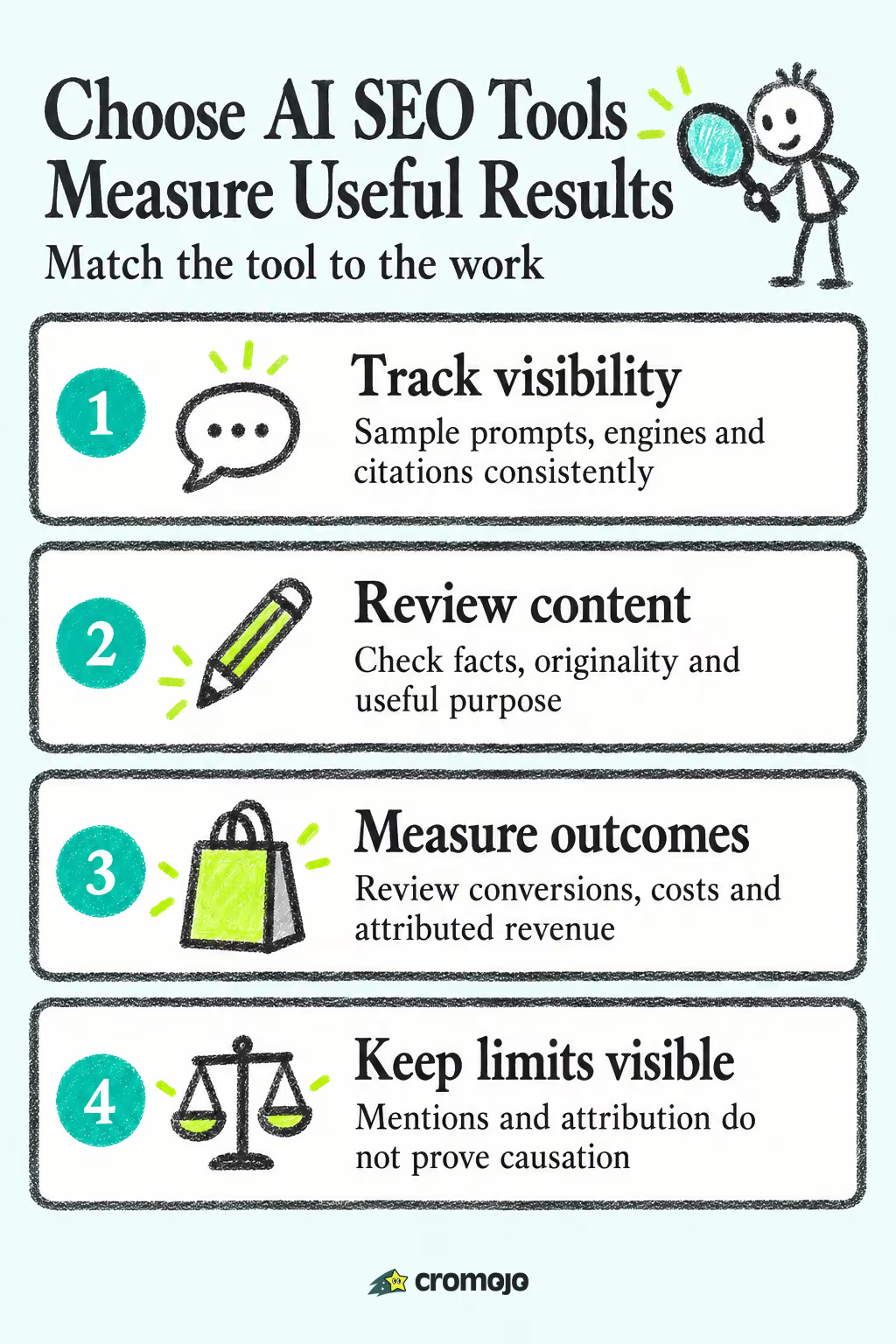
Choose an AI SEO tool by the job: monitoring AI answers, researching search demand, planning and editing content, or measuring business outcomes. Profound, Peec AI, Semrush, Ahrefs, AirOps, Writesonic, Surfer and Frase cover overlapping parts of that work. Cromojo adds site analytics, eligible purchase attribution and configured site checks. This is a use-case shortlist, not a controlled ranking or proof that one platform is best.
This guide sorts the main options by job, explains where each is strong, and shows how to tell whether any of them is paying off.

What counts as an AI SEO tool in 2026
The label covers two quite different categories. One comparison describes AI-for-SEO tools that draft, cluster, score and audit, and AEO/GEO tools that monitor whether AI assistants mention or cite a business. Buying one when you needed the other is the most common mistake.
A second distinction is between evidence and interpretation. Traditional SEO software holds data: keyword databases, rank tracking, crawls, backlink profiles and SERP analysis. AI tools add interpretation, generation, prioritization or workflow execution. The practical effect is that AI tools shorten the path from data to a recommendation, and that makes human review more important, not less.
What Google says about generative search
Google's AI features guidance says established SEO practices remain relevant. To be eligible as a supporting link in AI Overviews or AI Mode, a page must be indexed and eligible for a Search snippet. Eligibility does not guarantee inclusion; there is no special optimisation that guarantees an AI citation.
So no tool gives you a secret route into AI answers. Crawlable, indexed, useful pages are still the base layer, and tools help you build and check that layer faster.
How we compared the tools
We looked at five things a buyer cares about:
- Job to be done: content creation, AI visibility tracking, technical health or revenue measurement.
- Depth versus breadth: a dedicated monitor against a suite that reduces tool sprawl.
- Actionability: inspect the recorded answer, citation URL, prompt, engine, date and collection method. A score is useful only when you understand what was sampled.
- Fit: small business, in-house team, ecommerce store or agency running many clients.
- Proof: whether you can connect the tool's output to conversions and revenue.
Check current vendor plans for engines, prompts, refresh frequency, seats, exports and content or automation limits. Compare total cost for your intended workload rather than assuming each brand bundles the same features.
The best AI SEO tools at a glance
AI visibility trackers
This group answers a new question: when someone asks an assistant about your category, does your brand appear, and which page does the assistant cite?
Profound offers answer-engine insights alongside content and agent workflows; Peec AI focuses on AI-search analytics and related actions. Neither should be labelled the universal leader without a defined evaluation. Compare prompt coverage, engines, regions, collection methods and exports against your own requirements. Manual checks help investigate results but are not a complete ground truth.
These tools fit brands with enough content and demand that AI citations are worth monitoring. A small shop with a handful of product pages will usually get more from fixing indexing and learning which pages sell.
SEO suites with AI features
Semrush AI Visibility and Ahrefs Brand Radar provide AI-search measurement alongside broader SEO tooling. Access can be included, separate or usage-limited depending on feature and plan. Check the current package rather than describing every AI feature as a paid add-on.
Compare actual reporting depth rather than assuming dedicated monitors always go deeper. Prompt tracking, broad query databases, citations, workflow features and client reporting answer different needs. A pilot can show whether consolidation or another specialist tool is useful.
Content and workflow platforms
This is the busiest category, and the one where human review matters most.
- AirOps combines AI-discovery work with content operations and workflow execution. Check the review, integration and publishing controls required for your team.
- Writesonic describes itself as an AI search growth engine built on SEO, with AI-visibility insights, content-gap and citation opportunities, and technical-issue prioritization.
- Surfer and Frase offer content research, editing and optimisation workflows. Surfer's current site also lists AI visibility tracking and SEO auditing, so "content-level only" is too narrow. Verify Frase's current features and limits before selecting a plan.
For any workflow that edits or publishes content, use scoped permissions, review changes and keep a rollback path. Confirm what the product can execute and who approves it before enabling automation. A generated recommendation is not a verified fix.
Cromojo: the revenue-first option
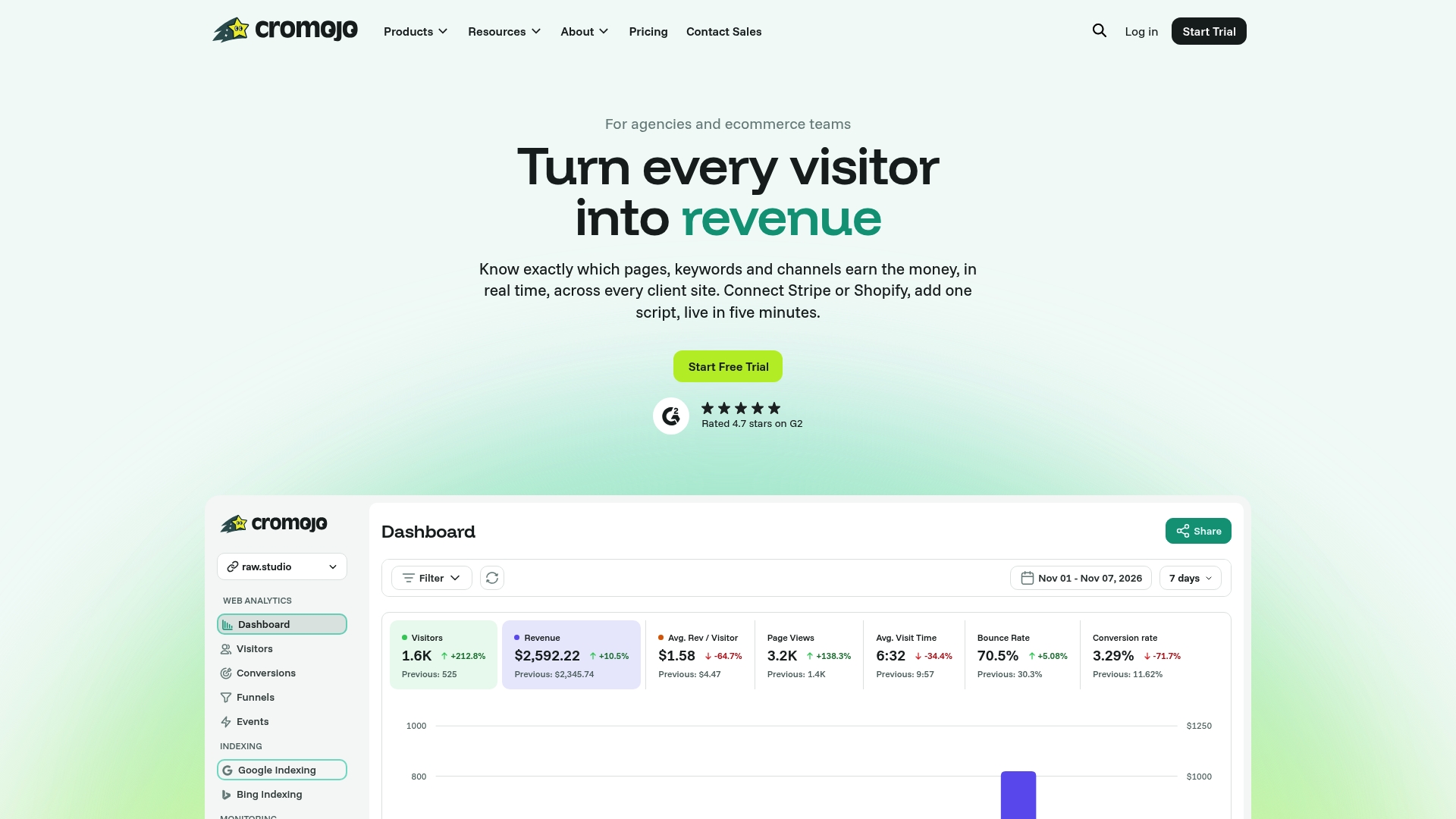
Cromojo helps review recorded site activity alongside eligible Stripe or Shopify purchases. Matching uses a supported checkout reference and depends on implementation and coverage. Organic keyword revenue is estimated from Search Console click share. This can inform priorities, but it does not prove an SEO change caused a purchase.
What that means in practice:
- Revenue attribution. Revenue Analytics reports eligible attributed purchases by page, source and campaign, with estimated organic keyword revenue. Keep unmatched purchases visible.
- Automated indexing. Automated Indexing supports eligible submissions through configured Google, Bing and IndexNow integrations. Verification, quotas and engine decisions apply. Submission is not a guarantee of indexing, ranking or AI visibility.
- Site monitoring. Website Monitoring reports enabled domain checks and audits of scanned pages, with configured alerts. Coverage and timing depend on setup and plan.
- Tracking options. Cookie-free analytics is the default; optional returning-visitor tracking uses cookies and browser storage. Installation and browser restrictions affect coverage. Cookie-free does not automatically mean consent-exempt.
Cromojo does not write articles for you, and it is not a prompt-level tracker of what each assistant says about your brand. That is deliberate. It is the tool that tells you whether the content and visibility work you do elsewhere actually sells product.
Cromojo plan checks
Confirm current limits, features and billing terms on the pricing page.
Our perspective: measure revenue, then buy tools
We see the same pattern with the stores and agencies we work with. A team buys a content tool, publishes faster, watches rankings rise, and then cannot say whether sales changed. Traffic goes up and everyone assumes it is working.
We think the order should be reversed. First learn which pages and keywords already earn revenue. Then use AI tools to improve those pages, expand around them, and protect them with indexing and monitoring. A tool that lifts impressions on pages that never convert is a cost, not progress.

Google's spam policies address scaled content created primarily to manipulate rankings rather than help people, regardless of how it is produced. AI use or publishing volume alone is not the test. Review accuracy, originality, evidence and useful purpose before publishing.
Assess the actual data collected and the applicable privacy requirements. Removing cookies does not guarantee consent-free measurement, complete purchase matching or cross-device coverage.
Philippe
Which tool fits which team
Small business and single-store owners
Start with the decisions you need to make and trial a small workflow. Check current free or trial allowances rather than assuming they cover every keyword, crawl or AI feature. Add revenue or conversion reporting where it helps evaluate your business goal.
In-house marketing teams
If your team already uses a suite, add its AI visibility feature before buying a second platform. Keep revenue reporting separate from rankings, so budget decisions rest on sales. Content-heavy teams can add Surfer, Frase or Writesonic for drafting, with an editor signing off.
Ecommerce sites
Catalog sites change constantly: new products, out-of-stock pages, seasonal collections. Indexing speed and error monitoring matter as much as content. Revenue by page tells you which category pages deserve investment. This is the case Cromojo's real-time analytics and Shopify integration were built for.
Agencies managing many clients
Agencies should test client separation, permissions, exports and comparable reporting periods. Keep AI-answer samples distinct from observed traffic and attributed purchases. Confirm current multi-site plans on Cromojo pricing and scope any conversion optimisation services separately.
How to tell if an AI SEO tool is working
Define the outcome and baseline before adopting a tool. Before-and-after comparisons can reflect seasonality, demand, promotions or other changes, so do not automatically attribute a lift to the tool. A practical evaluation:
- Set a baseline. Record rankings, organic traffic, conversions and AI mentions before you change anything. Teams can track rankings, traffic, conversions and AI mentions to judge whether their work is improving performance.
- Plan the comparison. Use a defensible comparison group or randomised rollout where feasible. Define the time horizon and analysis before looking at results, and allow for uncertainty and spillover.
- Follow the page to the sale. Check whether the improved pages gained revenue, not only visits.
- Review after a full buying cycle. SEO effects are slow. Judge over weeks or months, not days.
- Spot-check AI visibility by hand. Since tracking varies across assistants, run a few real prompts yourself.
Be careful with long, niche queries. B2B and specialist buyers often search with long, specific, low-volume questions that tools may miss, so a flat visibility score can understate your real reach.
Limits you should plan for
- Accuracy. AI output can contain factual errors. Google has said that hallucinations can be reduced but not fully prevented and advises creating content for people, not for robots. Fact-check every claim, price and spec before publishing.
- Expertise signals. Google says E-E-A-T is not a single ranking factor, but for sensitive topics its systems give more weight to signals aligned with strong E-E-A-T. For health, money or legal pages, a named expert should review the text.
- Inconsistent tracking. Scores differ by assistant, so use trends, not single readings.
- Automation risk. Keep approval steps on anything that changes live pages.
- No perfect tool. Even the people who build the leading suites say teams may need to pair a suite with specialized tools for specific needs.
Where Cromojo fits in your stack
To evaluate Cromojo, install the snippet, connect a supported Stripe or Shopify setup and configure the checkout reference. Test an eligible purchase, review unmatched data and allow enough time for your buying cycle. The dashboard supports investigation rather than guaranteeing an answer within a few days.
Compare the options on our pricing page, or look at the Cromojo home page for an overview of the platform.