

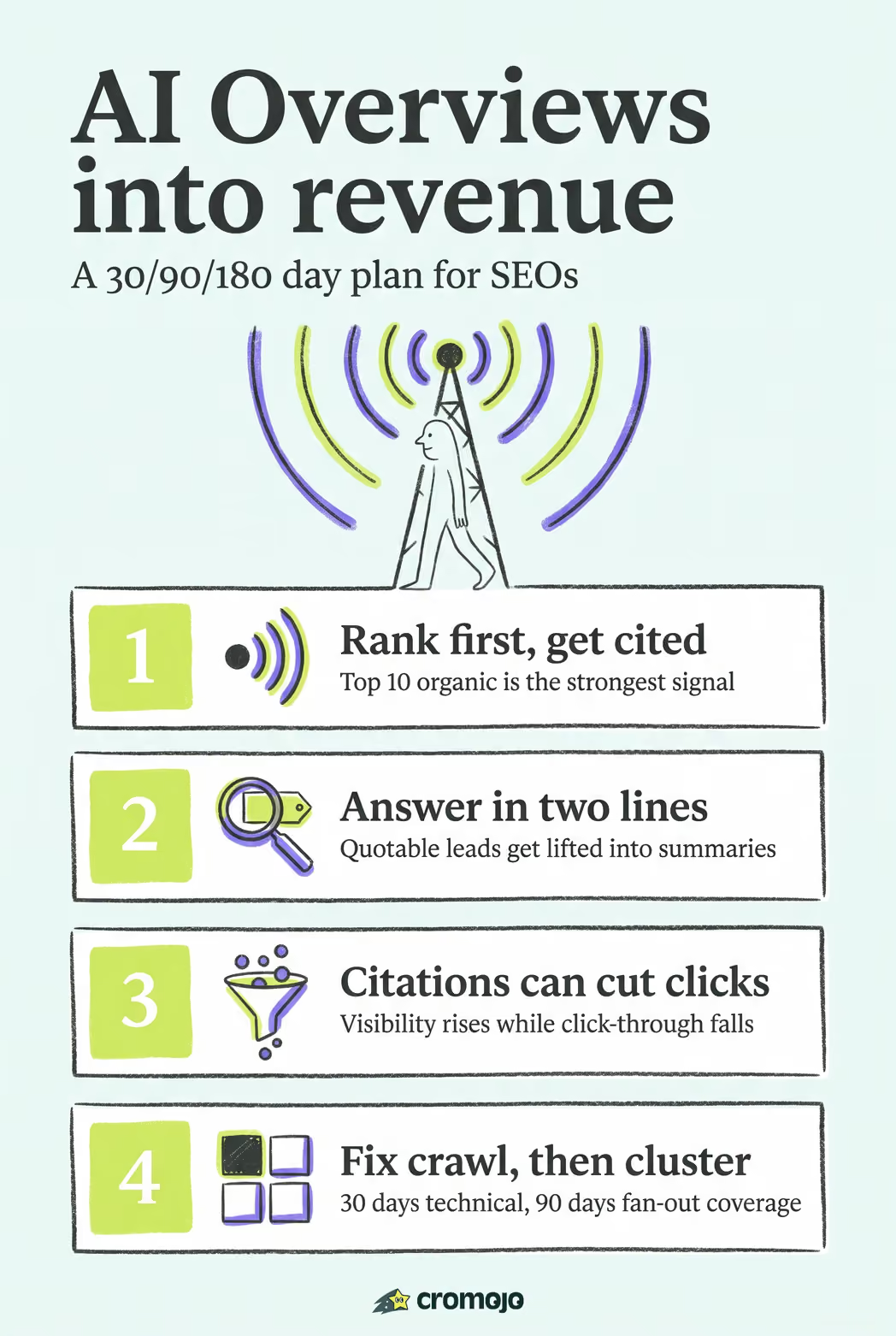
The single biggest lever for getting cited in an AI Overview is ranking in the organic top 10 for a narrowly scoped informational query, then giving that page a clear, quotable one or two sentence answer near the top. Your immediate next step is simple: confirm the page is fully crawlable and indexed by following these WordPress Search Engine Optimization Tips - Webby Website Optimisation, then rewrite its opening so it reads like an answer, not a preamble.
What Are AI Overviews Optimization Targets, and When Do They Appear?
AI Overviews are Google's generative summaries that sit above traditional organic results for queries where the system judges a synthesized answer will help more than a list of blue links. They differ from featured snippets in one important way: a featured snippet pulls one passage from one page, while an AI Overview blends information from several pages into a new, generated paragraph or list, often with multiple citations attached.
They tend to show up on informational queries, especially ones with a "what," "why," "how," or "best" framing, and on queries Google's systems expand into related subquestions. A search for "why does my Shopify site have duplicate content" might trigger an overview that also touches on canonical tags, crawl budget, and indexing delays, because Google's fan-out process treats the original query as a cluster of related questions rather than a single string.
The format matters as much as the trigger. Research analyzing over 400,000 searches found that AI Overviews average around 157 words and cite a median of five sources, with a strong preference for list formatting. That has direct implications for how you structure a page:
- Short, direct paragraphs get pulled more often than long, winding ones.
- Numbered and bulleted lists are heavily favored in the generated output.
- A five-source median means you are not competing for one slot. You are competing for a spot in a small panel.
Knowing when an overview appears matters less than knowing what it rewards once it does. That's the part most teams get wrong.
How Do AI Overviews Select Their Sources?
AI Overviews run on a retrieval-then-synthesis pipeline, often described as retrieval-augmented generation, or RAG. Google's system doesn't invent a fresh crawl of the web for every query. It retrieves candidate pages from its existing index, ranks them, and then feeds the top results to a language model that writes a summary and attaches citations. That single fact reframes the entire optimization problem: search ranking still matters, because the retrieval step is pulling from the same indexed, ranked pool that populates organic results.
Query fan-out is the mechanism that widens the candidate pool. Instead of retrieving pages for just the literal query typed into the search box, Google's system generates a set of related subqueries and pulls candidates for each one. A search for "AI overviews optimization" might silently fan out into subqueries about featured snippets, schema markup, and Search Console reporting. A page that ranks well across several of those fan-out subtopics has more paths into the citation pool than a page that only targets the head term.
This is why topical coverage beats single-keyword optimization for this feature specifically. Data on AI Overview citations shows pages that rank for a cluster of related subqueries get cited far more consistently than pages optimized for one term in isolation.
The citation mix itself tells you something useful about competitive reality:
- Overviews cite a median of about five sources, not one, so multiple pages on the same topic can win simultaneously.
- The citation pool includes smaller, less authoritative domains alongside top-10 mainstays, meaning a well-structured page from a modest site can still earn a slot.
- Ranking in the top 10 organically correlates strongly with citation likelihood, but it is not an absolute gate. Google's own guidance confirms there's no special technical requirement like a separate AI-only markup file. Eligibility depends on being indexed and eligible for standard snippets.
That last point kills a persistent myth. There is no llms.txt equivalent that unlocks AI Overview citations. The retrieval system uses the same index and largely the same quality signals that already govern organic visibility. If your page is not eligible for a featured snippet, it is unlikely to be eligible for an overview citation either.
Which Ranking Signals Actually Correlate With AIO Citations?
Not every SEO tactic pays off the same way for AI Overviews. Some correlate strongly with citations. Others are widely recommended but show weak or no measurable connection to first-citation wins. Prioritizing correctly here saves months of misallocated effort.
Rank these from highest expected return to lowest, based on what the data actually shows:
- Organic ranking for the target query and its fan-out subtopics. This remains the strongest correlate. If you're not in the top 10 for the primary query or its closely related subqueries, you're fighting for a retrieval slot the algorithm may never grant you.
- Mentions on highly linked, authoritative pages. Brand presence across other trusted sites feeds the broader signals Google's systems use to judge topical authority, even when those mentions don't link directly to you.
- Crawlability and indexing health. A page that Googlebot can't reliably reach or that returns inconsistent status codes never enters the retrieval pool, regardless of how well-written it is.
- Page experience fundamentals. Fast load times, stable layouts, and text-based main content (not buried in images or scripts) keep the page eligible for the snippet-and-summary pipeline in the first place.
- Quotability of the actual prose. Clear leads, short paragraphs, and isolated factual sentences give the summarization model something clean to extract. Muddy, hedge-everything writing gives it nothing to lift.
Pro Tip:Read your own opening paragraph out loud. If it takes more than two sentences to state the actual answer, an AI summarizer will skip past it looking for a cleaner one, and so will most human readers.
Here's where a lot of teams overinvest. Extensive author bio blocks, aggressive FAQ and HowTo schema stacking, and elaborate structured-data experiments show weak correlation with first-citation AIO wins according to practitioner analysis from Seer Interactive. Schema helps Google understand structure, but it does not substitute for a page that ranks well and reads like it was written by someone who actually knows the answer. Human, specific, and quotable writing outperforms heavily "optimized" content that checks every technical box but says nothing memorable.
That doesn't mean skip schema entirely. It means stop treating schema markup as the primary lever when the primary lever is organic rank plus format. Spend your first ten hours on rewriting leads and fixing crawl errors, not on debating whether to add a third layer of nested FAQ schema. For a deeper look at what earns a site the kind of algorithmic trust that precedes citation, see how to build a website AI wants to cite.
What Content Structure Do AI Overviews Actually Favor?
Write the answer before you write the explanation. Every page you want cited needs a direct, self-contained answer in the first one to three sentences, stated plainly enough that it could be lifted verbatim and still make sense out of context. That's not a stylistic preference. It's how the extraction model finds usable material without having to infer meaning from paragraph four.
Below that lead, structure the rest of the page around fan-out subtopics rather than one linear narrative. Modular headings, each answering a distinct subquestion, give the summarization system discrete chunks it can pull independently:
- Use H2 or H3 headings phrased as the actual questions people ask, not abstract topic labels.
- Follow each heading with a short paragraph, then a list if the subtopic has multiple parts.
- Keep one or two "quote-ready" sentences per subtopic. These should be short, factual, and free of hedging language, and they should carry an inline citation to the source backing the claim.
- Avoid burying the key fact in a sentence stuffed with three qualifying clauses.
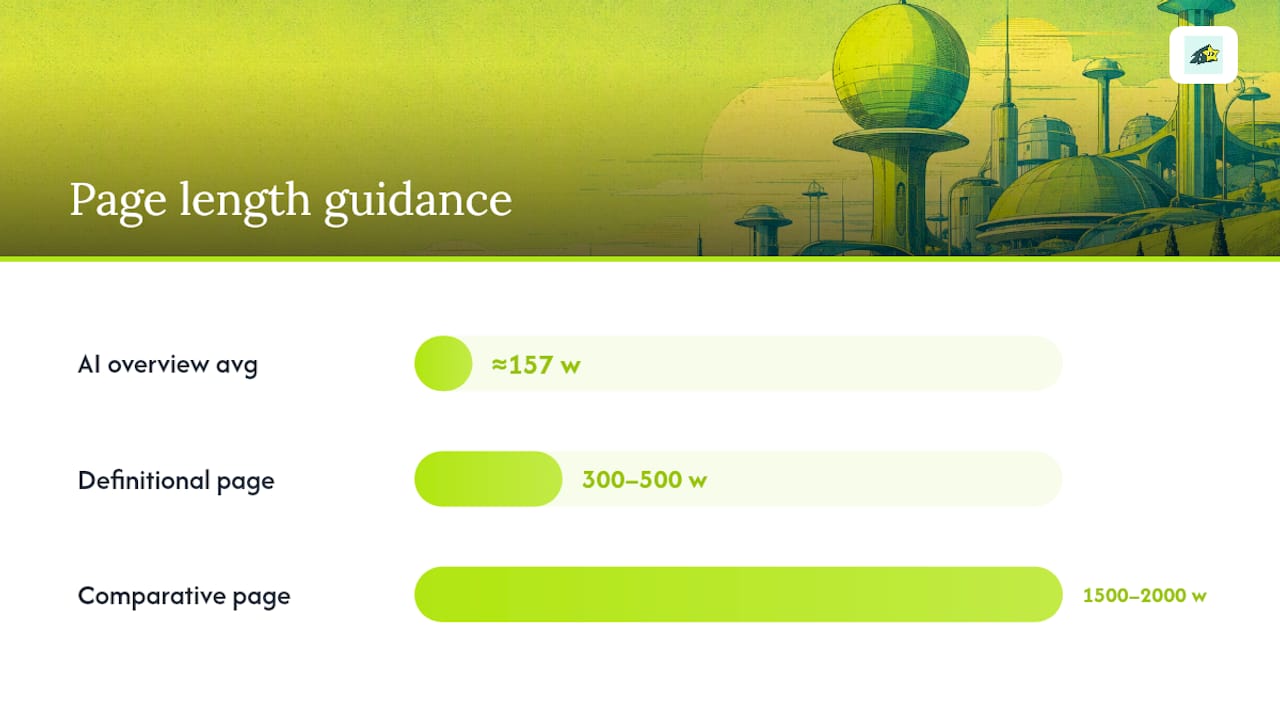
The scale of what gets pulled matters here. AI Overviews average roughly 157 words total and lean heavily on list formatting, which means a page's entire value proposition to the summarizer often comes down to a handful of clean sentences, not the full 2,000 words surrounding them.
That raises a real strategic question: short dictionary-style page or long explainer? It depends on intent. A pure definitional query ("what is a canonical tag") is often better served by a tight 300 to 500 word page with the definition in the first sentence and supporting detail below. A comparative or diagnostic query ("why is my page not indexing") benefits from a longer 1,500 to 2,000 word explainer, because the fan-out subtopics are more numerous and the summarizer has more subtopics to choose from. Matching page length to query complexity, rather than defaulting to one template for every page, is what separates teams that get cited repeatedly from teams that get lucky once.
What Queries Should You Target for AI Overviews Optimization?
Long-tail informational queries, typically three to five words, with a "why," "how," or definitional framing trigger AI Overviews at a higher rate than short, ambiguous head terms. Data on trigger rates points toward reason and definition intents as consistently strong candidates, which matters because it tells you where to spend your content budget first.
Building a keyword list for this specifically looks different from a standard traffic-focused keyword plan. You're not just hunting for volume. You're hunting for the query shapes that trip the fan-out mechanism:
- Start with your highest-revenue product or service pages and reverse-engineer the three to five informational questions a buyer asks before converting.
- Run a manual SERP check for each candidate query. If an AI Overview already appears, study its structure, its citation count, and which competing domains got cited.
- Use keyword tools to surface question-based variations ("why," "how," "what causes") clustered around your core terms, since these framings correlate with higher AIO trigger rates.
- Group the resulting queries into subtopic clusters, then design one page per cluster rather than one page per keyword.
That last point is the practical payoff of understanding fan-out. If you know Google will expand "AI overviews optimization" into subquestions about crawlability, citation counts, and content structure, you build one comprehensive page that answers the primary query and its two or three highest-value fan-out subtopics in dedicated sections. That single page then has multiple entry points into the retrieval pool instead of one. The AEO playbook walks through this clustering approach in more detail if you want a framework to apply across an entire content calendar.
How Do You Measure Whether AIO Optimization Is Working?
Google Search Console now surfaces generative AI-specific reporting alongside standard search performance data, and that report is your starting point, not organic rank alone. Watch it next to three other numbers: organic position for the target and fan-out queries, click-through rate on that query, and, critically, revenue attributed to that specific page.
The revenue piece matters more than most SEO reporting habits acknowledge. Track these four in combination rather than any one in isolation:
- Search Console's generative AI report, to confirm whether the page is appearing in overviews at all and for which queries.
- Organic rank movement for the primary query and its fan-out cluster, since rank changes usually precede citation changes.
- Click-through rate and time on page, watched together, because a citation can shift traffic patterns even when rank stays flat.
- Revenue attributed to the page, pulled from a tool that ties page-level traffic to actual transactions rather than assumed conversion rates.
That fourth metric exists because of a real trade-off documented in Pew Research's survey work: when an AI summary appears, users click through less often. A citation can raise your brand's visibility on a query while simultaneously lowering the raw click count for that same query. If you only track clicks, an AIO win can look like a loss on your dashboard. If you track revenue per page, you see the fuller picture, including cases where a citation drove brand awareness that converted somewhere else in the funnel.
Run small experiments to validate before scaling. Rewrite the lead paragraph on five comparable pages and hold five similar pages unchanged, then compare citation appearance after four to six weeks. Test whether prioritizing internal links toward a target page changes its fan-out coverage. Try outreach for a mention on one authoritative third-party page and watch whether citation behavior shifts on your own page as a result.
What's the 30/90/180 Day Playbook for AI Overviews Optimization?
Treat this as a staged rollout, not a one-time audit. Each phase builds on the last, and skipping straight to phase three without fixing phase one's technical basics wastes the later effort.
Within each phase, a few actions carry outsized weight:
- In the first 30 days, fixing a broken canonical tag or an accidental noindex often unlocks more citation potential than any amount of rewriting.
- In the 90 day window, one well-placed mention on a high-authority industry page can do more for brand-signal strength than five new blog posts.
- By 180 days, the goal shifts from individual page wins to a repeatable system, one where new content automatically gets indexed and monitored without a manual checklist every time. The indexing guide covers the technical side of that automation in more depth.
What Publisher Trust Signals Support AI Overview Readiness?
Google's own documentation is direct about this: there's no shortcut file or special markup that grants generative AI eligibility. The requirement is the same one that's always governed snippet eligibility: being indexed, crawlable, and judged helpful, as confirmed in Google's generative AI optimization guidance. That baseline is where E-E-A-T does its real work, not through bio length but through demonstrated depth on the topic.
A few proof points worth building into your own process:
- Automated indexing and site monitoring shorten the gap between publishing a rewrite and that page becoming eligible for retrieval, which matters because a page stuck in a crawl queue for two weeks is a page that can't be cited for two weeks.
- Revenue attribution by page and keyword changes which pages get prioritized for AIO work first. A page with modest traffic but outsized transaction value deserves the rewrite before a high-traffic, low-revenue page does.
- Background reading on E-E-A-T fundamentals explains why Google's quality systems reward demonstrated expertise over surface-level signals like schema density.
Measuring by revenue rather than pure traffic reorders your entire priority list. A page ranking eighth for a query that converts at 4% deserves more attention than a page ranking third for a query that never converts, even though the traffic-only view would tell you the opposite.
What Are the Real Limits of Optimizing for AI Overviews?
The biggest limitation is control. You can improve every signal available to you and still not get cited, because Google's retrieval and synthesis process makes the final selection algorithmically, with no direct submission path and no guaranteed slot. Unlike traditional rank tracking, there's no stable position to hold. A page cited today can disappear from an overview tomorrow with no visible change on your end, because the underlying model or the fan-out query set shifted.
Measurement is messier too. Search Console's generative AI reporting is still new relative to decades of organic click data, and attributing a revenue lift specifically to an AI Overview citation, rather than to a coincidental rank improvement or seasonal demand shift, requires careful experiment design most teams haven't built yet.
There's also a volume problem. Overviews don't appear on every query, and even informational queries with clear fan-out potential sometimes return standard organic results with no summary at all. Betting an entire content strategy on AIO citations, rather than treating it as one layer within a broader organic strategy, leaves you exposed if Google adjusts trigger rates for your category.
Finally, the click trade-off cuts both ways. A citation can raise brand visibility while lowering direct clicks, which means success here doesn't always show up as a traffic increase. Teams that measure only pageviews will sometimes conclude an optimization "failed" when it actually worked exactly as the format intends.
How Do AI Overviews Compare to Other AI-Generated Content Formats?
AI Overviews are just one format in a growing set of AI-generated answer surfaces, and they behave differently from the others in ways that change how you optimize for each.
Chatbot-style answers, the kind generated inside a conversational AI product, tend to synthesize from a broader, less rank-dependent pool and often cite fewer sources with less consistency than an AI Overview's median of five. Featured snippets, by contrast, pull one exact passage from one page rather than blending several, which makes them more predictable to target but less forgiving. There is exactly one winning passage, not a panel of five.
Google's "AI Mode" style conversational search experiences sit closer to chatbot behavior, following multi-turn context rather than a single query, which makes fan-out coverage even more important since a follow-up question can pull from an entirely different page than the original query did.
The practical implication is that a page optimized purely for classic featured snippet capture (one perfect 40-word answer) may underperform in AI Overviews, which reward broader topical coverage across a cluster. And a page built for broad topical coverage may lose out on a featured snippet to a competitor with a tighter, single-answer format. Building for both means writing a precise, isolated answer near the top and following it with the broader modular coverage that fan-out queries reward.
What Do Real Examples of AI Overview Citations Show?
Patterns across cited pages, rather than any single case, tell the clearest story. Pages that earn repeat citations across multiple related queries almost always share three traits: a direct answer in the opening lines, modular subheadings that map to fan-out subtopics, and organic rankings inside the top 10 for at least a few of those subtopics, not just the primary term.
The pages that get cited once and then disappear tend to share the opposite pattern. They rank well on the primary query but have no supporting coverage of the subtopics that fan-out generates, so when Google's query expansion shifts slightly, the retrieval pool shifts away from them toward a competitor with broader coverage.
The clearest applied lesson is that citation consistency comes from cluster strength, not single-page perfection. A site with five moderately optimized pages covering five related subqueries will typically outperform, in cumulative citation count, a single heavily polished page trying to cover the same ground alone. That's the direct, practical payoff of building fan-out clusters instead of one-off content: durability. A single page can fall out of favor with one algorithm shift. A well-built cluster rarely loses every citation at once.
Should You Chase AI Overview Citations or Protect Your Click-Through Rate?
Chase AIO visibility on pages where the citation itself builds brand trust or feeds a funnel that doesn't depend on that specific click, and protect ranking-driven click-through where the query is your primary revenue driver. These aren't the same trade-off, and treating every page the same way wastes effort in both directions.
The deeper discipline underneath all of this is grounded, factual writing. Content built on precise, sourced claims resists the summarization model distorting your point, and it holds its value even on the queries where no overview ever appears. Optimizing for a machine that might misquote you is a bad bet. Writing clearly enough that it can't easily misquote you is the actual skill.
How Cromojo Helps You Prioritize AI Overview Work by Revenue, Not Just Traffic
Cromojo gives you the one input this entire playbook depends on and most analytics tools don't: which pages actually generate revenue, not just clicks. Instead of guessing which of your fifty informational pages deserves an AIO rewrite first, Cromojo's revenue attribution ties real transactions back to the specific page, keyword, and channel that drove them, so you can rank your rewrite list by dollars, not traffic volume.
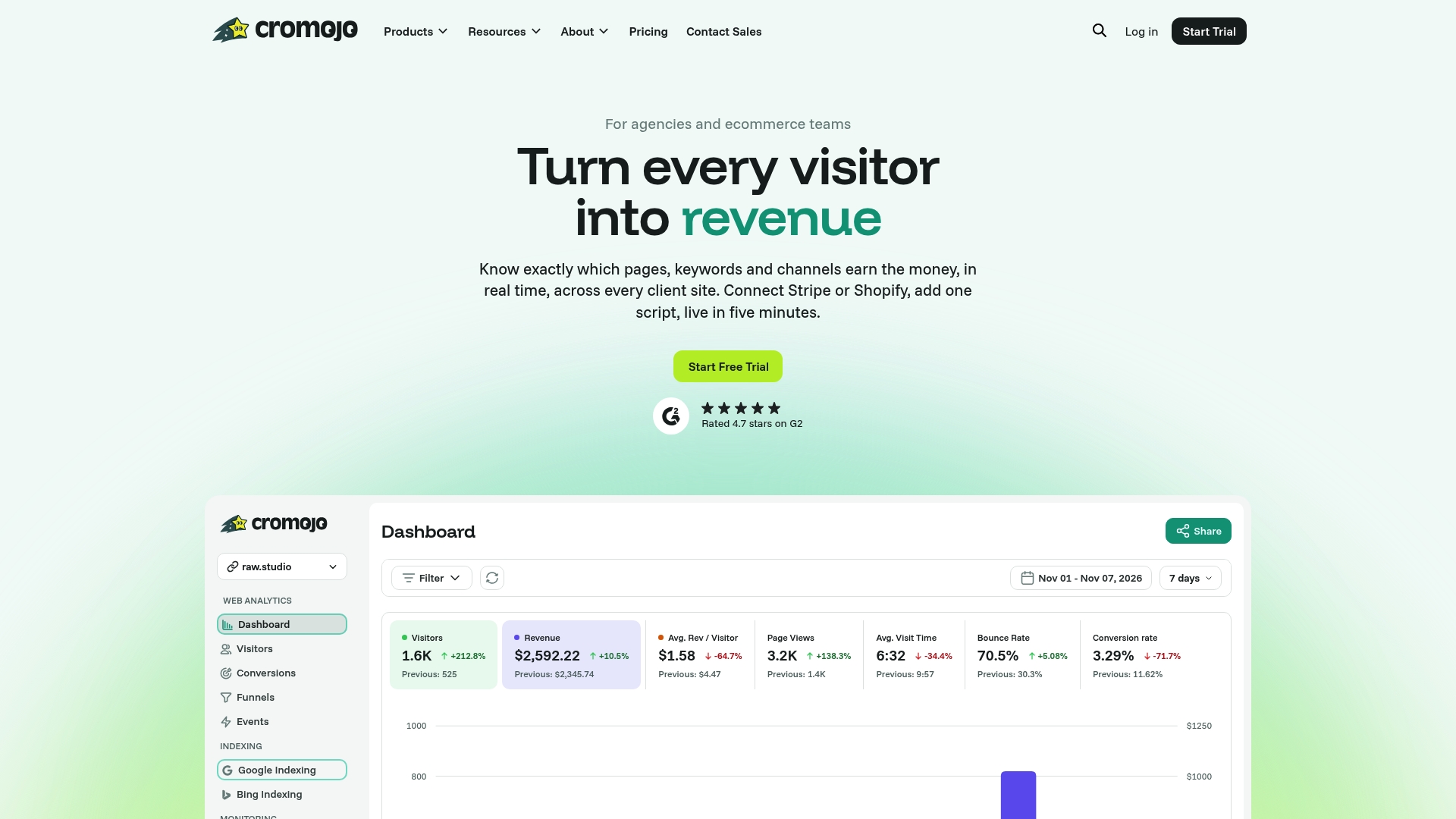
That same prioritization logic extends into the technical side of the playbook. Automated indexing and re-indexing push updated pages toward Google, Bing, and other AI search crawlers shortly after publishing a rewrite, reducing the lag between "I fixed the lead paragraph" and "the page is eligible for retrieval again." Site monitoring flags crawl errors and downtime before they quietly remove a page from the eligible pool altogether. Check the revenue attribution feature to see how page-level ROI data can reorder your next AI Overview sprint, and start a trial to see which of your pages deserve the rewrite first.