



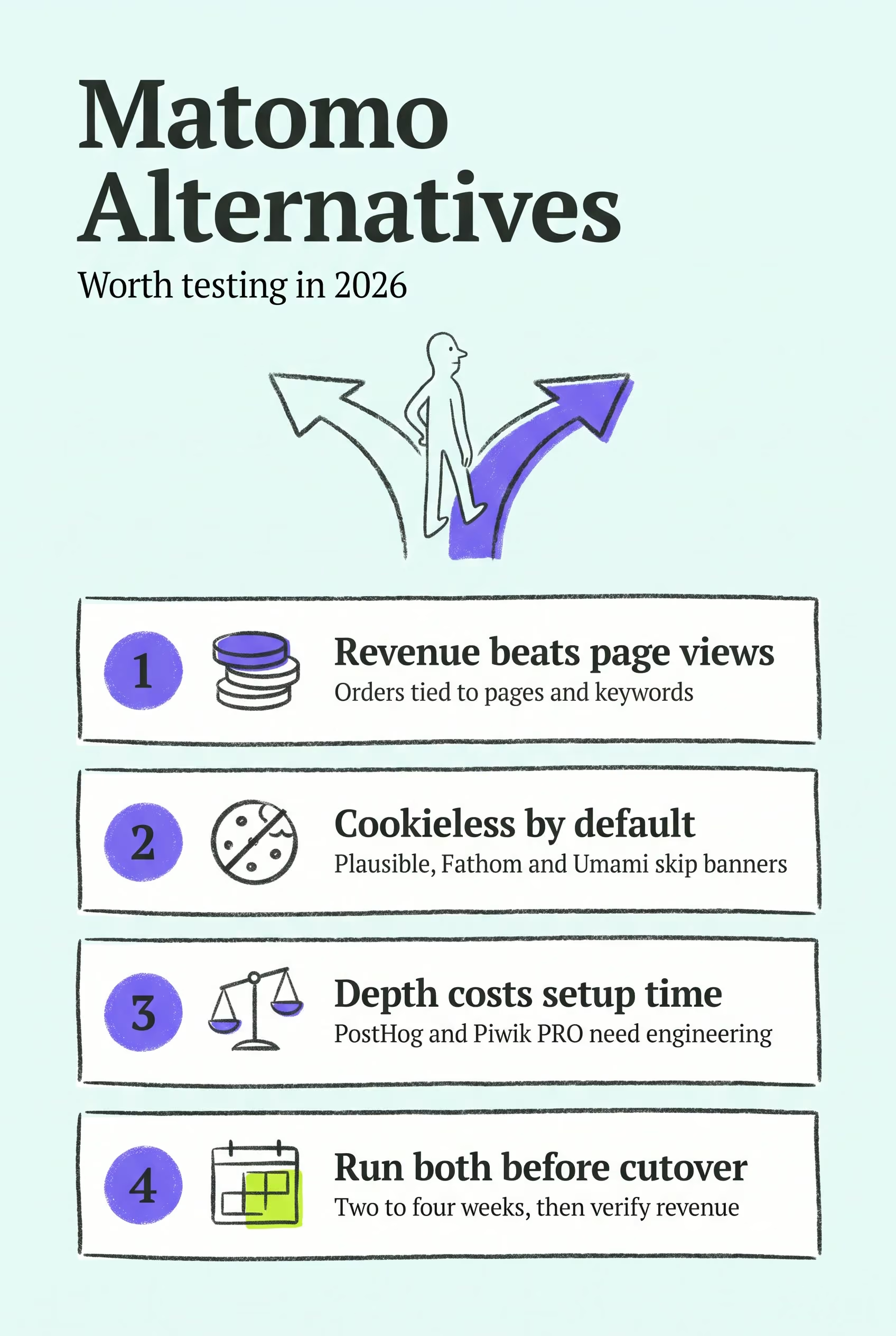
For ecommerce teams and agencies, Cromojo is the strongest Matomo alternative because it ties analytics directly to revenue, tracks visitors without cookies, and connects natively to Stripe and Shopify. If your priority is privacy without the ops burden, Plausible, Fathom, or Umami cover that ground well. If you need Matomo's full behavioral depth, PostHog or Piwik PRO come closest, though both ask more of your engineering time in return.
Matomo Alternatives Compared at a Glance
Choosing among Matomo alternatives usually comes down to three questions: how much you want to self-host, whether you need cookieless tracking by default, and whether you care more about page views or actual revenue. Those three questions sort the entire market into recognizable groups, and once you see the groups, picking a shortlist takes minutes instead of days.
Cromojo sits in a category of its own here. It's not trying to be a lighter Matomo or a self-hosted clone. It's built to answer a question none of these tools were originally designed to answer: which pages, keywords, and campaigns actually generate paid orders. That's a different job than counting sessions, and it shows in how the platform is structured, with Stripe and Shopify integrations doing the heavy lifting instead of a plugin marketplace.
The table below reflects publicly stated deployment models, privacy defaults, and feature depth for each platform, using pricing "shape" (free/self-hosted, flat fee, or usage-based) where exact figures aren't publicly standardized.
A few of these entries won't map cleanly onto every dimension. GoatCounter and AWStats, for instance, are so minimal that "feature depth" barely applies. That's fine. The point of the table isn't to force parity, it's to show you where each tool naturally lives.
Cromojo leads the pack for one specific reason: it's built around the buyer question that actually pays the bills, which is "which traffic turned into revenue," not just "how many people visited." The Gov guidance on tracking and consent obligations is a useful starting point if you're weighing privacy posture as a compliance question rather than just a UX preference, since cookieless defaults reduce (but don't eliminate) your exposure to consent requirements depending on jurisdiction.
Pro Tip: Don't judge "privacy-first" tools by their marketing copy alone. Ask each vendor directly whether their default configuration requires a consent banner in your specific market, because the answer often depends on what data fields you enable, not just the base script.
Three takeaways stand out once you look at the table as a whole.
- The closest drop-in replacements for Matomo's day-to-day reporting are Plausible, Fathom, and Simple Analytics, if you're willing to give up heatmaps and session recordings.
- No lightweight tool fully replicates Matomo's behavioral depth (heatmaps, session recordings, A/B testing) without adding a separate product like Hotjar or PostHog, according to comparative analyses of GA alternatives.
- If revenue attribution is your actual goal rather than a side benefit, none of the generic analytics tools on this list were built for it the way Cromojo was.
Buyers evaluating Matomo alternatives commonly weigh integration ease, support quality, and product capability against each other, and larger platforms like Google Analytics and Amplitude regularly show up on shortlists once teams outgrow simple page-view reporting, according to Gartner's vendor comparison data. That's useful context, but it also explains why so many teams end up running two or three tools at once instead of one.
What Each Matomo Competitor Actually Offers
Cromojo works differently from most of the names on this list. It's built to answer "what's making us money," attributing revenue in real time to specific pages, keywords, and channels, and syncing directly with Stripe and Shopify so an order shows up tied to the campaign that produced it. The tracking script is lightweight and cookieless, and Cromojo pairs that with automated site indexing and uptime monitoring, so a marketing team gets revenue data and technical health signals from one dashboard instead of three.

Google Analytics 4 remains the default choice for teams already deep in the Google ecosystem. Its integration with Google Ads and Search Console is unmatched among free tools, but its privacy posture depends on cookie consent in most jurisdictions, and its interface has a steeper learning curve than nearly everything else on this list.
PostHog and Piwik PRO are the two alternatives that come closest to matching Matomo's actual feature breadth. PostHog throws in feature flags, session replay, and experimentation tooling on top of its analytics core, which makes it attractive to product and engineering teams who want one tool instead of four, according to PostHog's own comparison of Matomo alternatives. Piwik PRO leans the other direction, toward enterprise governance: a built-in consent manager, granular access control, and hosting options built for regulated industries like finance and healthcare. Both typically require more setup time than a hosted, lightweight tool.
Plausible, Umami, Fathom, GoatCounter, and Simple Analytics form the "lightweight privacy-first" cluster. Plausible markets itself directly against Matomo on the strength of a small tracking script and cookieless-by-default operation that lets many sites skip a consent banner entirely, per Plausible's own comparison page. Umami and GoatCounter push that even further into self-hosted minimalism. GoatCounter ships as a single binary you can run almost anywhere, and Umami runs as a compact Node.js app that's genuinely easy to deploy on a weekend. Fathom and Simple Analytics take the opposite approach on ops: both are fully hosted, so you trade some control for a flat, predictable bill and zero server maintenance. None of these five will give you heatmaps or session recordings out of the box.
Mixpanel, Amplitude, and Hotjar aren't really Matomo replacements at all, they're specialists. Mixpanel and Amplitude are built for event-driven product analytics: funnels, cohorts, and retention curves that matter more to a SaaS product team than to a marketing team counting page views. Hotjar fills a different gap entirely, heatmaps, session recordings, and on-page surveys that show you how people behave, not just that they visited. Teams often run one of these alongside a lighter analytics tool rather than instead of one.
A handful of names round out the field for specific niches. Ackee and Open Web Analytics are smaller open-source projects with loyal followings among developers who want full code control. AWStats predates most of this list; it's a log-file analyzer still used on legacy hosting setups where installing a JavaScript tracker isn't practical. OpenPanel positions itself as a modern, developer-friendly self-hosted option, and a breakdown of self-hosted analytics trade-offs is worth a look if you're weighing that route. Countly and Woopra both target growth and product teams with event tracking similar to Mixpanel, while Heap automates event capture so you don't have to hand-code every tracking call. Clicky offers a real-time dashboard aesthetic that some agencies still prefer for client-facing reporting. MonsterInsights isn't a standalone analytics platform at all, it's a WordPress plugin that connects your site to Google Analytics, and its own roundup of Matomo alternatives is a useful reference if you're specifically on WordPress. Adobe Analytics closes out the list as the enterprise heavyweight, built for large organizations already inside the Adobe Experience Cloud, with a price tag and implementation timeline to match.
How Do You Choose the Right Matomo Alternative?
Run every candidate through the same checklist before you commit engineering time to a trial. The criteria that actually separate good fits from bad ones are:
- Revenue attribution: Can it tie a specific order back to the page, keyword, or channel that produced it, or does it stop at traffic counts?
- Privacy and compliance: Does it run cookieless by default, and does that hold up under your specific jurisdiction's rules, not just the vendor's marketing claims?
- Deployment model: Are you prepared to manage servers and updates yourself, or do you need a hosted product with zero ops?
- Integrations: Does it connect natively to Stripe, Shopify, or your CMS, or will you need custom development to wire it up?
- Event and funnel support: Can it track multistep conversion paths, or only single-page views?
- Data retention and export: Can you get your raw data out in a usable format if you switch again later?
- Script footprint: Does the tracking script add meaningful load time to your pages?
When you get vendors on a call, ask pointed questions: What format does data export come in? How does pricing scale once you cross their volume thresholds? Are advanced features locked behind paid plugins? Does the tool require third-party cookies to function, and if so, under what circumstances?
Watch for a few specific red flags. Unclear answers about who owns your historical data. Pricing pages that hide usage tiers until you've already signed up. A tracking script heavier than 20KB with no clear justification. No native ecommerce hooks, meaning you'll build custom event tracking from scratch. And any tool that quietly falls back on data sampling once you cross a traffic threshold, which distorts exactly the numbers you're trying to trust.
Pro Tip: If a vendor can't answer "what happens to our data if we cancel" in one sentence, that's your answer about data ownership, and it's worth walking away.
Your decision flow should follow your actual job, not a feature checklist. Ecommerce teams chasing revenue attribution belong with Cromojo or an enterprise platform like Piwik PRO. Teams with no dedicated ops resources and a privacy mandate belong with Plausible, Fathom, or Umami. Product teams optimizing user journeys belong with Amplitude or Mixpanel.
How Do You Migrate Away From Matomo?
Matomo lets you export raw data and reports through its API, and that export is your starting point for mapping events, goals, and custom dimensions onto whatever platform you're moving to. Most lightweight tools don't have a one-to-one equivalent for Matomo's custom reports or its heatmap and A/B testing modules, so flag those early rather than discovering the gap after cutover.
Run both systems in parallel for at least two to four weeks before you switch fully. That overlap period is the practical industry standard for verifying that event and ecommerce attribution stays consistent between the old and new platform. During that window, check three things closely: sessionization differences (tools define a "session" differently), unique visitor counts (consent banners filter volume differently across platforms), and whether ecommerce revenue numbers match within a reasonable margin.
A simple migration checklist:
- Export historical data and reports from Matomo's API before making any changes.
- Map every goal, event, and custom dimension to its closest equivalent in the new tool.
- Run both platforms simultaneously for several weeks.
- Verify ecommerce and revenue attribution numbers match within an acceptable range.
- Cut over only after your team has validated the new dashboard's numbers.
Why Cromojo Is Built Differently From a Typical Matomo Alternative
Cromojo's core design choice is treating revenue as the primary metric, not an afterthought bolted onto page views. Its Stripe and Shopify integrations attribute actual orders to the page, keyword, or campaign that produced them, which is a fundamentally different question than "how many people visited." That's paired with cookieless tracking, so privacy compliance isn't a separate project layered on top of analytics.
The gap between counting visitors and knowing which visitors paid you is the single biggest blind spot in most analytics stacks. Cromojo closes it by treating revenue attribution as the default report, not a custom build.
Beyond attribution, Cromojo bundles automated website indexing and re-indexing across Google, Bing, Yandex, and Baidu, along with uptime and SEO health monitoring, conversion funnels, visitor journey mapping, and advanced segmentation. For a small ecommerce team, that combination targets three measurable outcomes: faster revenue attribution than manually reconciling Stripe data against traffic reports, less integration time than wiring together separate analytics and monitoring tools, and a privacy posture that doesn't require a legal review before launch.
What Should You Actually Pilot First?
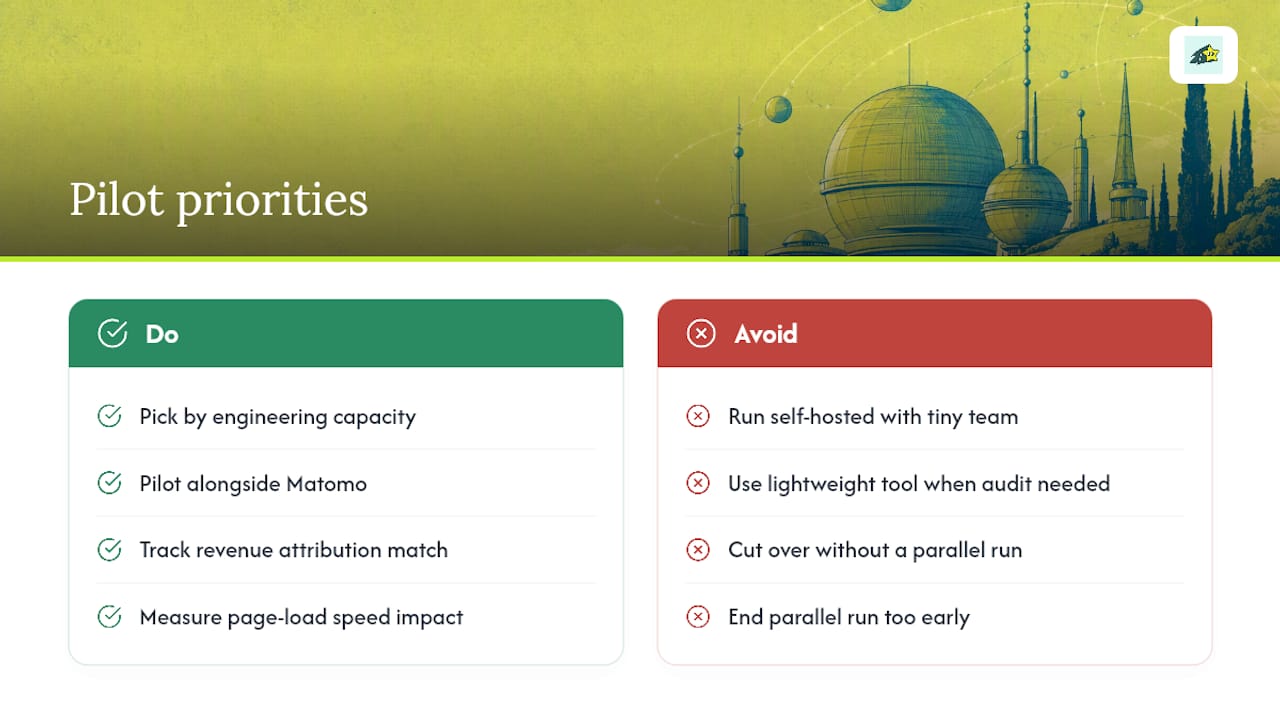
If your team is choosing between a lightweight privacy tool and a fuller self-hosted platform, the decision usually comes down to how much engineering time you have this quarter, not which tool has more features on paper. A two-person marketing team has no business running a self-hosted Piwik PRO instance. A funded engineering org with compliance requirements has no business relying on a tool that can't produce an audit trail.
Whatever you pick, pilot it alongside Matomo rather than cutting over blind. Track two numbers specifically: how closely revenue attribution matches your payment processor's own records, and whether the new script measurably affects page load speed. The most common mistake isn't picking the wrong tool. It's abandoning the parallel-run period too early, before consent-driven volume differences have had time to show up in the data.
- Philippe
Get Revenue Attribution Right With Cromojo
The tools compared above each solve one piece of the analytics puzzle: privacy, self-hosting, or product behavior. Cromojo is built to solve the piece that actually affects your bottom line, connecting every dollar in Stripe or Shopify back to the exact page, keyword, or campaign that earned it, without adding a cookie banner to your checkout flow.
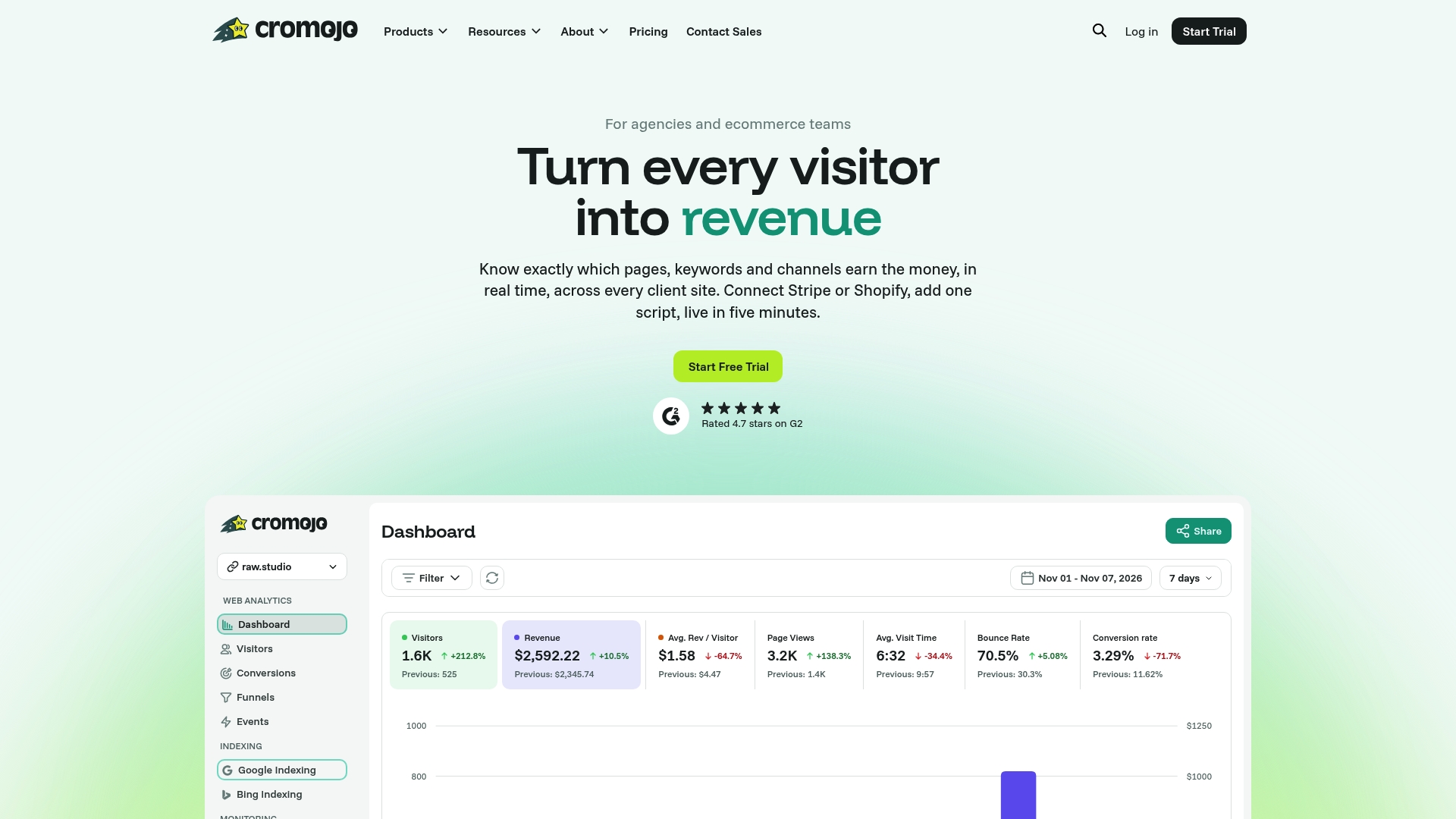
That means less time reconciling spreadsheets and more confidence that your marketing budget is going toward channels that convert, not just channels that get clicks. Cromojo's revenue attribution feature plugs into your existing Stripe or Shopify setup in minutes, with a lightweight, cookieless script that won't slow down your storefront. If you're currently weighing Cromojo against a tool like Simple Analytics, this comparison walks through exactly where the two diverge. Start a trial and see which pages are actually driving your next sale.