




For ecommerce teams, we recommend starting with Cromojo: it connects revenue directly to pages, keywords and channels in real time, integrates natively with Stripe and Shopify, and tracks without cookies. For complex B2B funnels, Dreamdata and HockeyStack handle account-level journey mapping better, while Google Analytics 4 still works as a free baseline layer. Below, we break down the shortlist, the buying checklist and what to expect from each platform.
Top Revenue Attribution Tools to Evaluate
Before you commit budget to any platform, it helps to see how the main contenders stack up against each other on a single page. Each tool below earns its spot for a different buying scenario, from ecommerce revenue tracking to long B2B sales cycles.
- Cromojo: best for ecommerce teams that want real-time, page- and keyword-level revenue attribution tied directly to Stripe or Shopify.
- Dreamdata: best for B2B teams mapping multi-stakeholder account journeys into pipeline and revenue.
- HockeyStack: best for B2B SaaS teams that want unified website, product and pipeline reporting in one dashboard.
- Ruler Analytics: best for teams that need to stitch offline conversions, like phone calls, back to digital campaigns.
- Triple Whale: best for direct-to-consumer brands optimizing ad spend against measured return.
- Google Analytics 4: best as a free, broad-coverage attribution layer before investing in a dedicated platform.
- Adobe Analytics: best for large enterprises that need custom modeling and tight data governance.
- Branch: best for mobile app teams tracking installs and in-app conversion paths.
- SegMetrics: best for content and funnel-driven teams that want segmentation baked into revenue reporting.
- Northbeam: best for ecommerce teams that prioritize signal aggregation across ad platforms.
If your sales happen through a webshop and get paid through Stripe or Shopify, Cromojo is the one to pilot first: it was built around that exact workflow rather than adapted to it. Pricing across this category tends to follow one of three shapes: usage-based tiers scaled by traffic or events, flat platform fees with add-on modules, or enterprise quotes gated behind a sales call. We cover concrete numbers, where they're published, in the vendor-by-vendor section below.
Vendor-by-Vendor Reviews: What Each Tool Gets Right
Here is how each platform earns its place on this list, with the integration and pricing signals that matter most when you're narrowing a shortlist.
- Cromojo. We built Cromojo around a simple frustration: most analytics tools tell you about traffic, not revenue. It connects directly to Stripe and Shopify to help relate observed sales to pages, keywords, and channels under its measurement rules, and the attribution updates in real time rather than overnight. Conversion funnels and visitor journey analysis sit alongside goal tracking and advanced segmentation, so a team can see not just that revenue happened but which step in the journey mattered. Cookieless tracking can reduce dependence on cookies, but does not guarantee complete data or remove every consent requirement. Review the actual implementation and applicable requirements. Automated indexing and site monitoring round out the platform, flagging downtime or SEO issues before they quietly cost conversions. Pricing runs Starter at $19 per month, Pro at $49, Business at $129, and Agency at $299, with Conversion Optimization Services available from $3,800 per month for teams that want hands-on funnel work.
- Dreamdata. For B2B teams running long, multi-stakeholder sales cycles, Dreamdata's strength is account-level journey mapping. Rather than attributing a single conversion to a single visit, it reconstructs the path an entire buying committee took across months, tying it back to CRM data. This fits companies where a single deal touches six-figure revenue and multiple decision-makers before a contract is signed.
- HockeyStack. HockeyStack pitches itself as a unified layer across website, product usage and pipeline data, which matters for B2B SaaS teams trying to connect marketing activity to actual revenue outcomes rather than just leads. No-code dashboards mean marketing ops can build views without pulling in engineering, a point the platform itself emphasizes in its own attribution software comparison.
- Ruler Analytics. When a meaningful share of your pipeline starts with a phone call, standard digital attribution misses it entirely. Ruler Analytics closes that gap by linking offline conversions back to the campaigns that generated the call or form fill, which makes it a natural fit for service businesses and sales-assisted B2B.
- Triple Whale. Triple Whale focuses squarely on ecommerce, building dashboards that connect ad spend to revenue so merchants can judge return on ad spend without exporting data into a spreadsheet. It fits teams running heavy paid acquisition across multiple ad platforms at once.
- Google Analytics 4. GA4 remains the default starting point for most marketing teams because it's free and already installed almost everywhere. It supports data-driven attribution, which distributes credit across touchpoints based on account data rather than crediting only the first or last click, and its model comparison report lets you see how different attribution models would change your numbers. The tradeoff is that GA4 was built for broad web analytics, not revenue-first ecommerce reporting, so most teams eventually layer a dedicated tool on top once revenue tracking needs get specific.
- Adobe Analytics. Enterprises with dedicated analytics teams and complex data governance requirements tend to land on Adobe Analytics for its custom modeling capability and depth of control. It demands more setup and internal expertise than most of the tools on this list, which is exactly why it suits large organizations rather than lean marketing teams.
- Branch. Mobile-first businesses need attribution that understands deep links and app installs, not just web sessions. Branch specializes in exactly that, tracking a user from an ad click through an app install and into in-app conversion events.
- SegMetrics. SegMetrics leads with segmentation, letting content and funnel-driven teams break revenue data down by audience segment rather than treating every visitor the same way. This suits businesses running email-heavy or content-heavy funnels where the path to purchase varies widely by segment.
- Northbeam. Northbeam aggregates signals across ad platforms to give ecommerce teams a clearer optimization picture when platform-reported numbers disagree with each other, a common problem once a brand runs campaigns across three or four channels simultaneously.

How to Choose the Right Revenue Attribution Tool for Your Stack
The right tool depends less on brand reputation and more on what your sales motion actually looks like. A direct-to-consumer brand selling through Shopify has almost nothing in common, measurement-wise, with a B2B company closing six-figure deals over four months.
Start by defining what you're actually trying to measure: raw revenue attribution per channel, campaign-level return on ad spend, or a broader marketing mix model that accounts for brand and offline effects. Each goal points toward a different category of tool. Then map your required data sources: do you need CRM data, ecommerce and payment platforms, ad platform exports, or offline conversion events like phone calls? A tool that can't ingest your actual data sources is disqualified regardless of how polished its dashboard looks.
Before signing anything, run through this checklist:
- Native integrations: confirm direct connections to your CRM, Shopify or other ecommerce platform, and payment processor like Stripe, not just generic webhook support.
- Offline touchpoint support: if phone calls or in-person sales matter to your pipeline, confirm the tool can ingest them.
- Attribution model flexibility: look for data-driven or custom multi-touch models rather than last-click only, as independent attribution software reviews consistently flag model flexibility as a top differentiator.
- Cookieless or server-side tracking: this protects your data as browsers tighten third-party cookie restrictions.
- Real-time reporting: revenue data that updates overnight is already a day behind the decisions you need to make.
When you talk to vendors, ask pointed questions: where does the underlying data come from and how is it reconciled across sources, how long does onboarding actually take versus what the sales deck claims, what sample size does their data-driven model need before it's statistically reliable, and is there API access if you need to pull data into your own warehouse later.
Implementation timelines vary by category. A revenue-first ecommerce tool with prebuilt Stripe and Shopify connectors can often go live within days. A B2B platform that needs CRM mapping and custom account definitions typically takes several weeks of onboarding. Pricing shapes follow the same split: ecommerce tools commonly scale with pageviews, events or tracked sites, while enterprise B2B platforms often price by seats or require a custom quote.
Pro Tip:Run a short 4-6 week pilot on a single funnel or campaign before rolling a new attribution tool out company-wide. Treat this as a starting plan, not a universal duration; a long sales cycle may require a longer observation window.
How We Selected and Evaluated Tools for This Roundup
We built this shortlist around one question: can this tool actually tell a marketing team which touchpoints generated real revenue, not just which ones generated traffic or leads.
- Attribution capability: we prioritized tools with demonstrated revenue or pipeline attribution features, not generic web analytics alone.
- Integration depth: native connections to CRM, ecommerce platforms and payment processors counted more than generic data export options.
- Market presence: we drew on independent attribution software testing and B2B multitouch attribution market reviews to ground category placement in documented buyer feedback rather than vendor claims alone.
- Relevance to revenue measurement: tools squarely built for ecommerce revenue tracking or B2B pipeline mapping were weighted over adjacent tools that only touch attribution tangentially.
This is an editorial shortlist of ten tools, not an identical hands-on benchmark. It combines vendor documentation and published category reviews. Category fit is a starting point rather than an objective best-tool ranking. Confirm current features, pricing, integration depth, and measured results with a pilot using your own data.
Cromojo's Fit for Revenue-First Ecommerce Teams
Cromojo focuses on relating observed website activity to revenue using ecommerce and payment integrations. Confirm the supported Stripe or Shopify workflow, attribution rules, and data coverage for your setup. Reconcile matched transactions with store records and report unattributed revenue rather than assuming every transaction has an observable marketing source.
- Real-time revenue attribution shows which pages and keywords generate sales as they happen, not the next morning.
- Conversion funnels and visitor journey analysis reveal where buyers drop off before completing a purchase.
- Cookieless tracking keeps data flowing even as browsers restrict third-party cookies and privacy rules tighten.
- Automated indexing and site monitoring catch SEO and uptime issues that quietly suppress organic revenue.
Setup runs through a lightweight script that drops into any site stack without a developer sprint, and most teams start seeing attributed revenue data within the first browsing sessions after install. During a pilot, the signals worth watching are whether top-revenue pages match your assumptions, whether funnel drop-off points align with what your team already suspected, and whether the Stripe or Shopify revenue numbers match your existing financial reports within a reasonable margin.
Integration checklist: demonstrate a real order or CRM record flowing into reporting, and check refunds, duplicate events, currencies, timestamps, and unmatched records. A native connector can reduce manual work but does not remove the need for reconciliation.
Comparing User Experience and Setup Across Tools
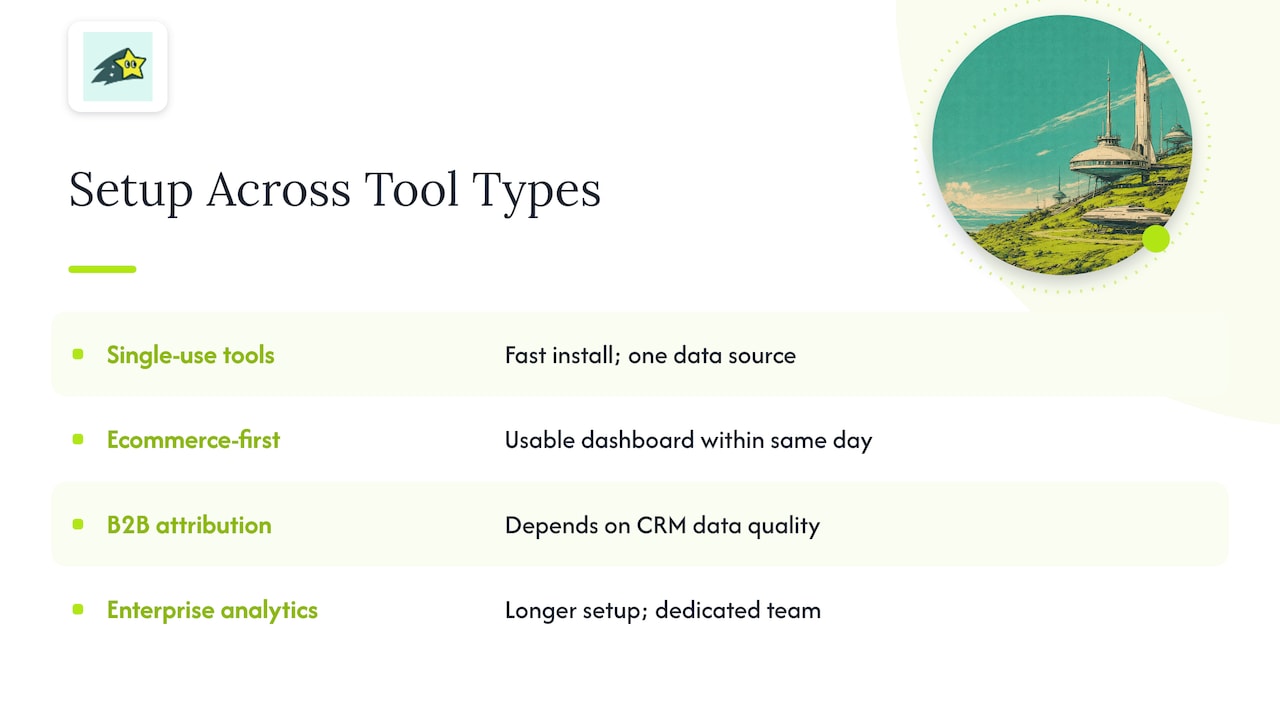
Setup friction varies sharply across this category, and it tracks closely with how narrow or broad each tool's job is. Platforms built for a single use case, like call tracking or QR attribution, tend to install fast because they only need one data source connected. Broader platforms that span CRM, ecommerce, ad platforms and offline data inherently need more configuration before the numbers mean anything.
Ecommerce-first tools with prebuilt Shopify and Stripe connectors tend to be the fastest to a usable dashboard, often within the same day, since there's no custom field mapping required. Enterprise analytics platforms like Adobe Analytics sit at the other end: the depth of customization that makes them powerful for large teams also means a longer configuration process, usually involving a dedicated implementation team. B2B attribution tools that map CRM data into account journeys fall in between, since they depend on how clean and consistent the underlying CRM data already is. A messy CRM extends onboarding regardless of how good the attribution tool itself is.
Case Studies and Examples of Attribution-Driven Decisions
Revenue attribution earns its budget line when it changes a real decision, not when it just produces a prettier report. A common pattern across ecommerce teams: once page- and keyword-level revenue data is visible in real time, marketing teams reallocate ad spend away from channels that drive traffic but not purchases, and toward the handful of landing pages that consistently convert.
For B2B teams, account-level journey mapping can help examine observed touches across a buying committee. Attribution assigns credit according to data and model rules; it does not establish causal influence on a deal. Use incrementality tests or other causal evidence when the decision requires proof of lift.
Support and Customer Service Quality
Support quality is one of the more unpredictable variables across this category, and it's worth weighing before you commit to an annual contract. Vendor reviews on platforms like G2 repeatedly surface integration help and onboarding responsiveness as recurring themes in buyer feedback, which suggests these are the moments when support quality matters most, not just when something breaks later.
Smaller, focused tools often respond faster simply because their support teams handle a narrower set of questions. Enterprise platforms tend to offer dedicated account management but can be slower to resolve a specific technical question, since requests often route through multiple tiers before reaching someone with the right access. When you're evaluating a vendor, ask directly about onboarding scope: whether setup help is included in the price, how quickly a technical ticket typically gets a first response, and whether there's a dedicated contact during the first weeks of rollout. Those details affect time-to-value more than almost any feature on a spec sheet.
Data Privacy and Compliance Beyond Cookieless Tracking
Cookieless tracking solves one piece of the privacy puzzle, but it isn't the whole picture. Server-side event collection, where data passes through your own server rather than a third-party script running in the visitor's browser, is becoming a common complement to cookieless approaches because it gives you more control over what gets collected and where it's processed.
Beyond the technical mechanism, look at how a vendor handles data retention, whether visitor-level data can be deleted on request, and whether the platform processes data in a way that aligns with regional privacy rules relevant to your customer base. A platform that's transparent about where data lives and how long it's kept makes compliance conversations with legal or security teams considerably shorter. This matters just as much for a small ecommerce shop as for an enterprise, since privacy expectations from customers don't scale down with company size.
Where Attribution Is Headed and What to Prioritize Now

Our honest read: most teams still over-invest in model sophistication and under-invest in data plumbing. A perfectly tuned multi-touch model built on incomplete CRM data or cookie-blocked sessions will always produce a confident, wrong answer. Fixing data quality at the source, clean CRM fields, consistent UTM tagging, server-side event collection, pays off more than chasing a marginally more elegant attribution formula.
Privacy will keep forcing the issue. Browsers will keep restricting third-party cookies, so the tools that support both client-side and server-side tracking will age better than those that depend solely on cookies. For B2B teams with long sales cycles, single-touch reporting was never a good model and matters even less now; account-level mapping that ties CRM activity to revenue will keep winning out over last-click attribution. For ecommerce teams, the decisive factor through 2026 will be speed: real-time revenue signals that let a team shift budget within the week, not after the monthly report lands, are what separate teams that compound small wins from teams that just collect dashboards. A broader look at revenue growth priorities for business leaders echoes this same shift toward measurement that drives faster decisions rather than more detailed ones.
Try Cromojo for Revenue-First Attribution
If your revenue runs through Shopify or Stripe, evaluate Cromojo against the pages, channels, and revenue questions your team needs to answer. Confirm the current integration and measurement behaviour before rollout, and review attribution coverage alongside your store records.
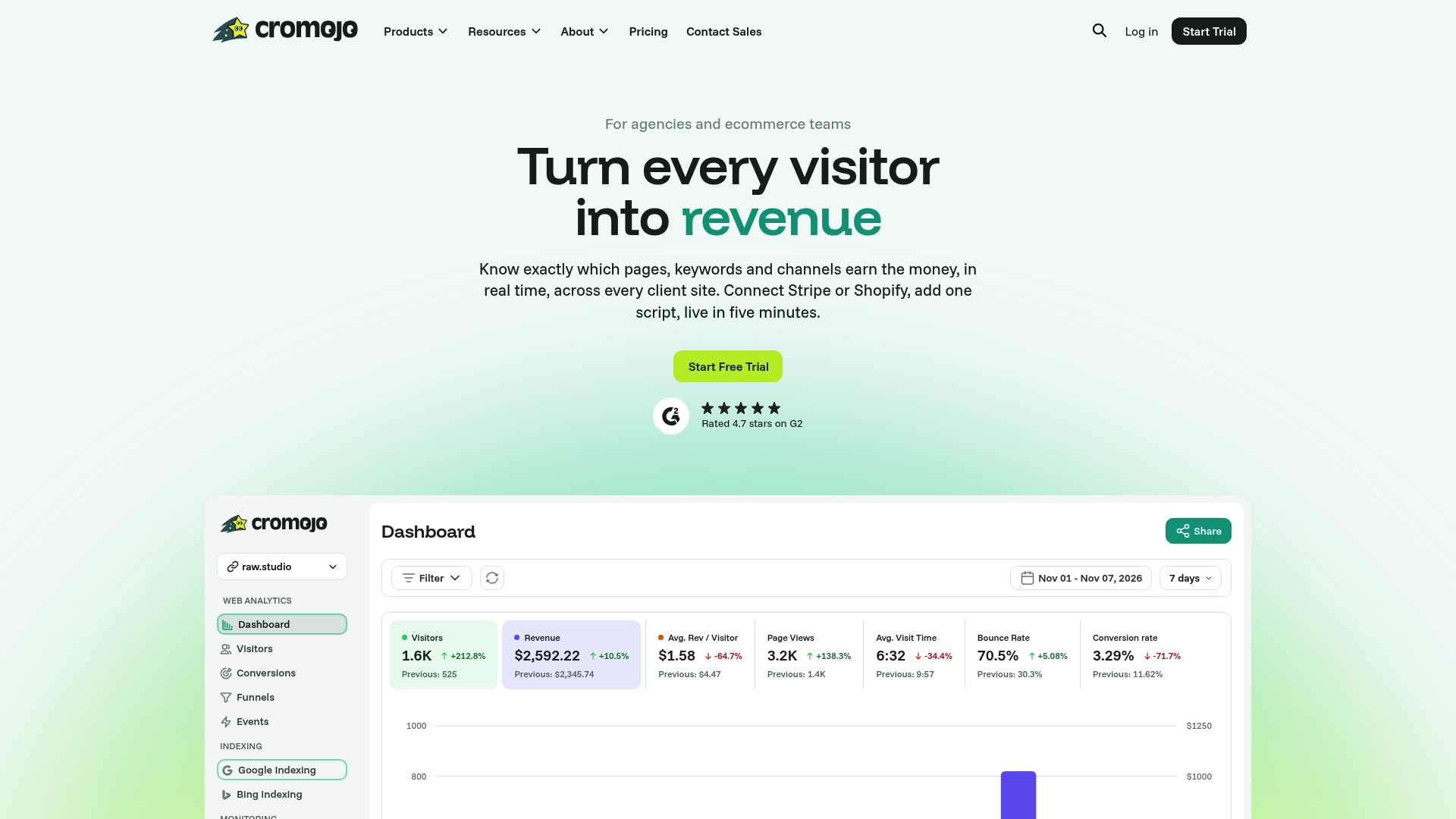
Getting started doesn't require an engineering project. The tracking script is lightweight enough to drop into any site stack, and most teams see attributed revenue data within the first sessions after install.
- Start free and connect your Stripe or Shopify account to see real revenue data against your top pages and keywords.
- Compare plans on the Cromojo pricing page, from Starter at $19 per month up to Agency at $299 per month.
- Explore the feature set on the revenue analytics page if you want the technical detail before signing up.
- Request Conversion Optimization Services, available from $3,800 per month, if you want our team hands-on in your funnel rather than self-serve.
Whichever path fits your team, the next concrete step is the same: connect your payment data and see your first real revenue report.