

Generative engine optimization (GEO) is the practice of structuring content so AI systems like Google's AI Overviews, ChatGPT, and Perplexity cite you as a source. Your first move is a crawlability audit: confirm your key pages are indexable, then rewrite your most important paragraphs into self-contained, factual statements a language model can lift cleanly. Google's own guidance and academic research on GEO both back this approach.
What Is Generative Engine Optimization?
Generative engine optimization means shaping your content, entities, and technical setup so AI-driven answer engines quote, summarize, or cite your pages instead of routing a click to you. You'll see it labeled a few different ways depending on who's writing: answer engine optimization (AEO) and LLM optimization (LLMO) get used almost interchangeably, and Wikipedia's own entry notes the terminology hasn't settled into one agreed definition yet.
The term picked up steam once AI Overviews and chat-based search started answering queries directly on the results page, cutting into traditional organic clicks. That shift changed the actual prize: getting referenced inside an AI-generated answer.
The evidence that GEO tactics move the needle is real. An academic evaluation published on arXiv found that applying GEO techniques, like adding citations, statistics, and clearer structure, boosted visibility in generative engine outputs by as much as 40% in controlled tests. That's the kind of lift that justifies rebuilding your content workflow around it.
Three terms worth knowing before you go further:
- GEO (generative engine optimization): optimizing to be cited inside AI-generated answers.
- AEO (answer engine optimization): a near-synonym focused on direct-answer formats.
- LLMO (LLM optimization): optimizing specifically for how large language models retrieve and summarize content.
How Does GEO Differ From Traditional SEO?
GEO doesn't replace SEO. It sits on top of it and changes what "success" looks like. Traditional SEO chases rank position and click-through rate. GEO chases citation frequency, being the source an AI model pulls from when it answers a question, even when the reader never visits your site.
That reframing matters because a16z's analysis of the shift describes it as moving from a rank-based model to a reference-based one. Instead of asking "did we hit position one," the better question becomes "how often do generative engines reference us as an authority."
What hasn't changed:
- Technical SEO fundamentals: site speed, mobile usability, clean architecture.
- Content quality and depth still decide whether a page is worth citing at all.
- Backlinks and domain authority still shape how trustworthy a source looks.
One misconception worth killing early: there's no secret AI-only file or hack that unlocks citations. Google's own guidance states plainly that standard SEO best practices are the foundation for visibility in generative features, not some special markup layer.
What Are the Core Principles of GEO Strategy?
Practitioner frameworks from outlets like Search Engine Land converge on the same five pillars, regardless of which AI platform you're targeting. Building your content strategy around these gives you a repeatable system instead of a pile of one-off tactics.
- SEO foundation. Crawlable, fast, well-structured sites remain the entry ticket. No amount of clever prompting fixes a site Google can't index.
- Entity clarity. Make it unambiguous who you are and what you cover. Consistent naming, schema where it helps, and clear author attribution reduce the guesswork an AI model has to do.
- Extractability. Write paragraphs that stand alone as a complete fact or answer. If a sentence needs three paragraphs of context to make sense, an AI system will skip it.
- Multi-platform presence. Show up on review sites, forums, YouTube, and industry directories, not just your own domain. Generative engines cross-reference sources.
- Reputation and mentions. Being talked about elsewhere, in press coverage, guest posts, community answers, signals to a model that you're a credible reference point.
Pro Tip:Structure author bios with a real name, a specific credential, and a link to a body of work on the topic. Vague bios like "our marketing team" give an AI system nothing concrete to anchor authority to.
What Technical Setup Do AI Systems Need to Find You?
None of this works if your pages aren't reachable in the first place. Run through this checklist before touching a single sentence of copy:
- Confirm pages return a 200 status and aren't blocked by robots.txt or a stray
noindextag. - Check that content renders in server-side HTML, not just client-side JavaScript. Some AI crawlers don't execute JS the way modern browsers do.
- Keep your XML sitemap current and submit it through Search Console and Bing Webmaster Tools.
- Set clean canonical tags so duplicate or paginated URLs don't dilute which version gets cited.
- Add structured data (FAQ schema, Article schema) where it genuinely clarifies content type. It helps, but it isn't required.
- Skip the llms.txt file unless you understand it's speculative. Google's guidance confirms no special AI-only file is necessary.
- Resist the urge to slice content into dozens of thin "chunked" pages purely to game extraction. Google explicitly warns against this kind of scaled content abuse, and it tends to hurt more than it helps.
How Do You Measure GEO Success?
Citation frequency, how often your brand or pages get referenced in AI-generated answers, is the headline metric. Beyond that, track AI share of voice against competitors, the specific query contexts that trigger a mention, and whether the sentiment attached to your citation is favorable.

Google's Search Console now surfaces a generative AI performance report, and Bing Webmaster Tools offers comparable visibility into AI-driven impressions. Both are worth checking weekly, not quarterly.
The real gap in most GEO measurement: teams track mentions in isolation from revenue. Combining AI visibility data with page-level attribution is how you prove GEO work actually pays off, not just that it generates buzz.
- Citation frequency and AI share of voice by topic cluster
- Context triggers: which query types surface your brand
- Sentiment of the citation (neutral, favorable, corrective)
- Revenue tied to the specific pages generative engines are citing, tracked through a revenue attribution platform
A 7-Step Action Plan to Start Ranking in AI Search
Treat this as a rolling checklist, not a one-time sprint. GEO rewards consistency more than intensity.
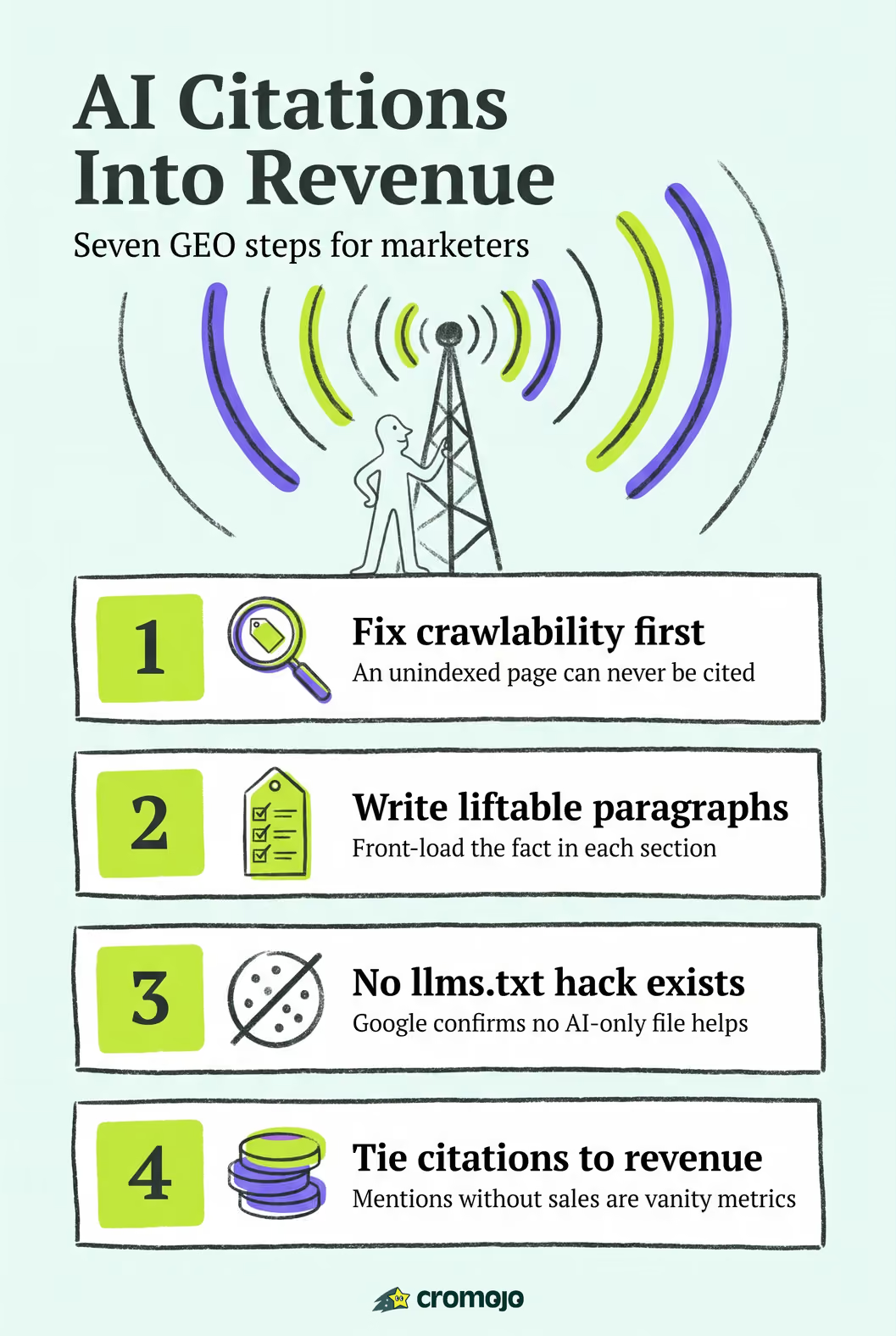
- Run a crawl and index audit. Fix blocked pages, broken canonicals, and JS-rendering gaps before anything else. If Google can't crawl it, no AI engine can cite it.
- Rewrite your best paragraphs for extractability. Pull out the core fact, definition, or statistic in each section and put it in the first sentence, not buried three lines down. Backlinko's GEO guidance makes the same case: self-contained paragraphs with clear headings get pulled more often.
- Strengthen your entity pages. Flesh out your About page, add real author bios with credentials, and use consistent naming across your site and third-party profiles.
- Build mentions and co-citations. Pitch guest content, answer questions on industry forums, and pursue press coverage. Every credible external mention adds a data point an AI model can cross-reference.
- Publish across formats. Text, video, and images each get indexed and referenced differently. A YouTube explainer can get cited where a blog post gets ignored.
- Monitor generative reports and iterate. Check Search Console's AI performance data and Bing's AI reports monthly, then adjust which topics you're doubling down on.
- Connect citations to revenue. Use page-level attribution to see whether the pages generative engines cite are actually driving sales, not just impressions.
Pro Tip:Start with step one and step seven simultaneously. Fixing crawlability without a way to measure revenue impact means you'll never know which parts of your GEO work actually paid off.
How Cromojo Supports GEO in Practice
GEO only works if your pages stay indexable and if you can prove the citations matter financially. Cromojo's automated indexing tool resubmits pages to Google, Bing, Yandex, and Baidu automatically, so freshly rewritten, extractable content doesn't sit unindexed for weeks. Site monitoring catches downtime or errors before they quietly tank your AI discoverability.
The harder problem GEO teams face is proving value. Cromojo's revenue attribution maps which pages, keywords, and channels generate actual sales, so when a page starts pulling AI-driven traffic, you can see whether that traffic converts, not just whether it arrives.
Quarterly Priorities: What to Start, Pause, and Scale
Start now: fix crawlability gaps and rewrite your top ten pages into extractable, front-loaded paragraphs. That's cheap and fast. Pause blanket content production aimed at chasing keyword volume with no citation strategy behind it. Scale over the next two quarters: PR and co-citation campaigns, multi-format publishing, and tighter integration between AI visibility tools and revenue attribution, so every citation eventually ties back to a dollar figure.
Where to Learn More About GEO
Start with Google's generative AI optimization guide for the platform-level rules, the arXiv GEO evaluation for the research behind the tactics, and Search Engine Land's GEO explainer plus BabyLoveGrowth's GEO overview for practitioner detail.
Quarterly Priorities and What Actually Moves the Needle
Most GEO advice treats every tactic as equally urgent, which is exactly backwards. The single highest-leverage move for the average marketing team isn't entity clarity or multi-platform publishing, it's fixing crawlability. A page that isn't indexed can't be cited no matter how well the paragraphs are structured, yet teams routinely skip straight to rewriting copy because it feels more like "real work."
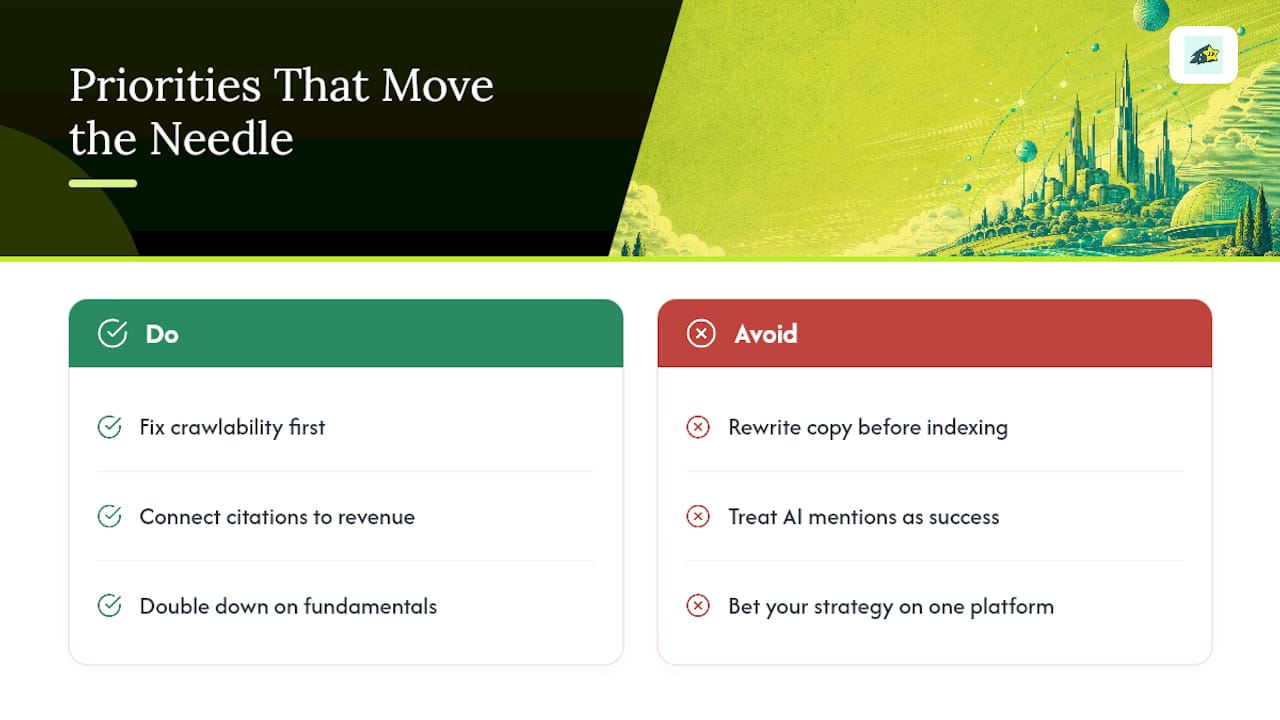
The other blind spot is measurement. Plenty of teams will proudly report a jump in AI mentions without ever connecting that mention to a sale. That's vanity metrics with a new coat of paint. GEO only earns its budget when someone can show a citation led to a page view led to a checkout. Ecommerce teams in particular should treat AI share of voice as an input to a revenue model, not a standalone success metric.
The honest challenge ahead is that generative engines change their retrieval logic faster than any SEO algorithm update in the past decade. Betting your entire strategy on one platform's current behavior is risky. The safer long-term posture is doubling down on content quality, entity clarity, and genuine reputation, the fundamentals that hold up regardless of which model is doing the citing next year.