
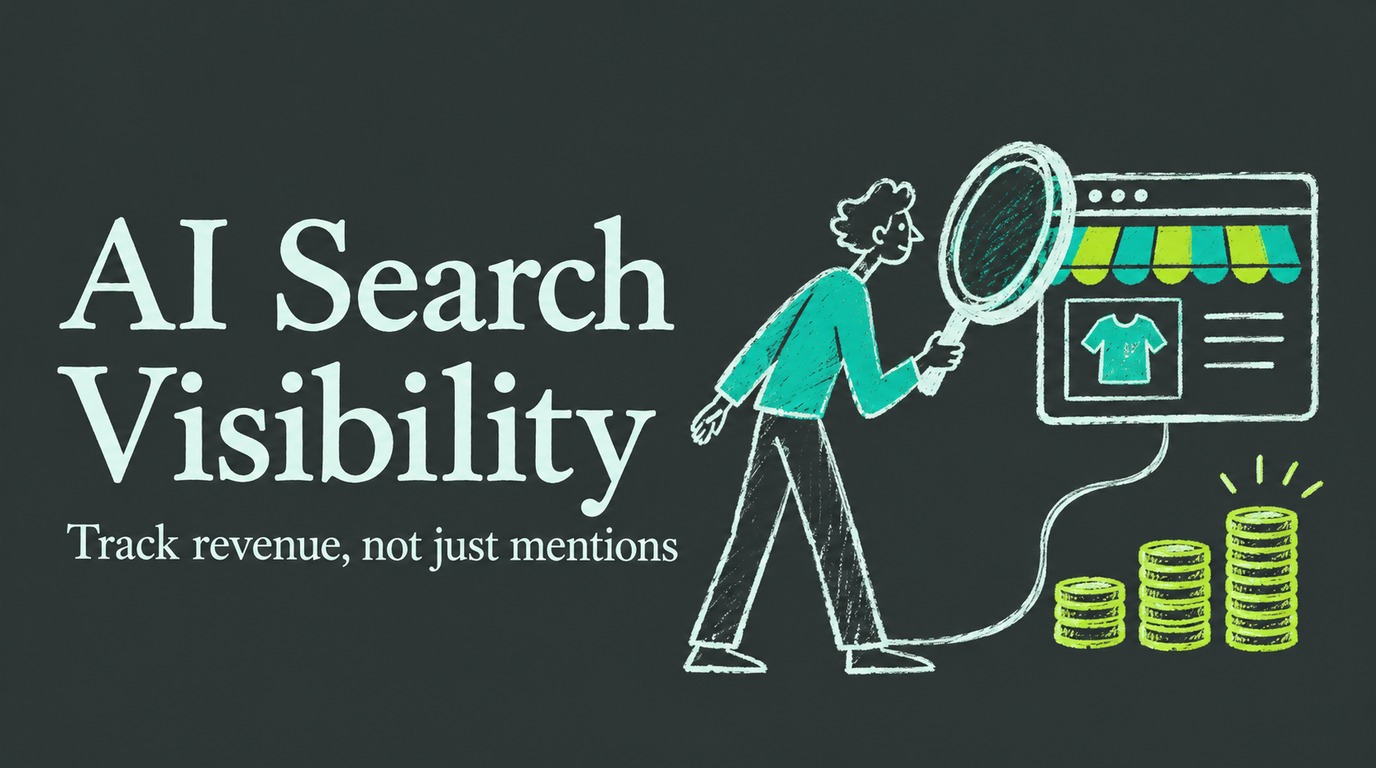

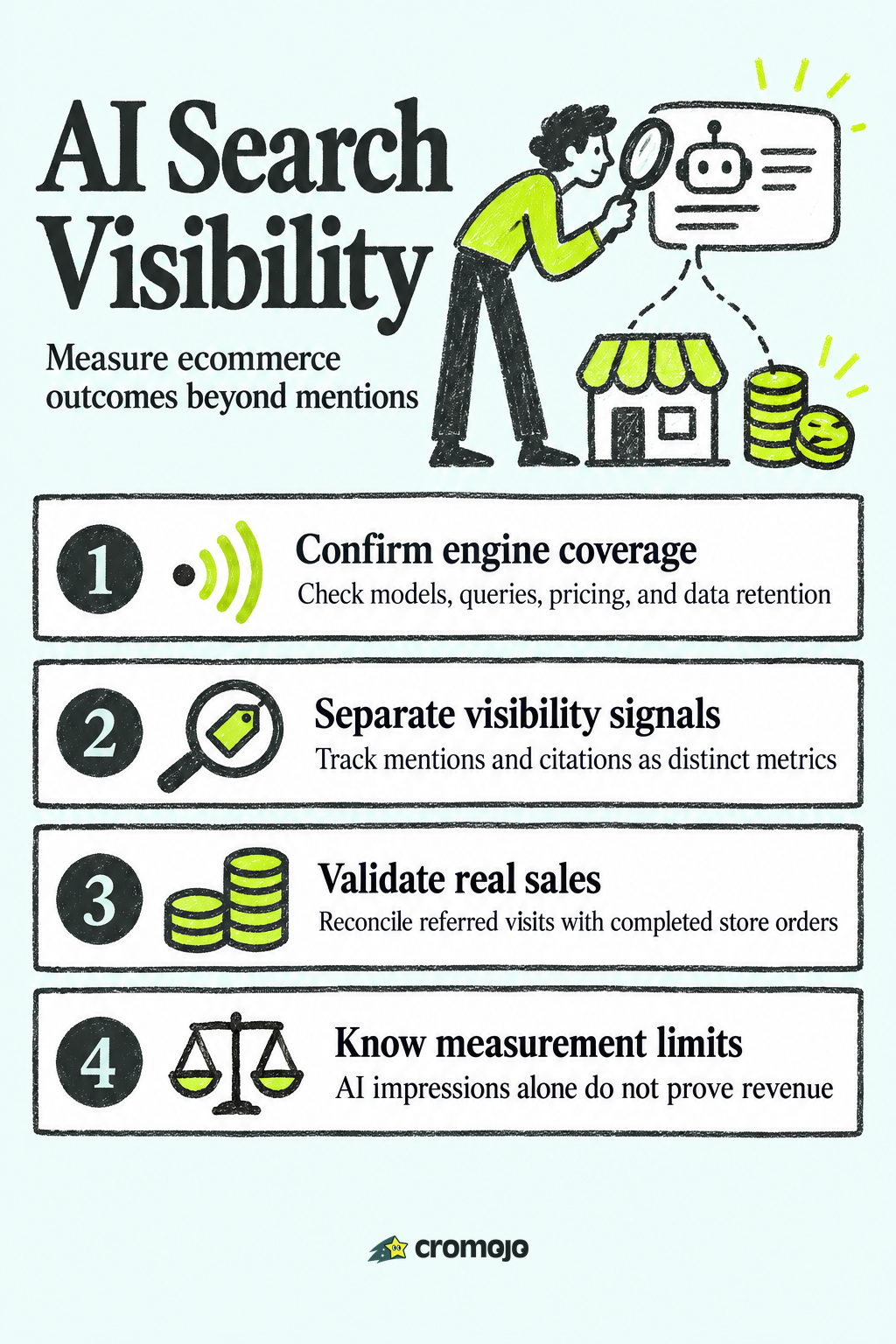
For ecommerce teams, AI search visibility is useful when it informs actions and measurable sales outcomes. Compare engine coverage and citation tracking alongside your ability to fix site issues and measure referred visits and purchases. Start with Search Console for Google visibility, then check which additional engines your team needs to monitor.
.jpg)
What AI search visibility tools do and why GEO matters to your revenue
AI search visibility tools track whether your brand, products, or content show up when people ask ChatGPT, Gemini, Perplexity, or Google's AI Overviews a question. That's a different job than traditional rank tracking, which watches where you land on a results page for a given keyword. Generative engines don't return ten blue links, they synthesize an answer from multiple sources, often without a click at all.
That shift matters more than it might first appear. Gartner predicted that traditional search engine volume could drop by as much as 25% by 2026 as chatbots and virtual agents absorb queries that used to go to a search box. On top of that, Pew Research found that Google users click on fewer links when an AI summary appears in the results. Put those two findings together and the picture is clear: fewer searches are landing on traditional result pages, and even when they do, fewer people click through. Being named inside the AI answer itself is becoming the visibility that counts. Gartner's figure is a forecast, not a measured 2026 outcome, and Pew's finding describes its study sample rather than every ecommerce site.
This is generative engine optimization, or GEO: the practice of making sure your content gets pulled into AI-generated answers rather than just ranked below them. Marketing teams that treat GEO as an extension of SEO, not a replacement for it, tend to adapt faster.
A useful AI visibility tool should walk you through three stages:
- Observation: it shows you which engines mention your brand, for which queries, and how often.
- Diagnosis: it explains why you're missing from an answer, whether that's thin structured data, weak page authority, or a competitor with a more citable source.
- Action: it helps you fix the gap, through schema updates, reindexing, or content changes, without waiting weeks for the next crawl cycle.
Tools that stop at observation leave you with a report and no lever to pull. The ones worth paying for close that loop and tie the fix back to a measurable outcome, which for an ecommerce team usually means revenue, not just impressions.
How mentions, citations, and structured signals shape your AI visibility
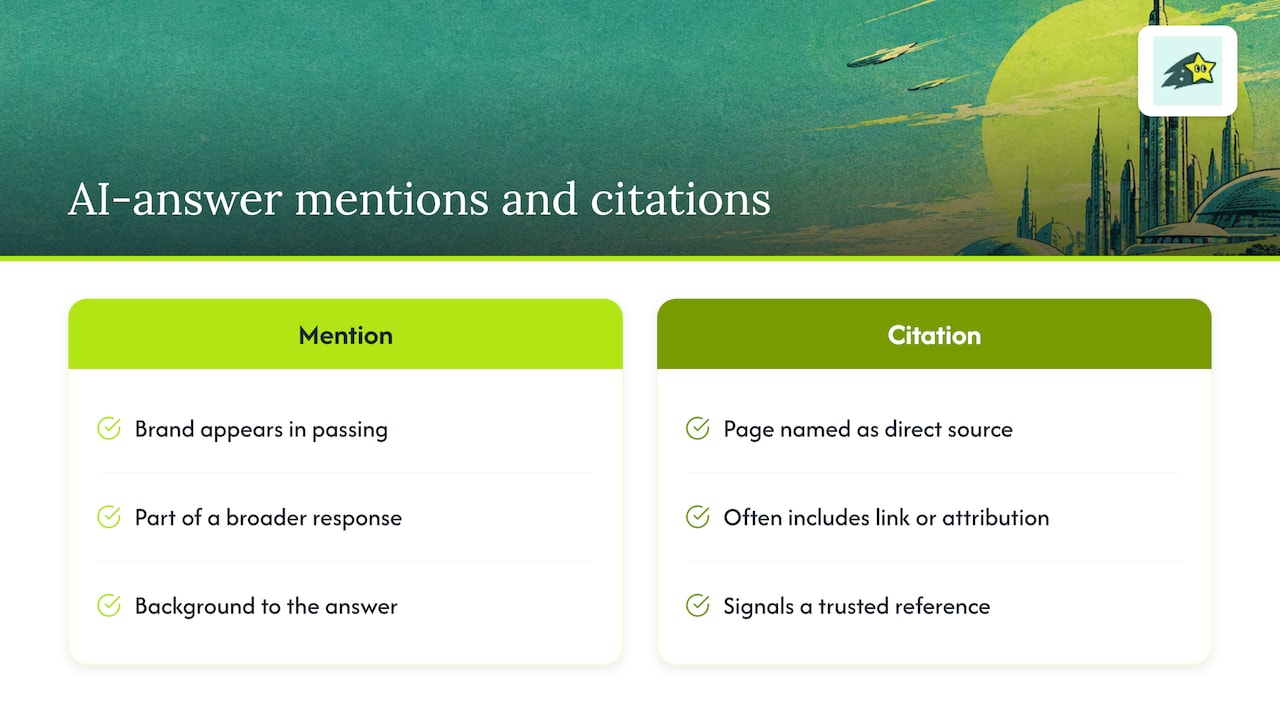
A mention names your brand or product inside an AI answer. A citation identifies a page as a source, often through a link. Track these separately, then measure visits and purchases where observable. A citation is not proof that a model independently verified a source, and neither metric guarantees revenue.
AI systems can retrieve information from accessible web pages and other sources, but their retrieval methods differ. Keep product facts clear, crawlable, and consistent with valid structured data. Google says no special schema is required for AI Overviews or AI Mode; markup does not guarantee an AI citation.
One of the clearest first-party signals now available comes from Search Console. Google rolled out dedicated generative AI performance reports in Search Console, showing impressions, pages, countries, and devices broken out specifically for AI features, with hourly, daily, weekly, and monthly views. That gives you a baseline straight from Google rather than relying only on a third-party estimate.
Treat visibility, representation, referred visits, and purchases as separate outcomes. Accurate content can improve how shoppers understand a product, but changes in mention or citation counts do not establish a conversion lift. Compare observed traffic and completed orders before drawing revenue conclusions.
Key features to check before you buy an AI visibility tool
Demos tend to look similar on the surface. The differences show up in the details, so run through this checklist before you sign anything.
- Confirm exact engine coverage. Ask specifically whether ChatGPT, Gemini, Perplexity, and Google AI Overviews are tracked, not just "AI search" as a vague category.
- Check for remediation features, not just dashboards: automated schema generation, bulk indexing requests, content gap suggestions, and CMS integrations that let you push fixes without a developer ticket.
- Verify revenue integrations. Ask how referred visits and completed orders are matched, which attribution model is used, and what remains unobservable. A Stripe or Shopify connection alone cannot attribute every AI impression to a sale.
- Ask about alerting granularity. Do you get notified when a specific product page drops out of an AI answer, or only a weekly summary?
- Confirm data retention and export options, especially if you report to clients or need historical trend data for budget conversations.
Pricing structures deserve particular scrutiny. Many platforms advertise one base price, then charge extra for each additional model you want tracked, or bill per query once you exceed a quota. Industry roundups, including Zapier's comparison of AI visibility tools, note that coverage and pricing structure vary widely between vendors, and that no single tool dominates across every engine. That's a reasonable expectation to carry into any RFP.
Pro Tip:Ask every vendor to show you, live, how they distinguish a citation from a mention in their reporting, not just how they define the two terms in their marketing copy.
Monitoring alone rarely moves revenue on its own
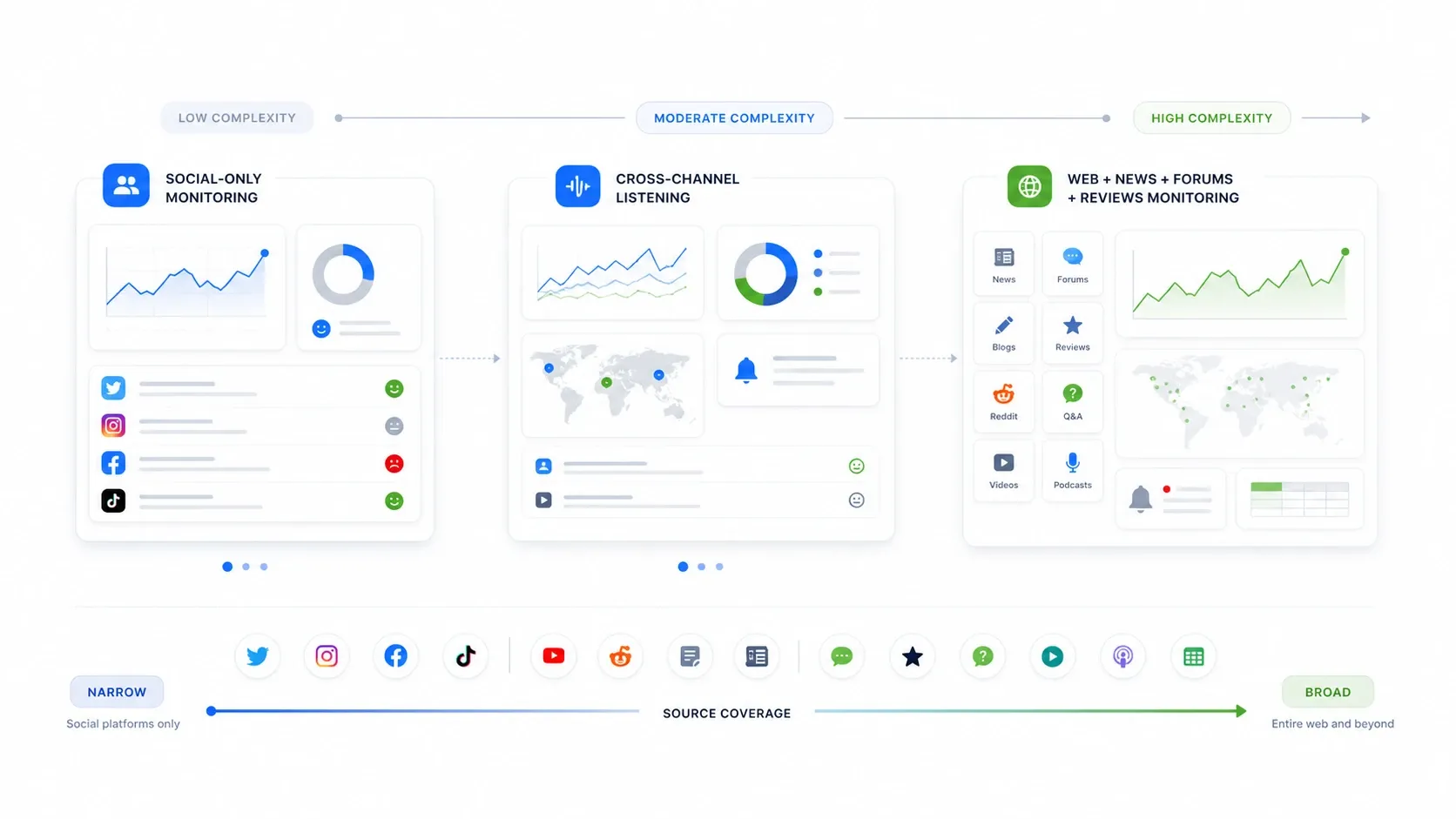
Monitoring-only platforms tell you where you stand: which queries surface your brand, which engines mention you, and how that trend moves week over week. That's useful intelligence, and it's often enough for a solo SEO specialist who just needs visibility data to bring into a broader content strategy conversation.
The limitation shows up when you try to act on what you've learned. Someone still has to update schema, resubmit URLs for indexing, or rewrite a product description, and in most teams that means a second tool, a developer request, or a content brief that sits in a queue.
Integrated, track-and-execute platforms close that loop. They typically include:
- Automated schema injection or suggestions pushed directly to your CMS.
- Indexing requests through supported channels, with clear eligibility limits. Submission does not guarantee crawling, indexing, timing, or inclusion in an AI answer.
- Content prompts tied to specific visibility gaps, rather than generic SEO advice.
- Alerts that connect a drop in AI visibility to a specific page or product, not just a category.
Which class you need depends on your team. A lean marketing team with strong content operations and occasional developer support usually gets more value from an integrated platform, since the fixes happen faster and with less back-and-forth. A larger SEO team with dedicated engineering resources can sometimes make a monitoring-only tool work, because they already have the pipeline to act on what it finds. For most ecommerce teams without a dedicated dev queue, the integrated route tends to be the more realistic one.
How to choose the right AI visibility tool for your team
Start with a readiness check before you look at a single vendor demo. Confirm you have Search Console access for the domain, that your ecommerce platform (Shopify, for instance) can support a tracking script or integration, and that someone on your team has the bandwidth to act on recommendations, whether that's a content lead, a generalist marketer, or outside help.
From there, bring a short list of questions into every demo:
- Which specific engines do you track, and is that list in the base price or does it require add-ons?
- How do you distinguish a citation from a mention in your reporting, and can you show a real example?
- What happens after you flag a gap? Does the platform generate a fix, or just a recommendation?
- Can you connect visibility data to revenue, through an integration with our payment or ecommerce platform?
- What's included at each pricing tier, and what triggers an overage or add-on charge?
Pricing clarity matters more here than in most SaaS categories, because "AI coverage" is not a standardized term. Confirm in writing which engines are covered at your tier, what counts as a tracked query, and whether historical data disappears if you downgrade.
A simple scoring rubric helps keep the comparison honest once you've run two or three demos:
Score each vendor against this table during the demo itself, while the answers are fresh, rather than trying to reconstruct it from a follow-up email.
Where Cromojo fits against this checklist
Running Cromojo's own feature set against the checklist above is a useful way to see how a revenue-first platform addresses each requirement rather than treating visibility and revenue as separate reports.
- Revenue integrations: Revenue Analytics connects directly to Stripe and Shopify, attributing real-time revenue to the specific pages, keywords, and channels that drove it, which is the integration most visibility-only tools skip entirely.
- Indexing and remediation: Automated Indexing supports URL submission workflows. Confirm supported engines, eligibility, quotas, and status reporting. Submission does not guarantee that a page will be indexed or cited.
- Site health as a visibility input: Website Monitoring tracks downtime, errors, and SEO health issues that can quietly suppress visibility before an AI engine ever gets the chance to cite a page.
- Real-time attribution: Real-time Analytics shows traffic and conversion behavior as it happens, rather than in a delayed daily batch.
Use site monitoring to identify technical issues, supported indexing workflows to request discovery of eligible pages, and revenue analytics to assess observed visits and transactions. Confirm the current capabilities and workflow during a demo; do not assume that a technical alert establishes why an AI answer omitted a page.
Cookieless tracking and privacy as part of visibility, not separate from it
Cookieless analytics and privacy requirements should be evaluated alongside your measurement plan. Ask vendors what data they collect, how visitors and transactions are identified, and what controls they offer. Avoid assuming that the absence of cookies makes a setup anonymous or removes every compliance requirement.
Evaluate a tracking script using measured page performance and the data your team needs, rather than assuming that every cookieless setup is faster. Review the actual implementation and applicable consent requirements before deployment; a product label alone does not establish that a banner is unnecessary.
The takeaway: compare privacy controls, measurement limitations, and implementation requirements alongside engine coverage and revenue reporting.
What the data actually tells us about AI visibility tools
Most of the advice circulating about AI search visibility treats it as a new flavor of rank tracking: watch your position, chase your mentions, report the trend. That framing undersells the opportunity. The real value isn't knowing you were mentioned, it's knowing whether that mention led to a sale.
The conventional advice also overstates how much a monitoring dashboard alone can do. Watching a citation count move up or down for months without a mechanism to fix what's broken is a reporting habit, not a strategy. Teams making real progress are the ones who treat visibility data as the first step in a loop that ends in a dollar figure.
If you take one thing from this, prioritize revenue attribution over citation volume. A hundred mentions that convert nobody matter less than ten that drive sales you can trace back to a specific page. Build your evaluation criteria, and your budget, around that order.
Get started with revenue-first AI visibility
Use AI visibility tracking, site health monitoring, and revenue analytics as complementary capabilities. Cromojo can support the site-health and revenue portions of that workflow; confirm current integrations and indexing coverage during evaluation, and verify whether a separate tracker is needed for the AI engines you care about.