
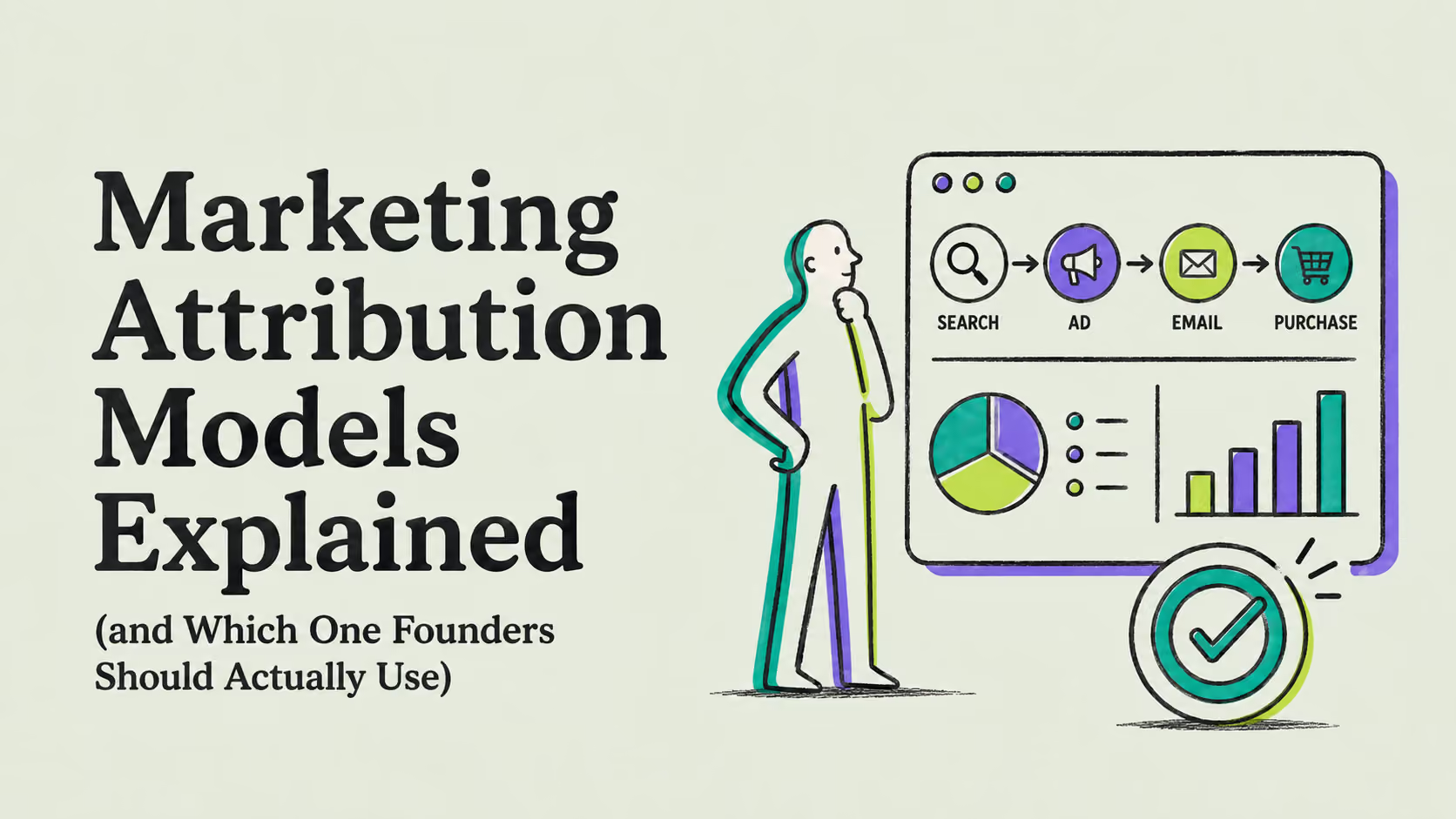

A customer rarely sees one ad, clicks once, and immediately buys.
They might first discover you through Google, read a blog post, see a retargeting ad a week later, open one of your emails, come back through branded search, and finally make a purchase.
When that sale appears in your dashboard, who gets the credit?
That is the problem marketing attribution is trying to solve.
An attribution model is simply a rule for deciding how much credit each marketing touchpoint receives for a conversion or sale. The model you choose changes how your channels look in your reports, which can influence where you spend your next marketing dollar.
That is why attribution matters. If your model gives too much credit to one part of the customer journey, you can end up cutting budget from a channel that was quietly helping customers move toward a purchase.
At the same time, founders can easily go too far in the other direction. It is possible to spend weeks building a sophisticated attribution model when the underlying tracking is still incomplete.
For most lean teams, the goal is not to build the most advanced model possible. It is to use the simplest model that gives you a reliable answer to the business question you are trying to solve.
Before choosing one, it helps to understand what each model actually does.
Key Takeaways
Marketing attribution works best when you start with clean tracking, connect it to confirmed revenue, and use the simplest model that answers the business question you actually need to solve.
What Is First-Touch Attribution?
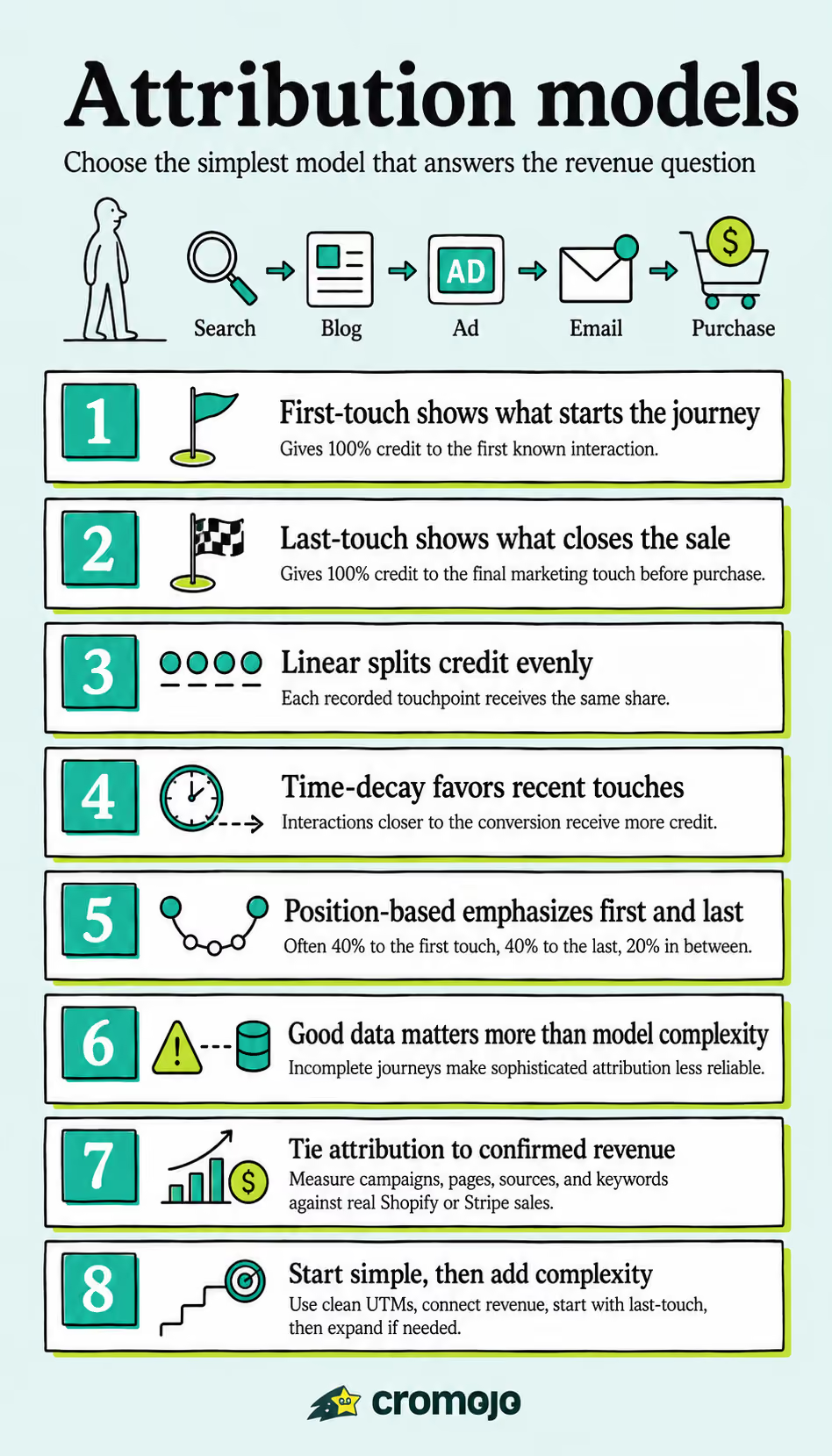
First-touch attribution gives 100% of the credit to the first known interaction a customer had with your business.
Imagine this journey:
Organic search → blog post → Instagram ad → email → purchase
Under first-touch attribution, the organic search gets all the credit because it introduced the customer to the business.
This model is useful when your main question is:
What is bringing new people into our funnel?
If you are investing heavily in SEO, awareness campaigns, partnerships, or content, first-touch attribution can help you understand which sources are introducing future customers.
The limitation is that it ignores everything that happens afterward.
A customer might discover you through a blog article in January, return several times, subscribe to your email list, click a product email, and finally buy in March. First-touch attribution still gives all the credit to that original blog visit.
That does not necessarily mean the model is wrong. It simply means it is answering a very specific question: where did the relationship begin?
It is less useful when you are trying to understand what ultimately persuaded someone to buy.
What Is Last-Touch Attribution?
Last-touch attribution takes the opposite approach.
It gives 100% of the credit to the final marketing interaction before the conversion.
Using the same journey:
Organic search → blog post → Instagram ad → email → purchase
the email would receive all the credit if it was the customer's final tracked marketing touch before the sale.
This makes last-touch attribution especially useful when you want to know:
What is closing sales?
Its biggest advantage is simplicity. There is no complicated weighting system to explain, and the result can be connected directly to a transaction.
That makes it a practical model for founders and small marketing teams that need clear answers quickly.
The weakness is equally straightforward: it ignores everything that happened earlier.
The email may have closed the sale, but perhaps the customer would never have joined the mailing list without finding your comparison article through Google three weeks earlier.
Last-touch attribution cannot tell you that.
Still, that does not make it useless. It simply means you need to understand the question it answers.
For businesses with relatively short buying cycles, particularly ecommerce stores and straightforward SaaS funnels, seeing the last marketing interaction before a real purchase can be extremely useful.
For long B2B sales cycles with months of research, demos, sales conversations, and multiple decision-makers, it tells a much smaller part of the story.
What Are Linear, Time-Decay, and Position-Based Attribution?
First-touch and last-touch force you to choose one interaction.
Multi-touch models take a different approach. They assume several interactions contributed to the purchase and divide the credit between them.
Three common models are linear, time-decay, and position-based attribution.
These models are still useful ways to think about attribution, even though GA4 no longer offers them as selectable reporting attribution models.
Linear attribution
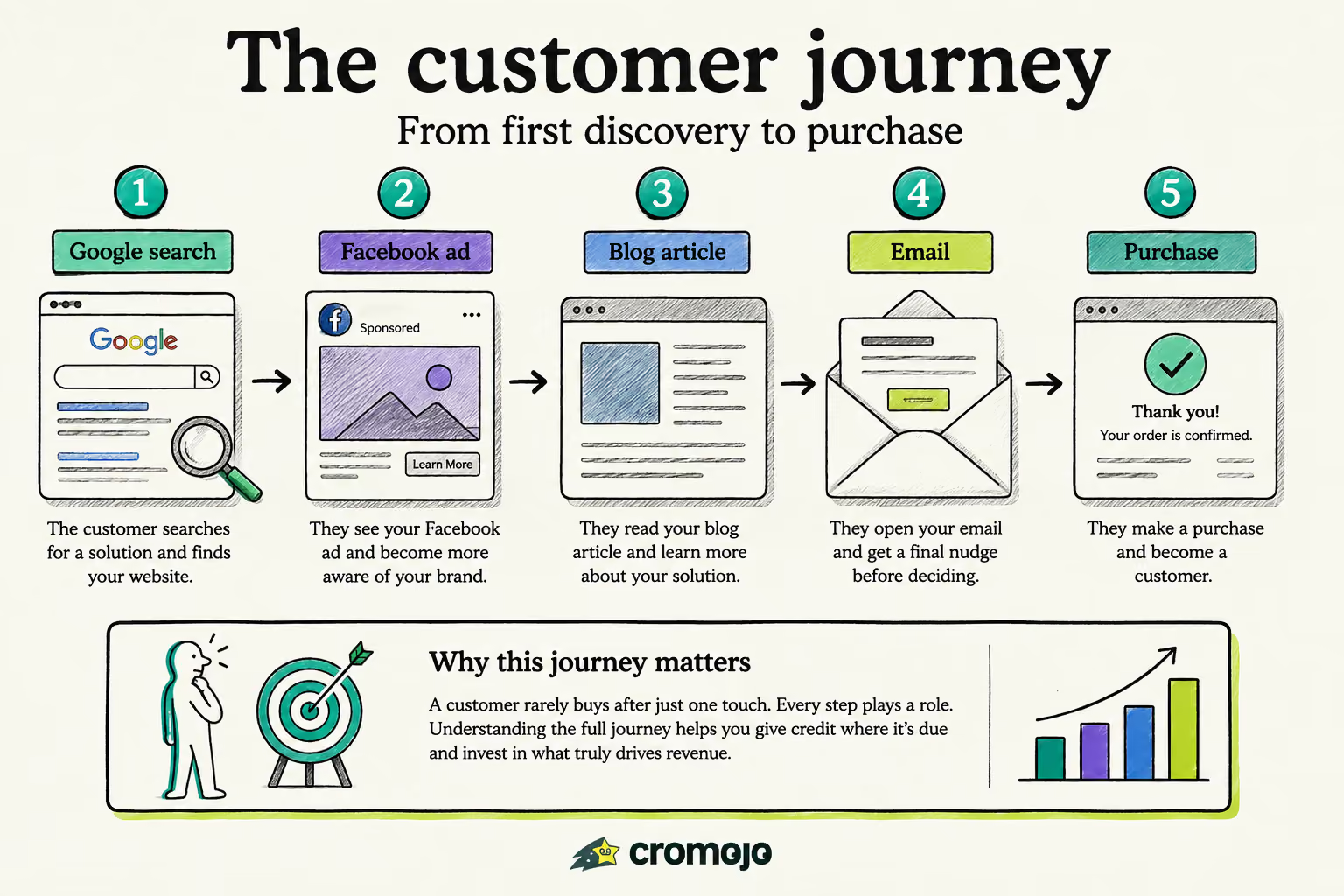
Linear attribution divides the credit evenly between every recorded touchpoint.
If a customer has four marketing interactions before buying, each interaction receives 25% of the credit.
For example:
Google search → Facebook ad → blog article → email → purchase
Each of the four marketing interactions receives one-quarter of the attributed revenue.
The appeal is fairness. No touchpoint is completely ignored.
The problem is that not every touchpoint is equally important.
A customer briefly clicking an ad and leaving after five seconds does not necessarily deserve the same amount of credit as an email that brought them directly back to complete a $500 purchase.
Linear attribution treats both interactions the same.
Time-decay attribution
Time-decay attribution gives more credit to interactions that happened closer to the conversion.
An interaction that occurred an hour before purchase would receive more credit than one that happened three weeks earlier.
This often feels more intuitive because later interactions are usually closer to the buying decision while still allowing earlier touchpoints to receive some recognition.
The trade-off is that you now have another assumption built into your model: how quickly should that credit decay?
There is no universal answer.
The right decay rate for a low-cost ecommerce purchase may be very different from the right one for a six-month B2B buying cycle.
Position-based attribution
Position-based attribution, often called U-shaped attribution, gives most of the credit to the first and last interactions while dividing the remainder among the touchpoints in between.
A common version gives:
- 40% to the first touch
- 40% to the last touch
- 20% divided across the interactions in between
The logic is easy to understand. The first interaction introduced the customer, while the last interaction helped close the sale. Everything in the middle played a supporting role.
For some customer journeys, that is a reasonable approximation.
But it is still an approximation.
You are deciding in advance that the first and last interactions deserve the most credit, whether or not that reflects how your customers actually behave.
That is the common limitation of rule-based attribution models: the rules are chosen by you, not discovered from the data.
The Real Problem With Multi-Touch Attribution
The biggest problem with multi-touch attribution is not choosing between linear, time-decay, and position-based models.
It is collecting reliable data in the first place.
A multi-touch model needs to know which interactions belong to the same customer.
That becomes difficult when someone:
- visits on their phone and later buys on a laptop,
- clears browser data,
- switches between paid search and organic search,
- interacts with email and social channels,
- purchases through Shopify while behavioral data lives in another analytics platform.
If your customer journey is incomplete, a more sophisticated attribution model does not automatically make it more accurate.
You simply end up applying better mathematics to incomplete information.
That is why it is useful to understand the full path before worrying about how to divide the credit. Cromojo's guide to revenue-focused user journey mapping explains how to connect customer interactions with real order data instead of treating the journey as a collection of disconnected sessions.

What Is Data-Driven Attribution?
Data-driven attribution tries to move beyond fixed rules.
Instead of deciding in advance that the first touch gets 40%, the last touch gets 40%, or every interaction gets an equal share, a data-driven model looks at actual conversion paths and estimates how much each interaction contributed.
The basic idea is appealing.
Suppose customers who encounter a particular email campaign are consistently more likely to purchase than otherwise similar customers who do not. A data-driven model can use patterns like that when assigning credit.
In theory, that gives you a more realistic view of how channels work together.
In practice, the quality of the result still depends heavily on the quality and quantity of the underlying data.
If you have a large number of conversions and well-connected customer journeys, statistical modelling can uncover patterns that a simple last-touch report misses.
If you have a small number of sales, fragmented customer journeys, or inconsistent campaign tagging, there is much less signal for the model to learn from.
That is why "data-driven" should not automatically be read as "more accurate."
The model still needs good data.
For context, Google Analytics currently uses data-driven attribution as its default model for event-scoped attribution reporting. But that does not mean every small business needs to build its decision-making process around a complex attribution system.
Your own requirements may be much simpler.
So Which Attribution Model Should a Small Team Actually Use?
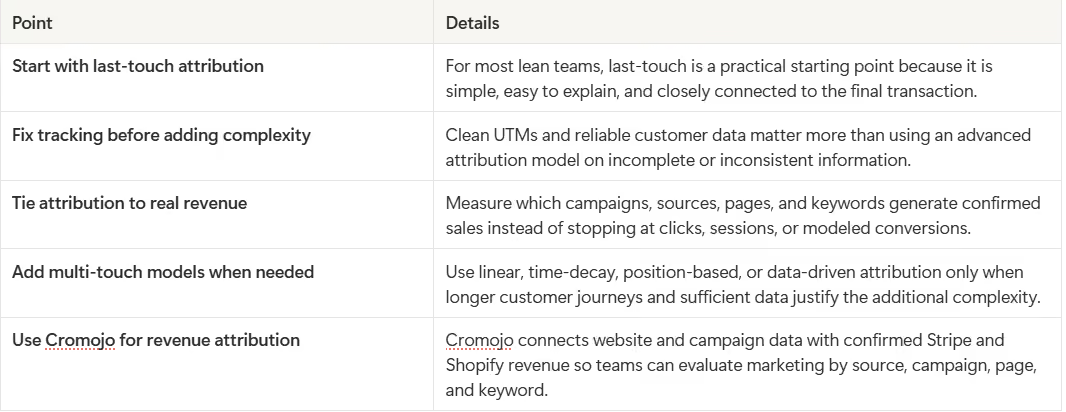
For many small teams, the best starting point is last-touch attribution connected to real revenue.
Not because last-touch perfectly represents the customer journey.
It does not.
Use it because it is simple enough to understand, consistent enough to compare over time, and close enough to the transaction to help you make practical marketing decisions.
If Campaign A generated 1,000 sessions and Campaign B generated 400, the traffic report makes Campaign A look stronger.
But if Campaign A produced $2,000 in revenue while Campaign B produced $8,000, you now have a very different business decision to make.
That is the distinction that matters.
For a lean team, improving the quality of the data behind a simple attribution model is often more useful than adding complexity to the model itself.
A clean last-touch revenue report can answer:
- Which campaign is closing the most revenue?
- Which traffic source brings paying customers?
- Which landing pages lead to sales?
- Which keywords are associated with purchases?
- Which channels generate traffic but very little revenue?
Those are questions you can act on immediately.
As your business grows, you can compare that last-touch view with broader customer journeys and multi-touch models.
The key is to earn that complexity.
Do not start with a sophisticated model simply because it sounds more advanced.
Revenue Matters More Than the Attribution Model
There is another issue founders should think about before debating first-touch versus last-touch.
What is the model actually attributing?
Sessions?
Form submissions?
Checkout events?
Or confirmed revenue?
An elegant attribution model tied only to website sessions still leaves a major gap.
You want to know which marketing activity ultimately produced money.
That means your analytics needs to connect acquisition data with the system where the actual transaction happened.
This is the gap Cromojo is designed to close.
Cromojo connects website traffic and campaign data with confirmed revenue from Stripe and Shopify, allowing you to see revenue by source, campaign, page, and keyword.
Instead of ending with:
"This campaign brought us 500 visitors."
you can ask:
"How much revenue did those visitors actually generate?"
That is a much more useful question when you are deciding what to fund next.
For Shopify teams struggling with differences between storefront, ad-platform, and analytics numbers, Cromojo's Shopify conversion tracking guide explains where those gaps come from and how to build a cleaner measurement setup.
And if you want to evaluate acquisition at a more granular level, the guide to keyword conversion rate looks at the difference between keywords that bring traffic and keywords that actually contribute to conversions.
[Image: Revenue attribution dashboard showing revenue by keyword, campaign, source, and page]
Do You Need Clean UTMs Before Attribution Works?
Yes, especially for campaigns you control.
Your attribution model can only work with the information it receives.
If one Facebook campaign uses:
utm_source=Facebook
another uses:
utm_source=facebook
and a third uses:
utm_source=fb
you may end up splitting what should be one source into several different rows.
The attribution model is not going to fix that for you.
The same problem appears when campaigns are missing tags entirely or when different people on the team use different naming conventions.
Before worrying about advanced modelling, make sure your campaign data is clean and predictable.
Cromojo's guide to UTM naming conventions covers how to standardize sources, mediums, campaigns, and naming rules across a team.
The principle is simple: clean tracking first, attribution second.
First-Party Data Makes Attribution More Useful
Attribution also depends on how reliably you can collect the underlying data.
As browsers, privacy controls, and ad blockers change the amount of information traditional tracking systems can observe, more teams are moving toward first-party measurement.
That does not magically solve every attribution problem. Cross-device journeys and long buying cycles can still be difficult to connect.
But first-party tracking gives you a stronger foundation because the relationship between your website activity and your business data is more direct.
Cromojo's first-party analytics guide covers the benefits, trade-offs, and practical considerations in more detail.
For a founder, the takeaway is simpler: before adding another attribution model, make sure you can trust the data being fed into it.
Attribution Should Help You Make a Decision
One reason attribution becomes unnecessarily complicated is that teams start treating the model itself as the goal.
It is not.
The goal is to make a better decision.
Should you put more money into Google Ads?
Should you invest in SEO?
Is your email program actually closing purchases?
Is that social campaign generating customers or simply generating clicks?
Should you improve a high-traffic landing page or focus on a lower-traffic page that produces much more revenue?
Your attribution setup should make questions like those easier to answer.
If the model is so complicated that nobody on the team understands why a channel received 17.4% of a sale, you may have created more analytical work without creating more clarity.
That is particularly important for founders.
You rarely need perfect attribution to make a better decision. You need consistent attribution, trustworthy revenue data, and enough context to understand the limits of the model you are using.
A Practical Attribution Setup for a Lean Team
If you are starting from scratch, keep the first version simple.
First, standardize your campaign tracking. Make sure paid campaigns, email links, partnerships, and other trackable acquisition sources use consistent UTMs.
Next, connect your analytics to the source of truth for revenue, whether that is Shopify, Stripe, or another transaction system.
Then start with a last-touch revenue view.
Use it to identify which campaigns, pages, sources, and keywords are associated with sales.
After that, look at the customer journey around your most valuable conversions. If you repeatedly see important earlier touchpoints that your last-touch report ignores, you now have a real reason to investigate multi-touch attribution.
This order matters.
Tracking → revenue → simple attribution → journey analysis → more sophisticated modelling when needed
Starting with the model and trying to repair the data later usually creates more work.
Cromojo's guide to the ecommerce conversion funnel is useful once you want to go beyond acquisition and see where visitors are dropping out before they reach the purchase.
Where Attribution Fits Into Your Analytics Stack
Attribution should not feel like a separate spreadsheet you update once a month.
Ideally, it should be part of the same system you use to understand traffic, customer behavior, conversions, and revenue.
When those pieces live in separate platforms, teams often spend more time reconciling numbers than learning from them.
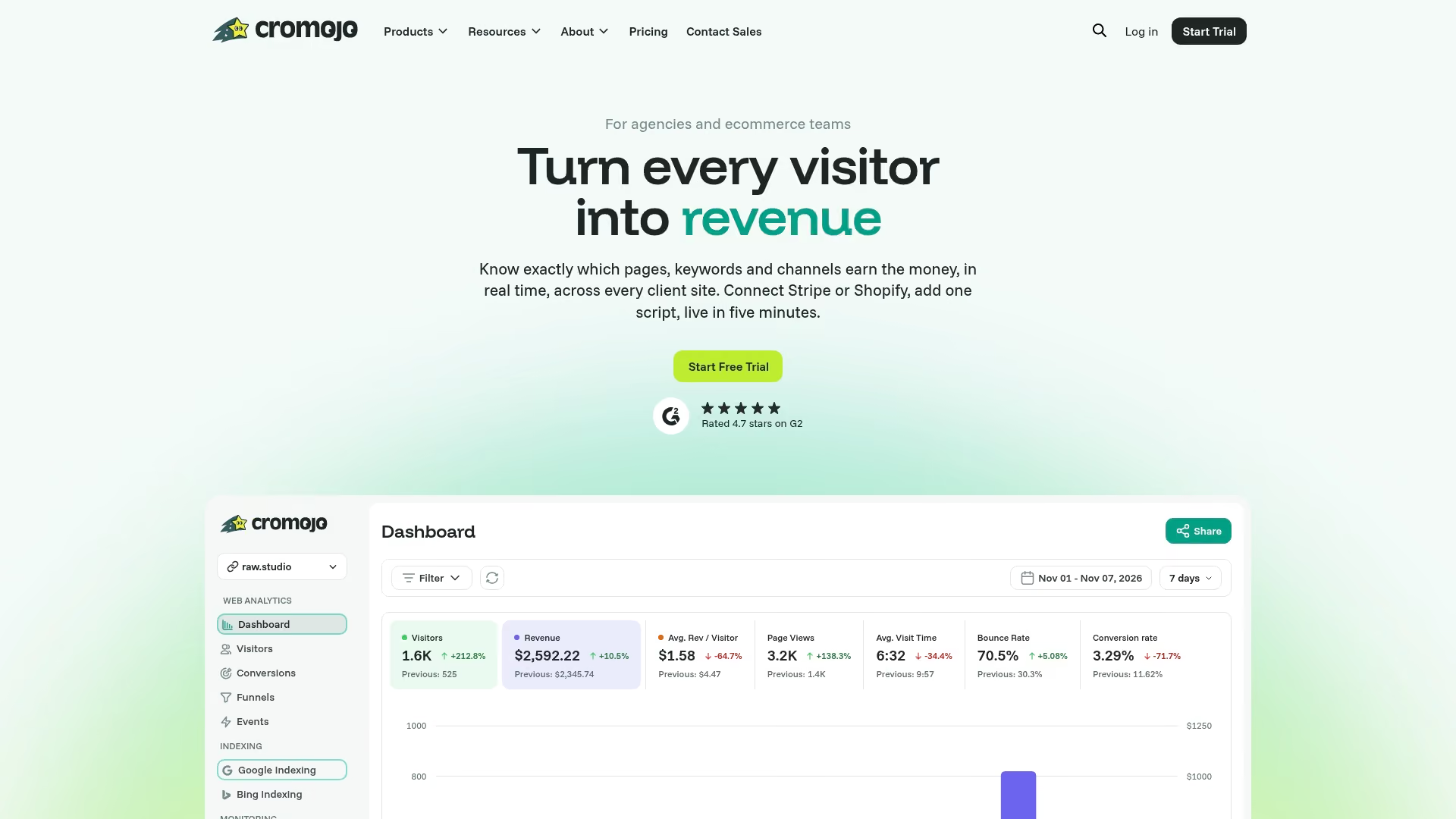
Cromojo brings website analytics together with revenue data from Stripe or Shopify, allowing teams to look at traffic and marketing performance through a revenue lens rather than stopping at pageviews or sessions.
Its analytics are cookieless and designed around first-party measurement, with revenue reporting across keywords, pages, sources, and campaigns.
If you are still deciding what kind of analytics platform makes sense for your business, Cromojo's comparison of the top web analytics tools for 2026 provides a broader look at the options.
Start Simple, Then Add Complexity When It Earns Its Place
There is no perfect attribution model.
First-touch tells you what introduced the customer.
Last-touch tells you what closed the tracked journey.
Linear attribution recognizes every interaction equally.
Time-decay favors the interactions closest to the purchase.
Position-based attribution emphasizes the beginning and end of the journey.
Data-driven attribution tries to estimate contribution from actual conversion patterns.
They are different ways of looking at the same customer journey, and each one leaves something out.
For most founders, that means the smartest place to start is not the most complicated model.
Start with clean tracking. Connect it to real sales. Use a simple model you can explain and act on. Then add more sophisticated attribution when your customer journey, conversion volume, and marketing spend actually justify it.
Most importantly, do not lose sight of what you are trying to learn.
You are not trying to find the channel that won an attribution argument.
You are trying to find the marketing that earns money.
Want to see which campaigns, pages, sources, and keywords are actually connected to revenue? Talk to Cromojo and see how your traffic connects to real Stripe or Shopify sales.