



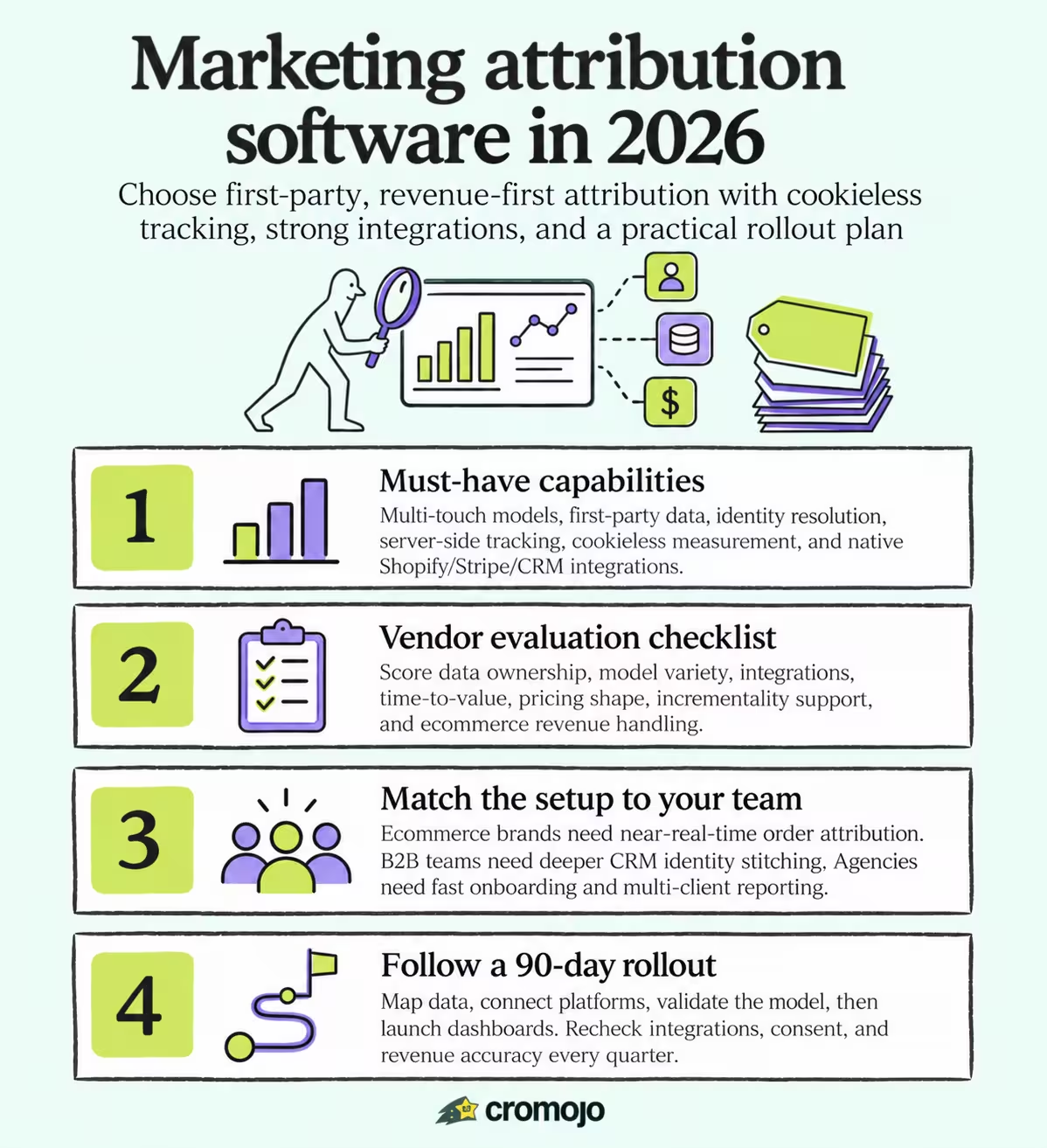
Prioritize revenue-first attribution software that runs on your first-party data and identity resolution, not third-party cookies. The must-have capability set is short: flexible multi-touch modeling, native CRM and e-commerce integrations (think Stripe and Shopify), server-side event tracking, and cookieless identity matching. This guide walks through a vendor checklist, a 90-day rollout roadmap, and where a revenue-focused platform like Cromojo fits for ecommerce teams and agencies.
What Marketing Attribution Software Must Do in 2026
Multi-touch models, and when each one earns its keep
First-touch attribution credits whoever introduced the buyer. It's useful for measuring which channels build your top of funnel, but it ignores everything that happened after. Last-touch does the opposite, crediting the final click before purchase, which flatters retargeting and branded search while starving the awareness channels that made the sale possible in the first place.
Linear attribution splits credit evenly across every touchpoint, which is fair but blunt. Positional (or U-shaped) models weight the first and last touch more heavily, on the theory that discovery and conversion matter more than the middle. Algorithmic, or data-driven, attribution uses statistical modeling to assign credit based on actual conversion patterns rather than a fixed rule. Gartner's own market definition for multi-touch attribution expects platforms to support several of these models plus AI-driven insights, not just one rigid formula.
The right answer depends on your sales cycle. A DTC brand with same-day purchases can lean on last-touch or algorithmic models. A B2B company with a six-month buying committee needs positional or algorithmic models that respect the whole journey.
First-party data beats cookies, and the gap is widening
Third-party cookies were never reliable, and browser restrictions have made them worse. Usercentrics notes that platforms built on first-party data and real identity resolution now outperform cookie-based analytics for revenue attribution, simply because cookies were blocked or expired before the conversion happened. Identity resolution stitches a visitor's early anonymous sessions to their eventual CRM record or billing profile, so the platform can credit the ad that started the relationship even if the purchase happens on a different device weeks later.
Snowplow's approach to this problem uses first-party behavioral data with warehouse-ready models, which avoids the fragility of cookie-dependent tracking entirely. That's the direction the whole category is moving.
Integrations that actually matter
A platform is only as good as what it connects to. Look for:
- CRM systems (Salesforce, HubSpot) to close the loop between marketing touches and actual deals
- Ad platforms (Google Ads, Meta, TikTok) for spend and click-ID data
- E-commerce and billing (Stripe, Shopify) so revenue attribution reflects real transactions, not proxy goals
- Data warehouses (Snowflake, BigQuery) for teams that want to own their raw event data
Reporting that ties back to revenue
Skip any platform whose dashboards stop at sessions and clicks. You want revenue-by-channel breakdowns, multi-touch path analysis, cohort views by acquisition month, and lifetime value trends. Without those four report types, you're still measuring traffic, not money.
Privacy and cookieless tracking
Cookieless tracking typically relies on a first-party script that assigns a persistent identifier tied to your own domain, rather than a third-party tracker a browser can block. This approach also happens to align with privacy regulations that are only getting stricter. The trade-off is minor: you lose some cross-site tracking granularity, but you gain data you can actually trust and own outright.
How to Evaluate Attribution Vendors: A Practical Checklist
Comparing attribution platforms feels harder than it needs to be because vendors describe the same features in different language. Cut through that by scoring every vendor against the same eight dimensions, weighted to match your business.
- Data ownership. Do you keep raw event data, or is it locked inside the vendor's dashboard?
- Identity resolution. Can it stitch anonymous sessions to CRM or billing records across devices?
- Model variety. Does it support first-touch, last-touch, linear, positional, and algorithmic models, or just one?
- Integrations. Native connectors to your CRM, ad platforms, and payment processor, not just CSV exports.
- Time-to-value. How many weeks from contract signature to your first trustworthy report?
- Pricing shape. Flat subscription, pageview-based, or event-based, and how that scales as you grow.
- Incrementality support. Can the platform run holdout tests or does it only report correlational attribution?
- Ecommerce revenue handling. Does it recognize refunds, subscriptions, and multi-currency orders correctly?
Weight those dimensions differently depending on who you are. An ecommerce team should weight integrations and ecommerce revenue handling heaviest, since Stripe and Shopify data accuracy determines whether your whole model is trustworthy. A B2B team should weight identity resolution and CRM integration highest, because buying committees generate touches across multiple people before anyone converts. An agency managing multiple client accounts should weight time-to-value and pricing shape, since it needs to onboard new clients fast without renegotiating a contract every time.
Here's a short run-through of how the scoring plays out. Say you're comparing two anonymized vendor feature sets. Vendor A offers five attribution models, native Stripe and Shopify integration, and weekly data exports, but takes six weeks to onboard. Vendor B offers three models and slower support for incrementality testing, but connects in under a week and includes cookieless tracking out of the box. For an ecommerce team that needs revenue visibility fast, Vendor B wins despite fewer models, because time-to-value and native integrations were weighted highest. For a B2B team running a complex sales motion, Vendor A wins because model variety and CRM depth matter more than onboarding speed.
Pro Tip:Ask any vendor how they handle "Direct" traffic before you sign. Unattributed direct traffic is often really dark social or an expired cookie in disguise, and platforms that enrich sessions with prior referrers and landing-page heuristics recover a meaningful share of that revenue instead of writing it off as unknown.
That direct-traffic gap is well documented. Practical Ecommerce's analysis found that a large share of what analytics tools label "Direct" is actually mislabeled organic, email, or social traffic, and vendors that use referrer enrichment and click-ID persistence close much of that gap. Test for it directly during a trial by pulling five closed deals and tracing them back to their true first touch.
Which Attribution Approach Fits Your Team
Not every organization needs the same setup, and buying more model complexity than your business actually uses, just adds noise to your reports.
Ecommerce and DTC brands need near-real-time revenue attribution tied to actual orders, not proxy conversion events. That means pixel tracking paired with server-side order stitching, so a purchase completed on Stripe or Shopify shows up against the exact campaign and keyword that drove it, usually within minutes rather than the next day's batch report. Cromojo's own approach to this problem is exactly this: real-time revenue tracking by page, keyword, and channel, built to sit on top of Stripe and Shopify data without engineering overhead. Our internal guide on multi-touch attribution covers when a DTC brand should move beyond last-touch reporting.
B2B companies with long sales cycles need something structurally different: company-level identity stitching, not just individual visitor stitching, because enterprise deals involve buying committees where five or six people touch your marketing before anyone signs a contract. Multi-touch models here need to pull from both web analytics and CRM stage changes to reflect the full committee's journey, which is a heavier integration lift than most ecommerce setups.
Agencies managing multiple client accounts have their own list of requirements:
- Multi-client data isolation, so one client never sees another's dashboard
- White-label reporting templates that match agency branding
- API access for building custom client-facing dashboards
- Fast onboarding, since agencies add and lose accounts constantly
Our revenue-first playbook for agencies covers templates for exactly this scenario.
On build versus buy: building attribution in-house only makes sense if you have dedicated data engineers and a genuinely unusual measurement need. For almost everyone else, the engineering cost of maintaining identity resolution, server-side tracking, and model logic outweighs a subscription fee within the first year.
Implementation Timeline, Data Requirements, and Cost Signals
Expect four phases, roughly in this order: discovery and data mapping, integration and identity stitching, model configuration and validation, then reporting rollout to stakeholders. Skipping straight to reporting without validating the model against known outcomes is the single most common mistake teams make, and it's why so many attribution dashboards get quietly ignored by leadership after the first quarter.
What you need before you start
- CRM records with clean deal and contact stages
- Order and billing event data from Stripe, Shopify, or your payment processor
- UTM parameters and click IDs captured consistently across campaigns
- Server-side event tracking for purchases, since browser-side tracking alone misses too much
- Consent records, so cookieless and first-party tracking stays compliant from day one
Pricing shapes and what they mean for total cost
Attribution vendors typically price one of three ways: per-pageview or per-event, flat subscription tiers based on traffic volume, or a base fee plus mandatory professional services for setup. Pageview and event pricing scales predictably with growth but can surprise you during a traffic spike. Flat subscription tiers are easier to budget but may force you into a higher tier before you're ready. Professional-services-heavy pricing often signals a platform that isn't self-service, which adds weeks to your timeline regardless of the sticker price.
A useful validation pattern, drawn from how Snowplow recommends implementation, is to instrument server-side purchase events, sync them to your CRM, then run the new attribution model in parallel with your old reporting for two weeks. Compare the attributed revenue against what your ad platforms self-report. The gap between the two tells you how much your old last-click reporting was overcrediting paid channels, which is often the number that finally gets budget reallocated.
Small teams with straightforward Shopify or Stripe setups can realistically get from signed contract to a validated dashboard within a few weeks. Mid-size teams juggling multiple ad platforms and a CRM sync generally need about a month or more. Enterprise B2B implementations with company-level identity stitching across several data sources often require several months, mostly due to data governance and consent approval cycles rather than the software itself.
Why This Guide's Methodology Holds Up
This guide was built by mapping vendor capabilities against the actual technical requirements marketing teams cite when their attribution reporting breaks down: cookie loss, direct-traffic misattribution, and CRM data that never quite matches what the ad platform claims. Feature checks focused on real integration behavior with Stripe, Shopify, and CRM systems rather than marketing copy alone, cross-referencing vendor claims against independent category definitions like Gartner's.
Cromojo's own product signals are worth stating plainly, since they inform the recommendations throughout this guide:
- Real-time revenue attribution by page, keyword, and marketing channel
- Native integrations with Stripe and Shopify for order-level revenue data
- Cookieless, privacy-first tracking that doesn't depend on third-party cookies
- Automated website indexing and re-indexing across Google, Bing, Yandex, and Baidu
- Site monitoring for downtime, errors, and SEO health alongside revenue reporting
The core insight worth internalizing: attribution accuracy isn't about buying the most sophisticated model. It's about whether the platform can honestly tell you which touches were measured directly and which were modeled through statistical inference. A platform that blurs that line will always look more confident than it deserves to be.
A 90-Day Roadmap for Revenue-First Attribution
Most teams don't fail at attribution because they picked the wrong platform. They fail because they tried to roll out full reporting in week one, before the underlying data was clean enough to trust. A staged rollout fixes that.
Month 0 to 1: get access and map the terrain. Secure CRM and billing data access before you touch a single dashboard setting. Map every touchpoint your business currently generates, from paid ads to email to organic search, and identify where UTM tagging is inconsistent or missing entirely. This month is unglamorous and almost entirely administrative, and skipping it is exactly how teams end up with attribution reports nobody trusts by month three.
Month 1 to 2: connect and instrument. Integrate your ad platforms and ecommerce or billing systems, and turn on server-side event tracking for purchases so you're not solely dependent on browser-side pixels that ad blockers and privacy settings can suppress. Run your first attribution model pass here, but treat the output as a draft, not a deliverable. Compare it against your existing last-click numbers and flag anything that looks implausible, like a channel suddenly getting credit for revenue it clearly didn't influence.
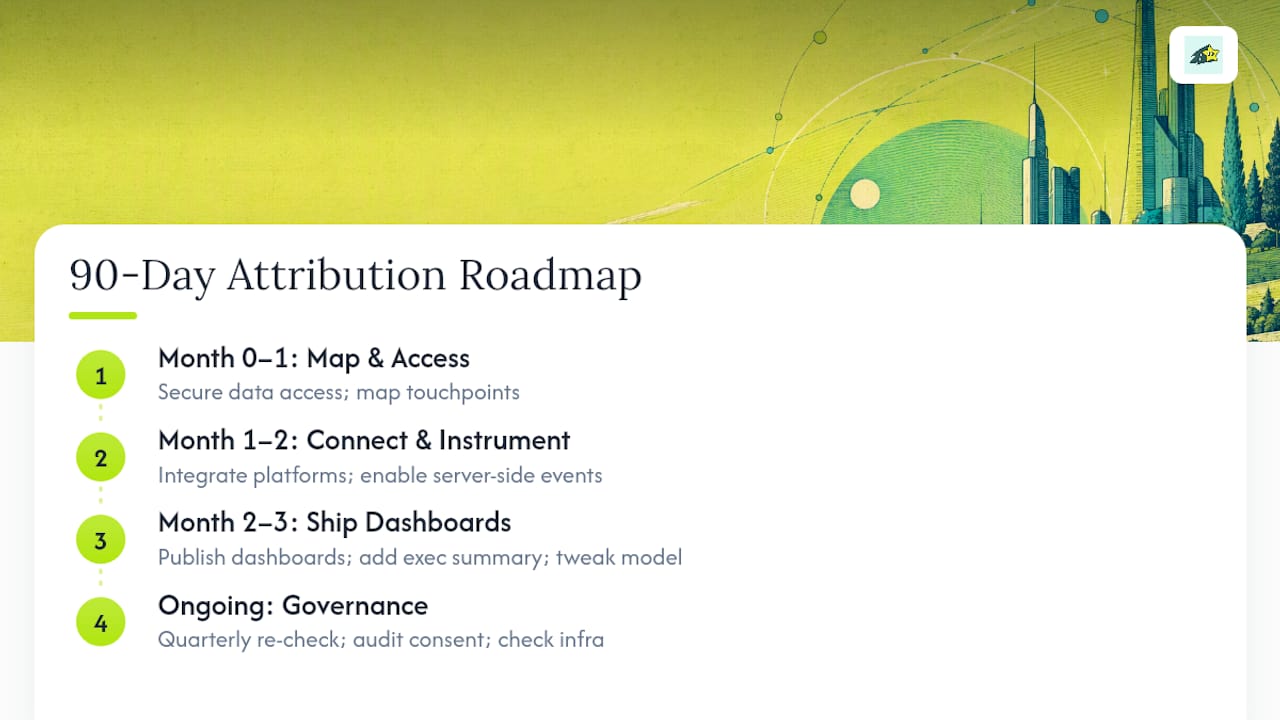
Month 2 to 3: ship the dashboards, and defend the numbers. Build revenue-attributed dashboards by channel and campaign, plus a short executive summary that translates the model's output into budget recommendations leadership can actually act on. Expect to refine model weightings at least once during this phase. That's normal. It's a sign the model is being tested against reality, not a sign it was configured wrong the first time. Our user journey mapping guide is a useful companion here for translating raw touchpoint data into a narrative stakeholders can follow.
Ongoing governance. Attribution isn't a project with an end date. Set a quarterly cadence to re-validate the model against actual closed revenue, audit consent records as privacy rules shift, and re-check integration health after any CRM or ad platform update. Teams that treat attribution as a living system, not a one-time setup, are the ones still trusting their dashboards a year later.
Getting Started With Cromojo's Revenue-First Attribution
For ecommerce teams and agencies, the real cost of most attribution platforms isn't the subscription fee. It's the weeks of engineering time spent stitching Stripe and Shopify events to ad-platform data before the numbers can be trusted. Some attribution platforms cut setup down to a lightweight script and native integrations, so revenue attribution by page, keyword, and channel can run in days, not months.
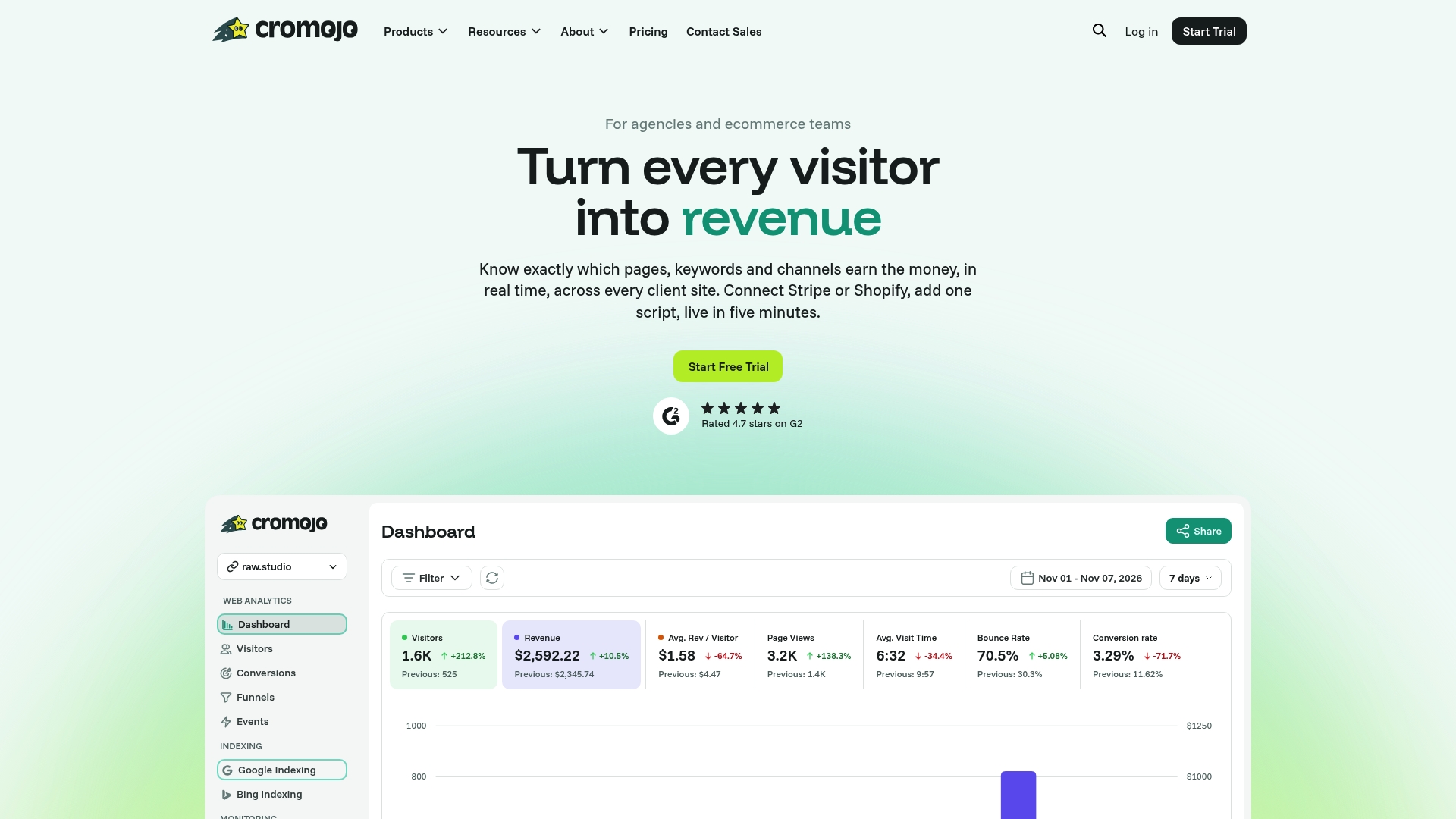
Some platforms are built around the checklist this guide walks through: first-party identity resolution instead of cookie dependency, direct connections to payment and ecommerce systems for order-level accuracy, and conversion funnels and visitor journey analysis that tie back to revenue rather than vanity traffic metrics. Some platforms also offer automated website indexing and site health monitoring. This helps the pages driving revenue stay discoverable across Google, Bing, and AI search engines instead of quietly dropping out of the index.
The customer profile that benefits most is often a small to mid-size ecommerce business or an agency managing several client sites, where a dedicated data engineering team isn't realistic but revenue accuracy still matters. Most teams see a working, validated dashboard within their first couple of weeks.
Start by reviewing Cromojo's revenue attribution analytics to see how channel and keyword-level revenue reporting is structured, or check website and uptime monitoring if site health and indexing are your more immediate concern. Either page has a trial you can start today.
.png)