



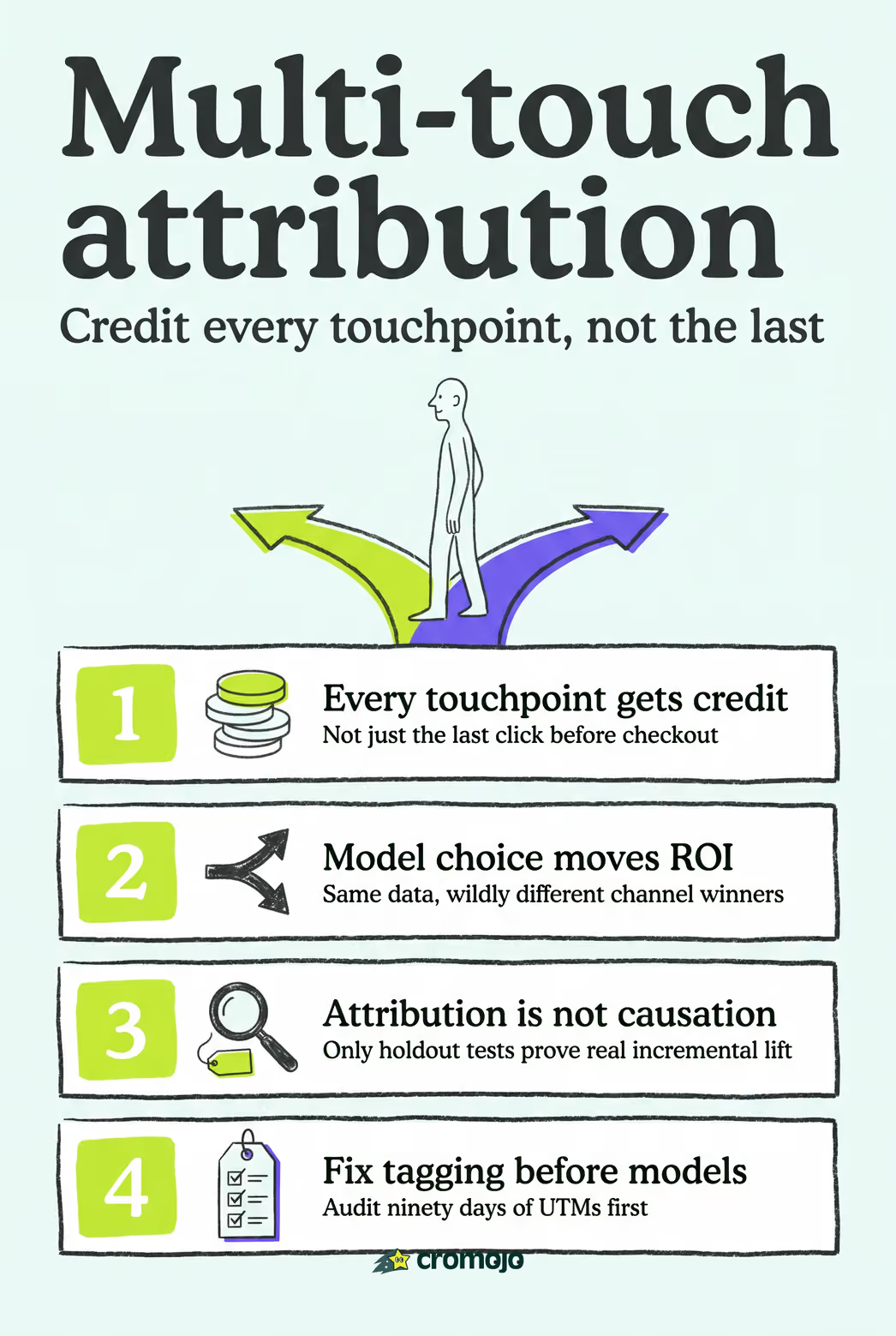
If a shopper sees a Facebook ad, clicks a retargeting email, then converts from a Google search, multi-touch attribution spreads value across all three instead of crowning the last click the winner.
You want this if you run a digital-first funnel with multiple paid and owned channels feeding the same audience. You do not want this as your only source of truth if your funnel leans heavily on offline events, phone sales, or word of mouth, or if you need to prove that a channel causes incremental revenue rather than just showing up near it.
- MTA works best for cross-channel budget decisions across ads, email, and organic search.
- MTA struggles with offline-heavy funnels (retail, B2B field sales, call centers).
- MTA is observational, not causal. Pair it with incrementality testing before you shift real budget.
Key Takeaways
Multi-touch attribution works when it's paired with incrementality testing and built on clean, unified touchpoint data rather than treated as a standalone source of truth.
Multi-Touch Attribution Models: Linear, Time-Decay, and Algorithmic
Every attribution model answers the same question differently: how much credit does each touchpoint deserve? The common taxonomy includes linear, time-decay, position-based, W-shaped, full-path, custom rules-based, and algorithmic models, and picking the wrong one for your sales cycle will quietly distort every channel's reported ROI.
Linear splits credit evenly. It's simple and fair on paper, but it treats a random blog visit the same as the click that closed the deal.
Time-decay weights recent touchpoints more heavily, on the theory that the ad someone saw three days before buying mattered more than the one they saw six weeks earlier. This tends to favor retargeting and bottom-funnel channels.
W-shaped adds a third anchor, typically the point a lead converts to a marketing-qualified lead, giving three moments 30% each.
Full-path extends that further across the entire journey, including post-sale touchpoints like renewal or upsell emails.
Custom rules-based models let you hand-weight channels based on internal judgment, useful when you know your last-touch data is skewed but you don't yet have the volume for an algorithmic model.
Algorithmic (data-driven) models skip fixed rules entirely. They examine both converting and non-converting paths statistically to estimate each touchpoint's actual contribution, which lets you aggregate results by channel, placement, or creative for real optimization decisions.
Statistic Callout: The Rules vs. Algorithm Trade-Off Rules-based models are faster to stand up but prone to misattributing credit, since the weights are guesses. Algorithmic models can be rebuilt frequently and rebalanced automatically as new conversion paths accumulate, but they need enough data volume and engineering support to be trustworthy.
Switching models on the same dataset can swing a channel's perceived ROI dramatically. A paid search campaign that looks dominant under last-touch often looks mediocre under linear, because linear finally credits the display and email touches that warmed the buyer up first.
How to Implement Multi-Touch Attribution Step by Step
Standing up multi-touch attribution is a sequencing problem before it's a technical one. Skip a step and the model you eventually build will run on incomplete or inconsistent data, no matter how sophisticated it is.
- Define your conversion events and map the buyer journey. Decide what counts as a conversion (purchase, signed contract, trial start) and sketch the realistic paths customers take to get there.
- Collect touchpoint data from every channel. That means ad platforms, your website, email, and CRM records feeding into one system rather than living in four separate dashboards.
- Choose an identifier strategy. Decide whether you're stitching identity via logged-in user IDs, hashed emails, or a mix, and be honest about where the gaps will be.
- Unify the data in a central location. A data warehouse or attribution platform needs to receive standardized events, not raw exports from five tools with five naming conventions.
- Enforce UTM and parameter governance. Inconsistent campaign tagging is the single most common reason attribution reports look wrong; a link tagged
fb-adin one campaign andfacebook_adsin another will fracture your channel view. - Handle cross-device stitching. Most people who own multiple devices routinely switch screens to complete a single task, so a model that can't connect a phone session to a desktop purchase will undercount mobile's influence.
- Configure your chosen model and set a reporting cadence. Weekly for fast-moving paid media, monthly for anything with a longer sales cycle.
- Operationalize the output. Attribution that doesn't change a budget allocation or a campaign brief is just a report nobody reads.
Pro Tip: Before you build anything, audit your existing UTM tags for the last 90 days. Most teams find at least three ways the same channel got tagged, and cleaning that up does more for attribution accuracy than switching models ever will.
Agencies managing this across multiple client accounts face a compounding version of the same problem, since naming conventions and tracking setups rarely match from client to client. A structured collection workflow built for that reality saves far more time than retrofitting one after the fact.
Why Attribution Models Diverge From Real Incremental Lift
Multi-touch attribution is observational. It describes correlation between touchpoints and conversions, not proof that any single touchpoint caused the sale. That distinction shows up constantly when teams compare model output against a controlled experiment.
Attribution models can diverge meaningfully from what a randomized experiment or geo-holdout actually measures, because selection bias and confounding variables inflate credit for channels that simply reach people who were already likely to buy.
Retargeting is the classic example. A shopper who already added a product to their cart is far more likely to convert regardless of whether they saw a retargeting ad. Attribution will often credit that ad heavily, when a proper holdout test might show the ad added little or no incremental lift at all, since that credit was never causal to begin with.
Common mismatches worth watching for:
- Brand search terms get credited as a discovery channel when they usually reflect demand created elsewhere.
- Email to an existing customer list often shows inflated attribution because the audience was already warm.
- Upper-funnel display and social frequently get undervalued in last-touch-leaning models despite driving real awareness.
Practical ways to check your attribution against reality:
- Geo holdouts: pause a channel in select regions and compare conversion rates against regions where it's still running.
- Randomized trials: split otherwise identical audiences and expose only one group to a given ad or channel.
- Publisher or platform holdouts: negotiate a holdout group directly with an ad platform to isolate its incremental effect.
Treat attribution as a map of where credit looks like it belongs, and treat incrementality tests as the ground-truth check before you move serious budget.
Choosing an Attribution Model and the Metrics That Matter
The right model depends on what you're actually trying to decide, not on which one sounds the most sophisticated; for instance, Marketing Attribution: Boosting Leads in Beauty Businesses shows how model choice depends on business context. Awareness campaigns benefit from position-based or full-path models that don't undervalue the first touch. Fast-moving acquisition funnels with short sales cycles often do fine with time-decay. Revenue optimization across a complex, multi-month B2B cycle usually calls for an algorithmic model, since fixed rules can't adapt to how differently each account's journey unfolds.
Statistic Callout: Metrics Worth Tracking Rather than chasing a single attributed-revenue number, track a small set together: weighted revenue attribution by channel, cost per attributed conversion, and incremental ROAS wherever a lift test is available to calculate it. Any one of these in isolation can mislead; together they tell you whether a channel is actually earning its budget.
- Weighted revenue attribution shows directional credit across the full path, not just the last click.
- Cost per attributed conversion lets you compare channels on efficiency, not just volume.
- Incremental ROAS (from a holdout or geo test) is the closest thing to ground truth you'll get.
Report changes in trend, not in single-week swings. A model's output shifting 15% in one reporting cycle is often noise from a seasonal spike or a tracking gap, not a real change in channel performance. Watch the direction over four to six weeks before reallocating budget based on it, and treat any dramatic single-model spike as a prompt to double-check tagging before you double-check strategy.
Tracking and Identity Requirements Under Privacy Constraints
Reliable attribution depends on how well you can connect a touchpoint to a person, and that job has gotten harder as third-party cookies erode. Three collection methods dominate: client-side JavaScript tags (simplest to deploy, most exposed to ad blockers and browser restrictions), server-side tagging (more resilient, requires engineering setup), and server-to-server event forwarding (most reliable for revenue events like purchases, since it bypasses the browser entirely).
Identity stitching typically relies on one of two approaches. Deterministic matching links touchpoints using a known identifier, a logged-in user ID or a hashed email, and is highly accurate but only works when that identifier is present. Probabilistic matching infers a connection from signals like device type, IP range, and timing, which fills gaps but introduces error.
- Prioritize first-party data collection over third-party cookies wherever possible.
- Use hashed emails or logged-in IDs as your primary deterministic key.
- Treat cookieless signals as a coarser but more durable fallback, not a replacement for deterministic matching.
- Decide early whether you need a data warehouse for full control or a vendor platform for speed; that decision drives your entire cost structure.
First-party identifiers and server-side collection materially improve measurement continuity compared to relying on cookies alone, which is exactly why more attribution vendors have shifted toward cookieless-first architectures.
How Cromojo Operationalizes Revenue Attribution
Most attribution breaks down at the same point: the model can tell you a touchpoint mattered, but not whether it actually produced dollars. Cromojo closes that gap by stitching revenue events directly to session and campaign data through native Stripe and Shopify integrations, so a page, keyword, or channel's attributed value maps to a real transaction instead of a proxy metric like clicks or form fills.
- Real-time revenue attribution by page, keyword, and channel.
- Direct Stripe and Shopify integrations for dollar-accurate conversion data.
- Cookieless, privacy-first tracking that doesn't depend on third-party cookies to hold up.
- Conversion funnels and visitor journey mapping to see where a path breaks down.
Pro Tip: When you evaluate any attribution tool, ask specifically how it ties a touchpoint to actual revenue, not just a "conversion" event. That one question exposes most of the proxy-metric problems before you sign a contract.
A Governance Checklist to Keep Attribution Reliable
Attribution decays the moment nobody owns it. A checklist beats a one-time setup, because tagging drift and model staleness happen quietly.
- Enforce UTM naming conventions across every team touching a campaign link (example template:
channel_campaign_asset, applied without exception). - Reconcile attributed revenue against actual billing data monthly to catch tracking gaps before they compound.
- Refresh or rebuild the model on a set cadence, typically quarterly for algorithmic models, sooner if channel mix changes significantly.
- Schedule incrementality tests around major budget decisions, not just once a year as a formality.
- Assign clear ownership, usually a growth or analytics lead, who presents results and has authority to trigger a rollback if a live experiment contradicts the attribution model's recommendation.
- Set a rollback trigger in advance, such as a lift test showing negative incremental ROAS on a channel the model rated highly.
The Real Skill in Multi-Touch Attribution Isn't the Model
Most of the debate around multi-touch attribution focuses on which model is "correct," and that's the wrong argument. No model is correct in an absolute sense. Every one of them is an approximation built on assumptions about how credit should flow, and the research on attribution's observational limits makes that clear enough that treating any single model's output as gospel is a mistake regardless of which one you pick.
What actually separates teams that use attribution well from teams that don't is discipline around data quality and a willingness to test their model against reality. A mediocre model fed clean, unified, revenue-accurate data will beat a sophisticated algorithmic model fed fragmented, poorly tagged data every time. That's an uncomfortable trade for marketers who want to believe the model matters more than the plumbing underneath it.
The other habit worth building: treat every attribution-driven budget shift above a meaningful threshold as a hypothesis, not a conclusion, until a holdout test confirms it. Attribution tells you where to look. Incrementality testing tells you whether you were right.
Get Revenue Attribution Without Sacrificing Privacy
Cromojo is built for the exact gap this article keeps circling back to: attribution that shows real dollars, not proxy conversions. Every touchpoint Cromojo tracks connects directly to actual revenue through native Stripe and Shopify integrations, so a keyword or channel's reported value is a transaction, not an estimate.
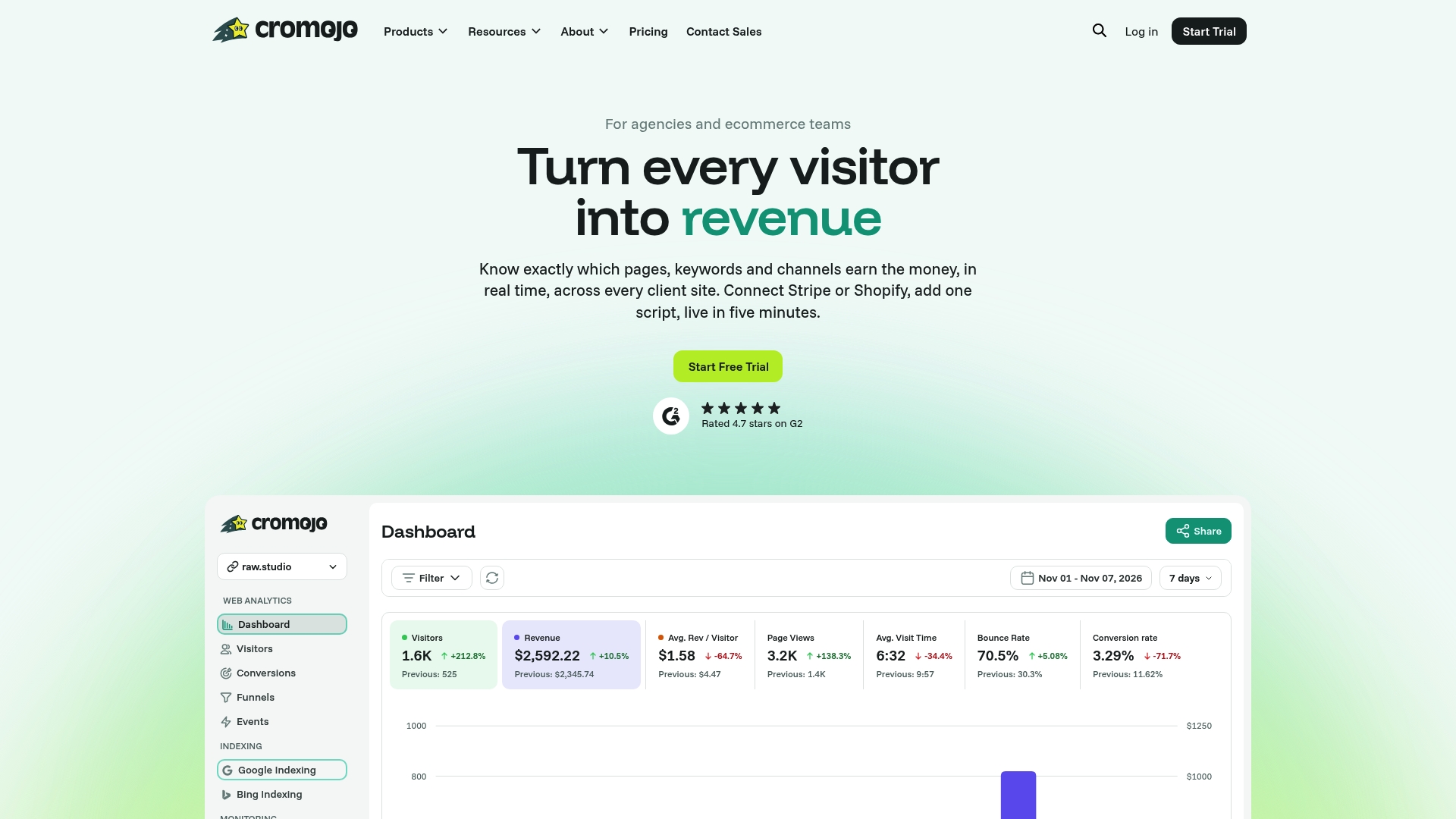
That matters most for the identity and privacy problems covered above. Cromojo runs on cookieless, first-party tracking, which means your measurement holds up as browser restrictions tighten instead of quietly degrading. Setup takes a lightweight script, no engineering sprint required, and the revenue attribution features map directly to page, keyword, and campaign-level performance. If you're weighing a cookie-dependent tool against something built for the post-cookie reality, the cookieless alternative to Google Analytics is worth comparing side by side. Start a trial and see which pages and campaigns are actually generating revenue before your next budget cycle.