



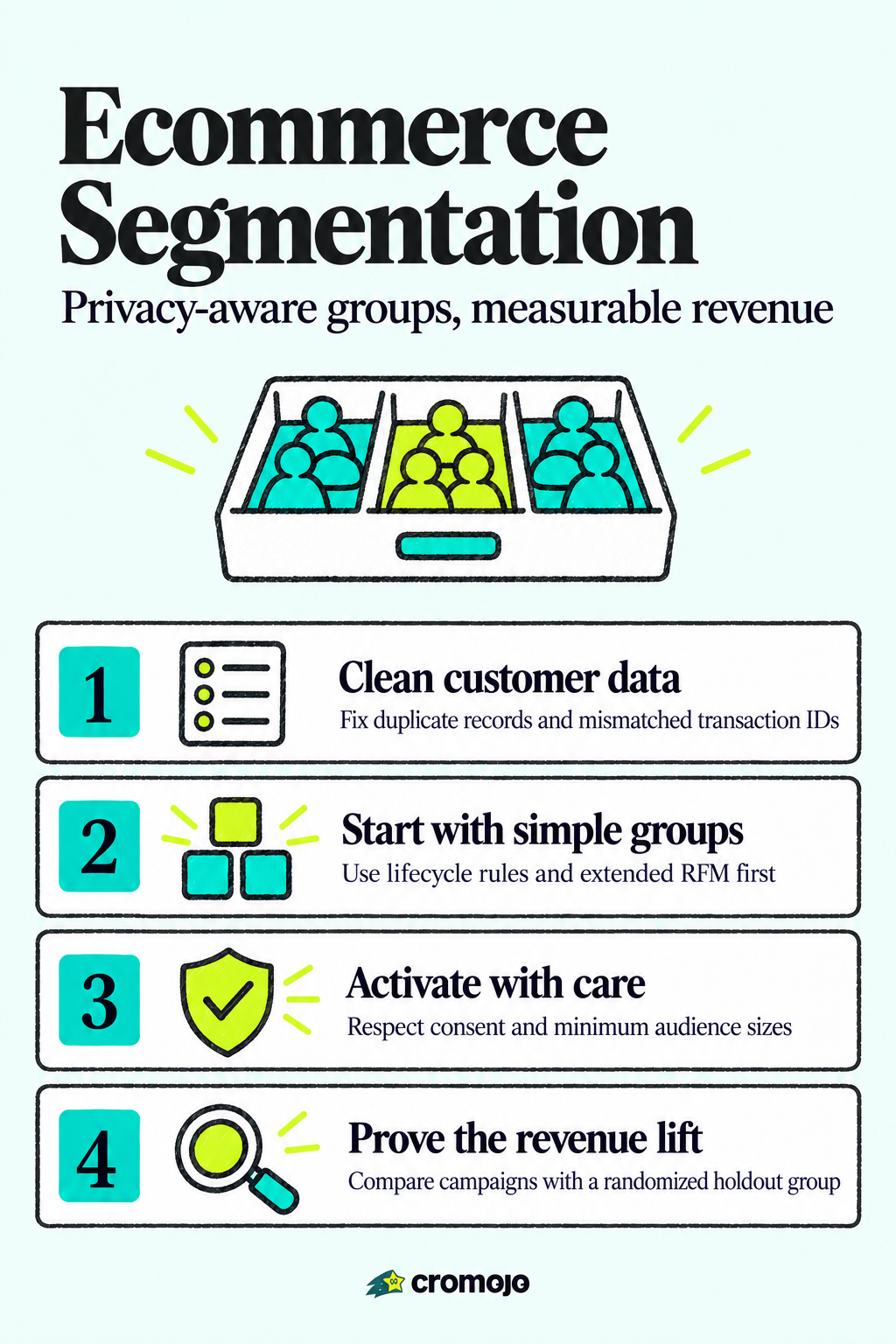
Advanced ecommerce segmentation means grouping customers by privacy-safe behavioral and predictive signals so every campaign maps back to revenue, not just clicks. The single best next step is to audit your identity and data hygiene, then pilot an extended RFM plus uplift test on one high-value cohort. From there, the priorities are data foundations, method selection, privacy-preserving activation, and measurement that proves each segment earns its budget.
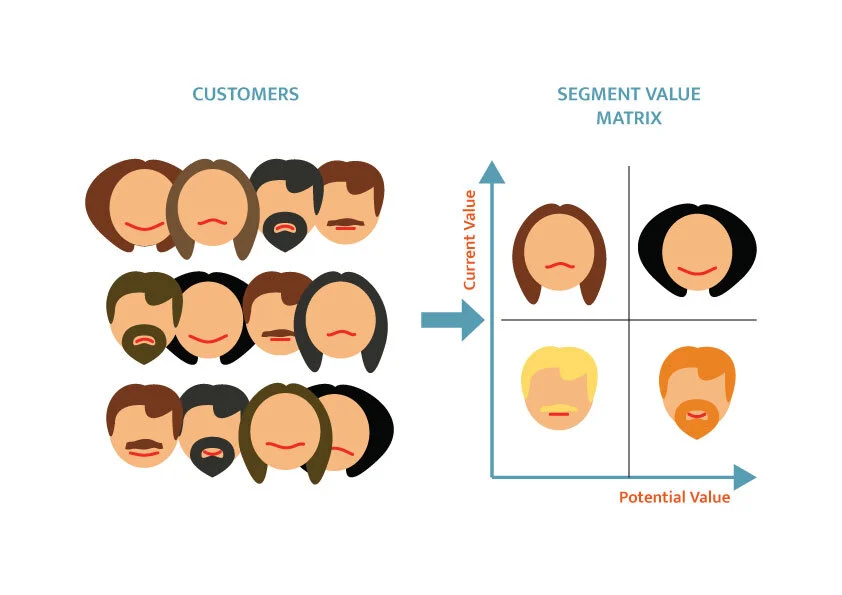
Why revenue-first segmentation changes what you track
Segmentation only earns its keep when it moves a number a finance team recognizes: customer lifetime value, average order value, retention rate, or return on ad spend. A "Champions" segment built from extended RFM scoring should be judged on retention lift and repeat purchase rate, not open rate. An "At-Risk" segment earns its place when a win-back campaign shows a measurable bump in reactivation revenue compared with a holdout group.
Treat every segment as a hypothesis about revenue, not a label. That framing changes how you build the segment in the first place: you choose features that predict spend behavior, not just ones that are easy to query.
The other shift is automation. Ad-hoc segment lists built once in a spreadsheet decay within weeks as purchase patterns move. Reproducible pipelines, whether built in SQL, a customer data platform, or a warehouse model, recalculate segment membership on a schedule and keep the definition versioned, so a marketer looking at "VIP customers" in March is looking at the same logic as in June, just with fresh data. That consistency is what lets you trust a quarter-over-quarter comparison instead of guessing whether the segment definition quietly drifted.
Building the data foundation: identity, first-party signals, and cookieless tracking
Segmentation is only as reliable as the data feeding it. Before any modeling work, you need a clear inventory of what you have and where it lives: transaction records, product catalog data, on-site events, CRM fields, payment metadata from processors like Stripe, email engagement history, and marketing touchpoint logs.
Identity stitching connects these sources into one customer record. Common approaches include:
- Transaction keys: order IDs and customer IDs from your commerce platform, the most reliable join point.
- Hashed email: a privacy-conscious way to match records across systems without exposing raw personal data.
- Server-side joins: matching events to a customer profile on your own infrastructure rather than relying on third-party cookies that browsers increasingly block.
Each approach carries a trade-off. Transaction keys are precise but only cover logged-in or checkout events. Hashed email matching extends coverage across channels but depends on consistent email capture. Server-side joins reduce data loss from cookie blocking but require engineering investment to maintain.
Consent constraints add another layer. Google's consent mode uses behavioral modeling to estimate the actions of visitors who declined tracking, filling gaps statistically rather than through raw event data. That modeling comes with eligibility thresholds and feature restrictions, so a segment built partly on modeled data will not have the same precision as one built on fully consented, first-party events. Our guide to first-party analytics covers how to structure consent-respecting data collection from the start.
Before trusting any segment, run basic hygiene checks: confirm timestamps are in a consistent timezone, deduplicate customer records across systems, verify currency normalization for multi-market stores, and flag any source with an unusual drop in event volume. Segments built on dirty joins will misclassify customers no matter how sophisticated the scoring model behind them.
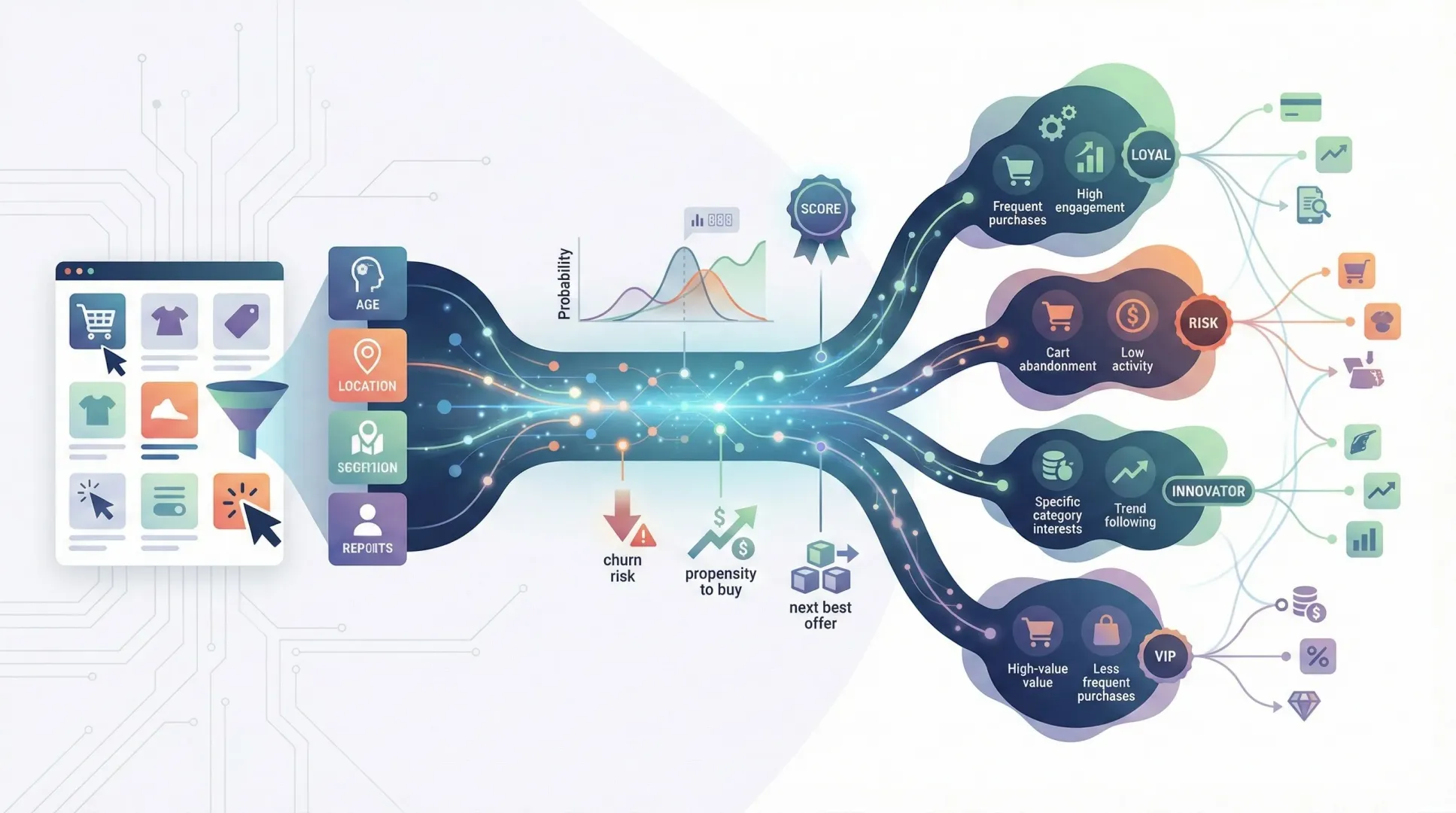
Core segmentation methods and when each one earns its place
Not every segment needs a model. Rule-based lifecycle segments, new customer, repeat buyer, lapsed, dormant, are quick to build and give you an immediate way to route email flows and onsite messaging. They are the right starting point when you need something live this week rather than perfectly optimized.
Extended RFM is the natural next step. Traditional RFM scores customers on recency, frequency, and monetary value, but adding basket depth, campaign share, and inter-order interval variance sharpens the segmentation considerably. Basket depth shows whether a customer buys single items or full baskets. Campaign share reveals how much of their spend is discount-driven. Inter-order interval variance flags customers whose buying rhythm is becoming erratic, often an early churn signal. Quintile scoring across these dimensions produces clusters that align closely with actual campaign strategy rather than generic labels.
Clustering algorithms group customers by feature similarity without a supervised target. K-means is fast and works well on numeric, roughly spherical clusters. K-medoids is more robust to outliers, useful when a handful of extreme spenders would otherwise skew the centroids. Fuzzy C-means allows partial membership, which fits ecommerce better than most industries since customers rarely belong to one behavioral bucket cleanly. Whichever algorithm you pick, validate cluster quality with indices like Silhouette score, Dunn index, or Davies-Bouldin, rather than trusting the first output.
Predictive models add a forward-looking layer: customer lifetime value forecasts, propensity-to-buy scores, and churn probability. Favor interpretable models such as logistic regression or gradient-boosted trees with feature importance output over black-box alternatives when marketing teams need to explain why a customer landed in a segment.
Uplift modeling and strategic querying push this further by targeting for causal impact rather than raw likelihood to convert. Strategic querying is particularly relevant under modern privacy constraints: research on blind targeting under third-party privacy limits found that this approach recovered nearly all of the targeting performance of non-privacy-preserving causal forest methods, while relying on far fewer noisy aggregate queries. That means you don't have to sacrifice targeting accuracy just because you're working with aggregated, privacy-safe data.
Our RFM segmentation playbook walks through implementation details for teams starting with the rule-based and extended RFM layers before moving into predictive scoring.
- Batch scoring suits segments refreshed daily or weekly, like CLV tiers.
- Real-time scoring suits triggers that need to fire within minutes, like cart abandonment.
- Fallback rules matter when a model fails to score a customer, defaulting to a safe, rule-based segment prevents that customer from falling out of every campaign.
Pro Tip:Start with extended RFM before adding a predictive model. It's cheaper to build, easier to explain to a marketing team, and often captures most of the signal a more complex model would find anyway.
Keeping targeting effective under privacy constraints
Modern ad platforms and analytics tools increasingly return aggregated, noise-added data instead of raw user-level records, a direct response to privacy regulation and browser restrictions. That shift limits how precisely you can target, but it does not eliminate the value of segmentation if you adjust your querying strategy.
Strategic querying is the practical answer. Rather than requesting broad, low-value aggregates, the approach prioritizes queries that carry the most information for a given targeting decision. The research behind this method showed it recovering nearly all of the performance of unrestricted causal targeting models on tested ecommerce data, using a fraction of the raw queries a naive approach would need.
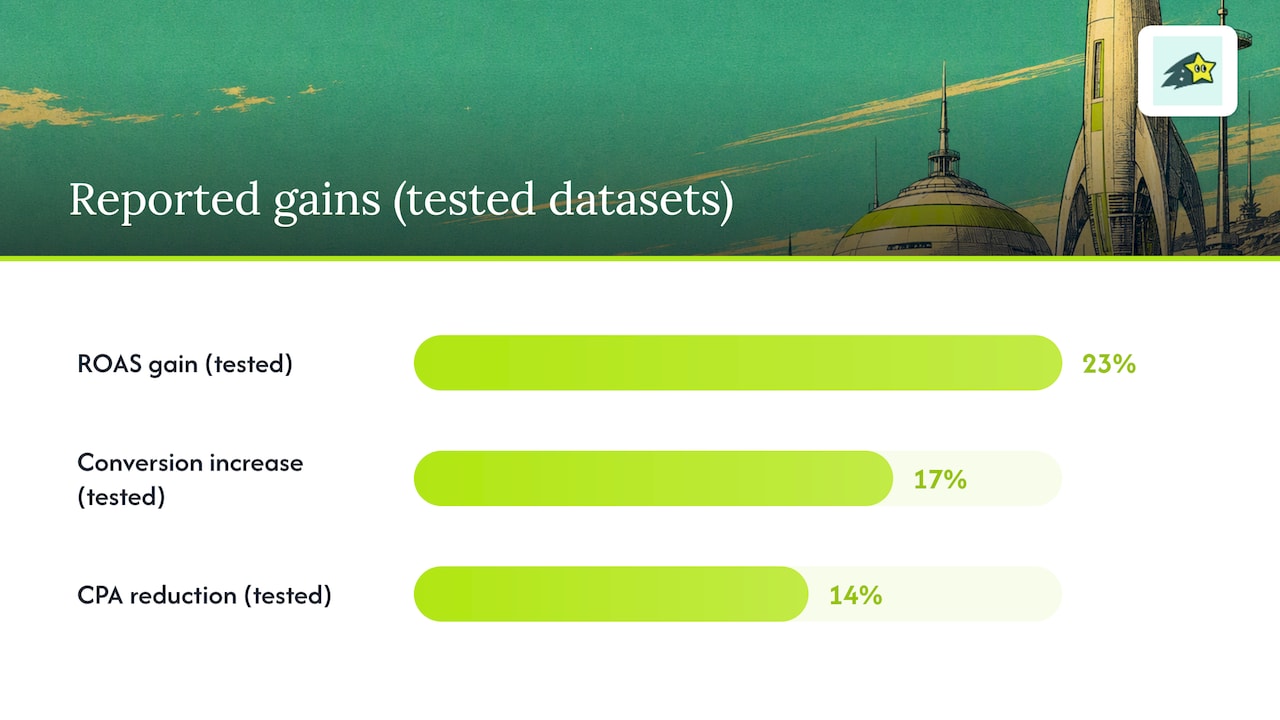
Data cleanrooms and federated learning extend this further by letting two parties, say a retailer and an ad platform, compute shared insights without exposing raw customer records to each other. A study on privacy-preserving segmentation for media optimization reported gains of roughly 23% in ROAS, a 17% increase in conversion rate, and a 14% drop in cost per acquisition when this kind of framework replaced conventional targeting in tested datasets. Those are reported results from one study's tested conditions, not a guarantee, but they point to real headroom when privacy-preserving methods are implemented well rather than treated as a compliance afterthought.
Before adopting either approach, run through a short checklist: confirm which data sources are actually eligible for cleanroom matching, set a query budget so you don't exhaust your privacy allowance on low-value questions, and monitor for model drift since aggregated inputs change more slowly than raw event streams, which can mask a segment going stale.
Pro Tip:Treat your privacy budget the way you'd treat an ad budget. Spend your highest-value queries on the segments that drive the most revenue, not evenly across every experiment you'd like to run.
Getting segments from the model into the channels that use them
A segment that lives only in a data warehouse does nothing for revenue. Activation is the step that connects scoring to the channels where customers actually see something different: email, ads, onsite personalization, SMS.
Three connection patterns cover most ecommerce setups:
- Webhooks push events in near real time from your commerce platform to a scoring service the moment a purchase or cart action happens.
- Server-side APIs let your own backend send updated segment membership directly to ad platforms and email tools without relying on browser-side tracking.
- Hashed audience uploads match customer lists to ad platforms for retargeting while keeping raw personal data out of the platform's hands.
Real-time triggers and audience exports solve different problems. A cart-abandonment message needs to fire within minutes, which calls for a real-time trigger with deduplication logic so the customer isn't messaged twice. A quarterly "high-CLV" audience for a prospecting lookalike campaign is fine as a batch export, since a few hours of latency changes nothing about its value.
A typical flow looks like this: a purchase event lands from Shopify or a payment record from Stripe, a scoring job updates the customer's RFM and CLV tier, and the updated segment membership pushes to the relevant ad platform or email tool as a refreshed audience. Our real-time analytics feature and the piece on designing experiences that convert go deeper into how that real-time layer should behave in practice.
Watch export thresholds closely. Most ad platforms require a minimum audience size before they'll activate a list, and pushing segments that are too small both wastes the upload and risks re-identifying individuals from an overly narrow group, which undercuts the privacy protections you built earlier in the pipeline.
Proving segments actually move revenue
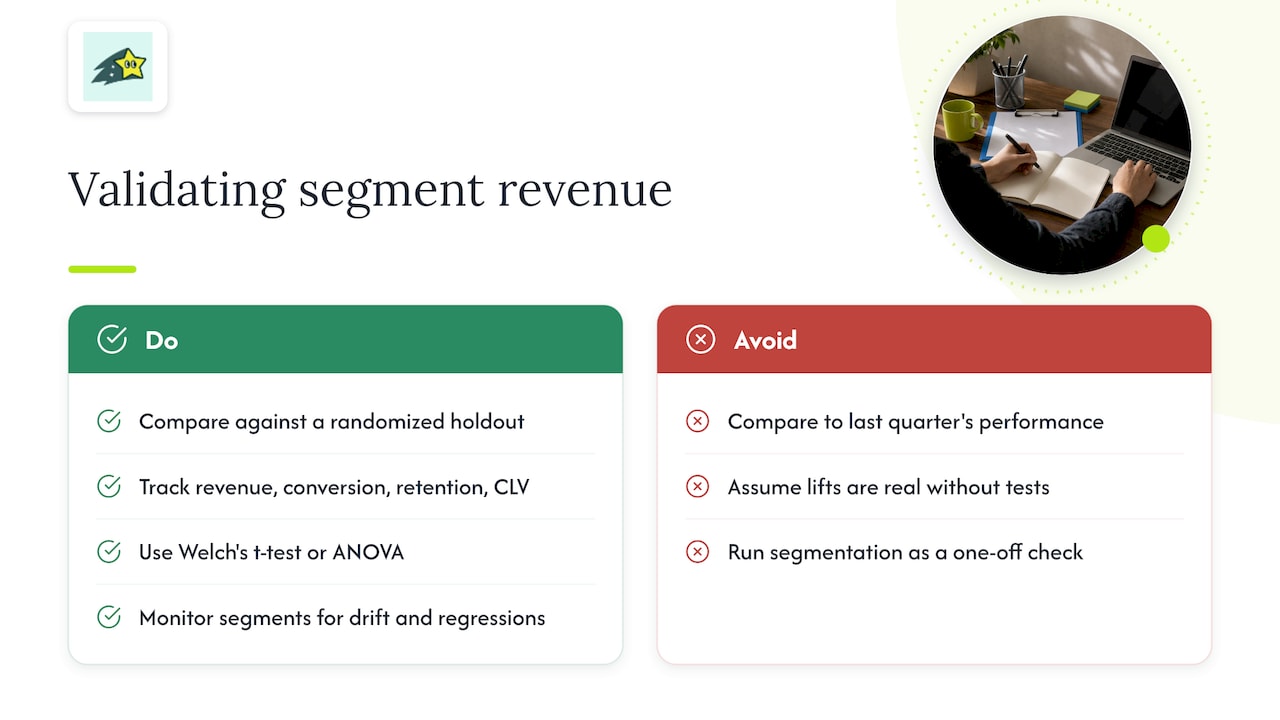
A segment is worth nothing until you can show it changes behavior compared with customers who never saw it. The right KPIs are revenue per recipient, conversion lift, retention rate, and CLV movement over time, tracked against a holdout group that receives no special treatment.
Statistical validation keeps you honest about whether a difference is real or noise. Welch's t-test compares means between two segments without assuming equal variance, which fits ecommerce data well since spending patterns rarely have identical spread across groups. ANOVA extends that comparison across three or more segments at once, useful when testing a full lifecycle model rather than a single pair. Open-source RFM pipelines demonstrate how these tests get built directly into a reproducible segmentation workflow rather than run as a one-off check.
A rigorous holdout design is the difference between correlation and proof. Randomize assignment before the campaign runs, keep the holdout large enough to detect a meaningful lift, and measure incremental revenue against that group rather than against last quarter's performance.
Once a segment is live, keep monitoring it. Segment drift, where the customers inside a group quietly change character over a few months, and data-quality regressions, like a broken event feed, are the two most common ways a previously validated segment stops earning its keep. Our attribution models guide covers how to keep segment performance tied cleanly to revenue attribution rather than vanity engagement metrics.
Rolling it out: a checklist and the mistakes that undo it
Operationalizing segmentation is less about sophistication and more about discipline. Follow this sequence:
- Audit your data: confirm identity resolution, timestamp consistency, and source completeness before building anything.
- Define segment rules and features: start with lifecycle and extended RFM before layering in predictive scores.
- Set a sampling and validation plan: decide holdout size and statistical test before the campaign launches, not after.
- Connect activation destinations: confirm webhook, API, or hashed upload paths are tested end to end.
- Establish monitoring and governance: version every segment definition and log changes.
The most common failure is overfitting a segment to a small sample, chasing a pattern that a bigger dataset would erase. Stale segmentation, where a "new customer" bucket still includes people from eight months ago, is a close second. Privacy leaks from oversized personal-data exports and simple export mistakes, like uploading an unhashed customer list, round out the usual list of avoidable errors. Name and version every segment, automate refresh schedules, and keep an audit log so a rollback is a five-minute fix instead of a forensic investigation. Readers weighing whether this level of rigor fits a smaller catalog should see our take on whether privacy analytics is overkill for a small website.
What actually separates teams that see revenue from this work
The teams that get the most out of advanced segmentation are rarely the ones with the fanciest models. They're the ones who fix identity resolution first, since a clustering algorithm built on duplicate or mismatched customer records is precise about the wrong thing.
Complexity should follow proof, not precede it. Start with a rule-based lifecycle segment and one validated uplift test, prove the lift, then add a predictive layer. Teams that jump straight to clustering and propensity scoring often spend months tuning a model whose input data was never trustworthy to begin with.
How Cromojo shortens the path from segment to revenue
A segment only matters if you can trace it back to actual revenue. Cookieless tracking can keep identity data privacy-friendly by default, and integrations with payment and commerce platforms can feed transaction data to your segmentation pipeline without a separate data engineering project. Advanced segmentation features can enable building extended RFM and lifecycle groups directly against real-time revenue attribution.
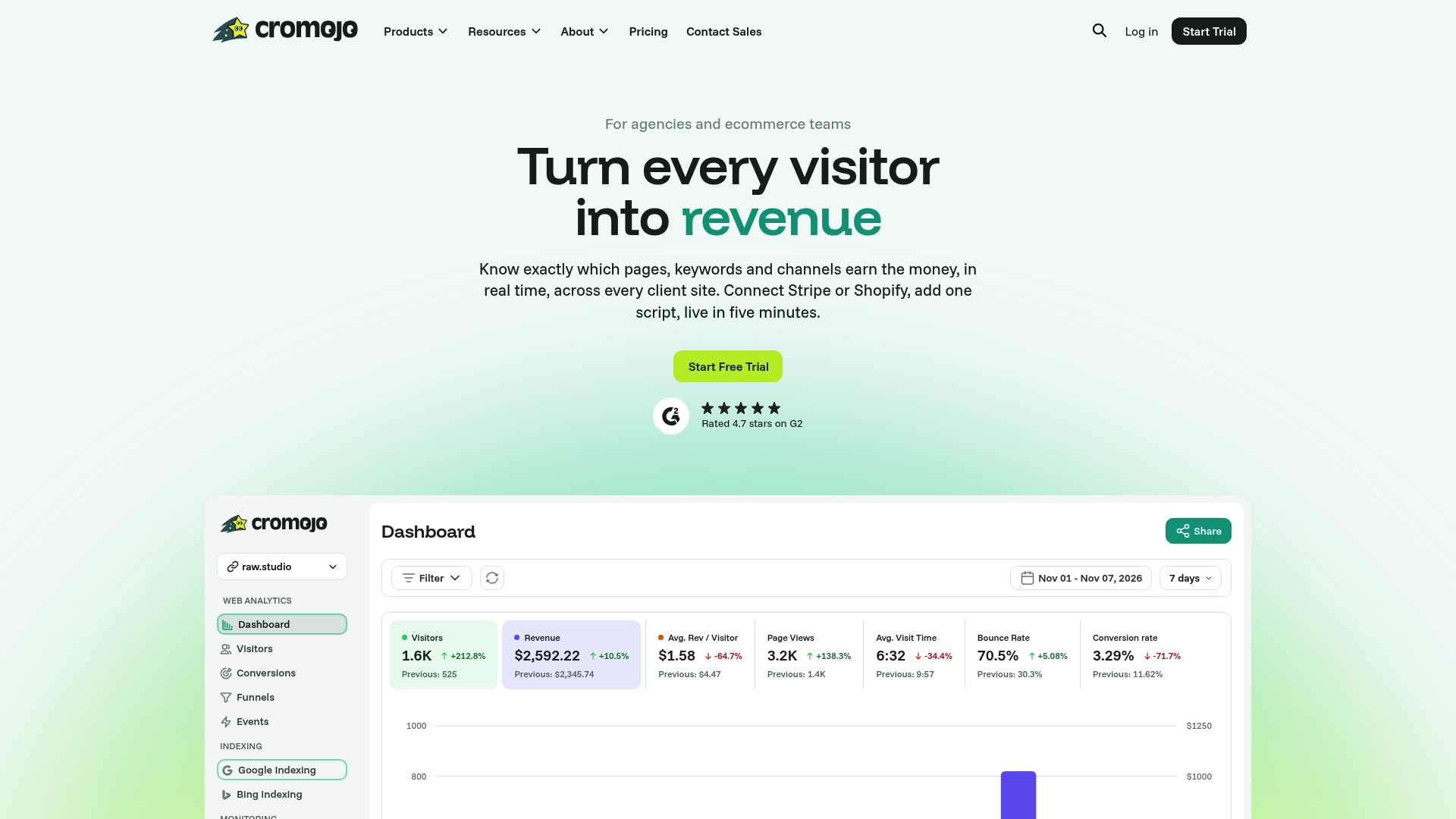
In practice, that shortens the distance between "we have an idea for a segment" and "we can see whether it worked":
- Real-time revenue attribution shows which pages, keywords, and channels a segment's purchases actually came from.
- Automated indexing and site monitoring keep the underlying traffic data clean, so segmentation isn't built on top of tracking gaps.
- Conversion funnels and visitor journey analysis give you the behavioral inputs extended RFM needs without a separate analytics stack.
Most teams see their first working segment tied to revenue within days, not months, since the data connections are already built rather than assembled from scratch. If you're evaluating options, our comparison of Cromojo against Simple Analytics breaks down where the revenue-first approach differs. Start on the free plan or check the Pro and Business tiers if you're ready to connect Stripe or Shopify data directly.