


Marketing ROI tracking measures the profit generated by marketing activity, calculated by comparing revenue against cost. Today's best approach combines attribution, marketing mix modeling, and incrementality testing on a first-party data foundation. ROI and ROAS are not the same thing: ROI accounts for cost and margin, while ROAS only measures revenue per ad dollar. Prioritize incremental revenue and customer lifetime value over headline numbers alone.
Key metrics that show whether marketing is working
Every marketing dashboard drowns in numbers. The trick is knowing which ones actually change a decision and which ones just look good in a slide deck.
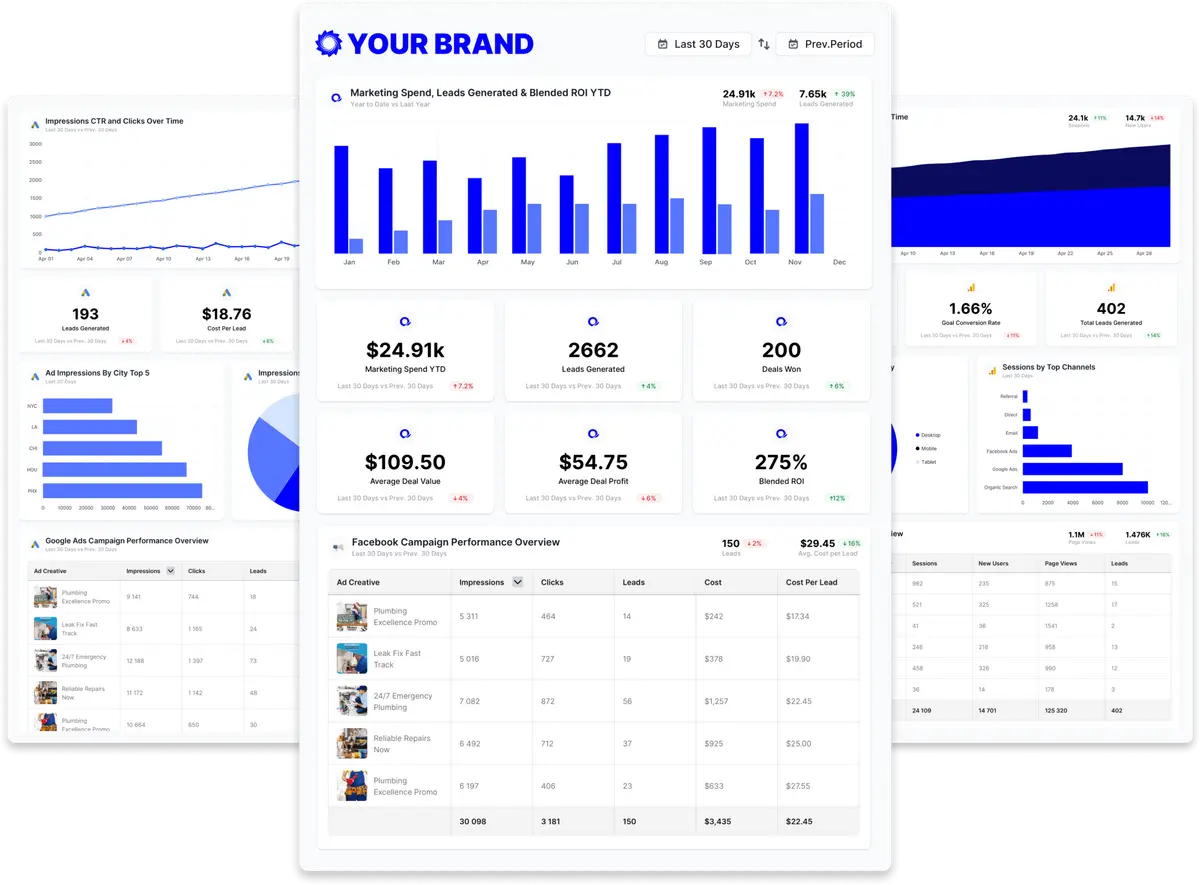
Start with the fundamentals: Revenue attributable to marketing, Marketing Cost (media plus tools plus labor), Customer Acquisition Cost (CAC), and Customer Lifetime Value (CLV). These four feed almost every other calculation you will run. From there, layer in ROAS for channel-level ad efficiency, incremental ROAS for the portion of that revenue marketing actually caused, conversion rate to spot funnel friction, and attribution window length, which quietly shapes every number above it.
Marginal ROMI (return on marketing investment) deserves its own attention. Because returns on marketing spend rarely scale in a straight line, the marginal return on your next dollar of spend often differs sharply from your average return across the whole budget.
- CAC and conversion rate drive short-term, tactical optimization like bid adjustments and creative testing.
- CLV and incremental ROAS inform long-term strategy, including which channels deserve bigger annual budgets.
- Marginal ROMI answers the specific question executives care about: should we spend more or less here next quarter?
When you report upward, executives want CLV, incremental ROAS, and marginal ROMI framed as business outcomes. Your operations team needs CAC, conversion rate, and channel ROAS updated daily to make tactical calls.
How to calculate marketing ROI: formulas and worked examples
The standard formula is straightforward: Marketing ROI equals (Revenue minus Marketing Cost) divided by Marketing Cost, multiplied by 100. ROAS, by contrast, simply divides revenue by ad spend and ignores cost structure and margin entirely, which makes it useful for quick channel comparisons but risky as a profitability signal on its own.
For a fuller picture, adjust for gross margin and lifetime value rather than one-time revenue. This is sometimes called CLV-adjusted ROMI, and it matters most for subscription or repeat-purchase businesses where the first sale is only part of the story.
- Acquisition campaign example: say a campaign spends $10,000 and generates $15,000 in first-purchase revenue. ROI is (($15,000 minus $10,000) divided by $10,000) times 100, or 50%.
- Retention campaign example: say a $2,000 win-back campaign drives $3,000 in immediate revenue, but those customers carry an average CLV of $9,000. Judged only on immediate revenue, ROI is 50%. Judged on lifetime value, the return is far higher, which is why retention campaigns often look weak until you account for CLV.
The modern measurement toolbox: attribution, MMM, and incrementality
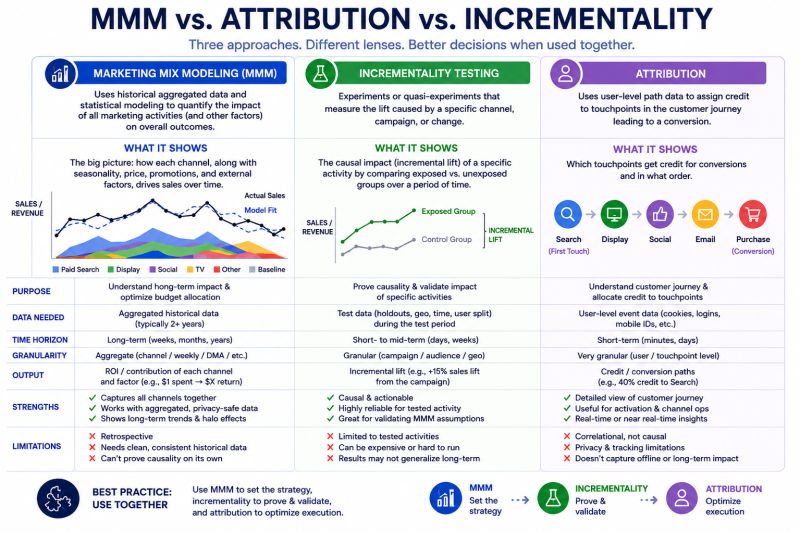
No single measurement method tells the whole story, which is why the modern approach blends three complementary methods rather than relying on one.
- Data-driven attribution offers granular, near-real-time visibility across touchpoints and is well suited to daily optimization decisions, such as reallocating budget between ad sets.
- Marketing mix modeling (MMM) looks at aggregate spend and outcomes over longer periods, making it privacy-resilient and strong for quarterly and annual planning.
- Incrementality testing isolates causal lift by comparing exposed and unexposed groups, and it is widely treated as the gold standard for proving a channel actually caused a sale rather than merely correlating with one.
Attribution tells you what happened across touchpoints, MMM tells you what tends to work at scale, and incrementality tells you what would not have happened without the spend.
Calibration ties the three together. Run an incrementality test on your largest channel, compare the lift to what your attribution model claimed, and adjust the model's weighting accordingly. Repeat quarterly, since channel behavior and consumer response shift with the market.
Pro Tip:Treat attribution numbers as a starting hypothesis, not a verdict, until an incrementality test has checked them against reality.
Building the data foundation: first-party tracking and consent
Reliable ROI tracking starts long before a dashboard. It starts with the data infrastructure underneath it, and most measurement problems trace back to gaps here rather than to the formulas themselves.
First-party data collection is the foundation. Every site needs a consistent event taxonomy (what counts as a lead, a checkout start, a purchase) applied the same way across every page and campaign. Server-side tagging reduces the data loss that comes from browser restrictions and ad blockers, and it holds up better as third-party cookies keep fading.
- UTM hygiene matters more than it gets credit for: inconsistent campaign naming quietly breaks attribution reports for months before anyone notices.
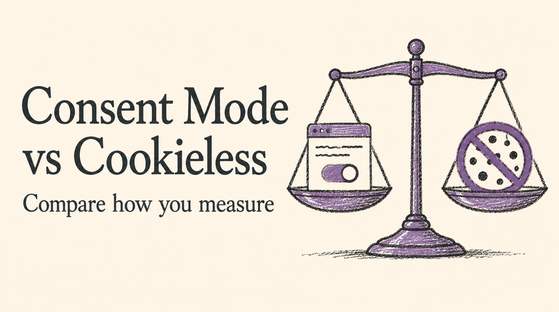
- Consent Mode and conversion modeling help recover visibility lost to declined tracking permissions without violating a visitor's choice.
- Revenue source integration, connecting tools like Stripe, Shopify, or a CRM directly into your analytics, closes the gap between "a click happened" and "a sale happened."
Cookieless approaches deserve a specific mention here. They shift measurement toward aggregated, privacy-respecting signals rather than individual-level tracking, which fits neatly with the MMM and incrementality methods described above and sidesteps a lot of the consent friction that plagues cookie-based systems.
What to demand from an ROI-tracking tool or platform
Not every analytics tool that claims to track ROI actually does the job well. Before committing to one, check it against a short list of non-negotiables.
- Integrations that matter: direct connections to your ecommerce platform, ad accounts, CRM, and (ideally) a data warehouse, so revenue and cost data meet without manual exports.
- Measurement depth: support for data-driven attribution at minimum, with incrementality testing options and the ability to export data cleanly into an MMM process.
- Operational fit: real-time or near-real-time revenue attribution, a privacy-first or cookieless tracking mode, and setup that does not require a developer sprint to complete.
- Reporting that reflects reality: dashboards built around marginal ROI and incremental ROAS rather than raw click counts, calibrated periodically against test results instead of left on autopilot.
A tool that scores well on integrations but weak on measurement depth will give you fast, confident-looking numbers that are wrong in ways you will not catch until a quarter's budget has already been spent on the wrong channel.
A 30 to 90 day plan to get ROI tracking working
Trying to fix marketing measurement all at once usually stalls. A phased plan gets a working system in place within a quarter.
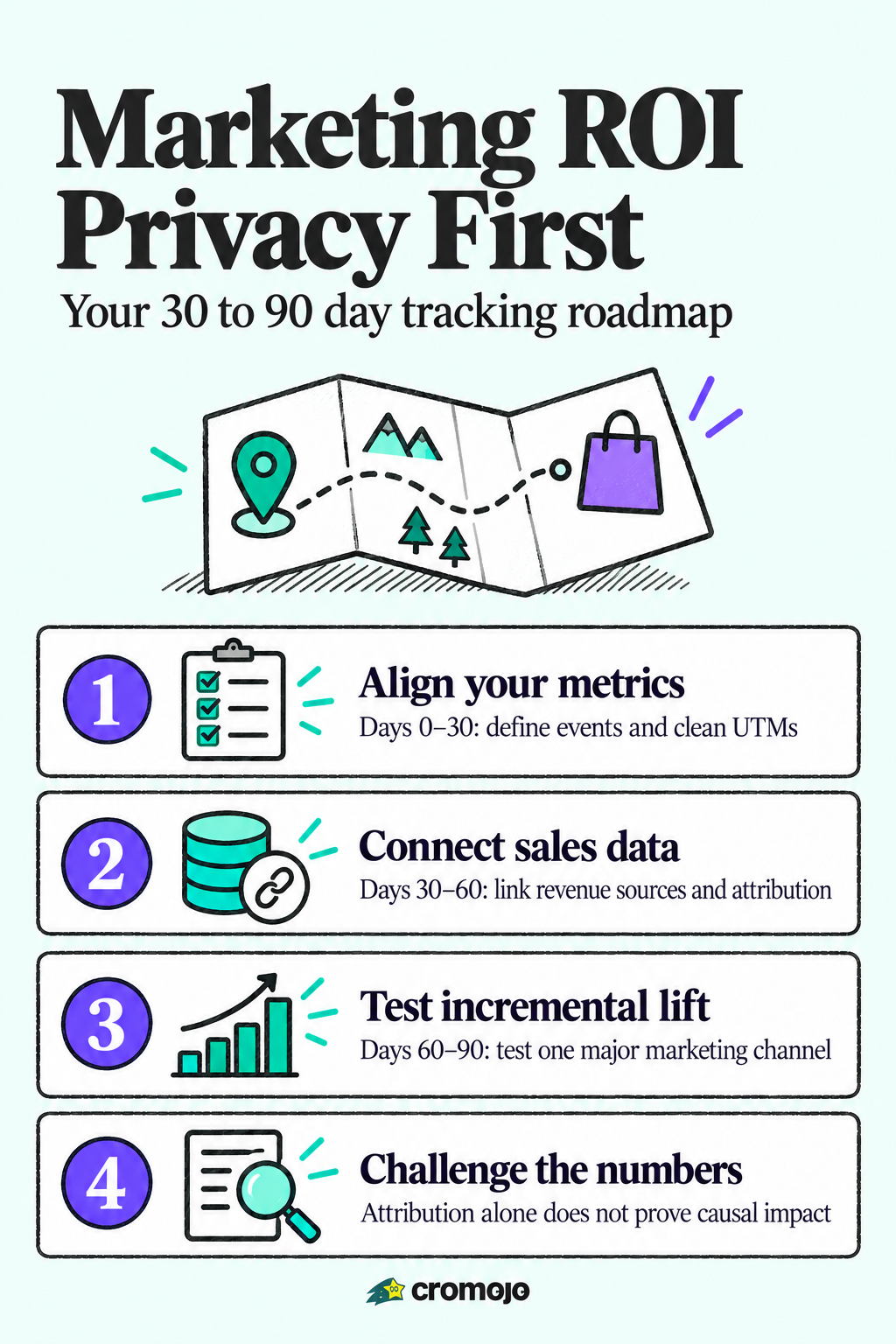
- Days 0 to 30: align stakeholders on which KPIs actually matter, define your conversion events precisely, and fix any broken or inconsistent UTM tagging across active campaigns.
- Days 30 to 60: implement server-side or sitewide event tagging, connect revenue sources like Stripe or Shopify directly into your analytics, and start producing basic attribution reports.
- Days 60 to 90: run your first incrementality test on the channel with the largest budget, and begin building a lightweight marketing mix model using the historical data now flowing in.
- Ongoing: calibrate attribution against test results quarterly, report marginal ROI rather than headline ROI to leadership, and iterate the whole stack as channels and consumer behavior shift.
Expect the first 30 days to feel like housekeeping, since fixing tagging rarely produces exciting charts. The payoff shows up in the next phase, when clean revenue attribution starts making budget conversations shorter and less speculative.
Pro Tip:Run your first incrementality test on the channel you already suspect is overrated. A clear result there builds more internal trust in the system than a test on a channel everyone already agrees is working.

How a revenue-first analytics platform fits into this stack
Cromojo is built around real-time revenue attribution by page, keyword, and channel, with direct Stripe and Shopify integrations that link sales to the marketing that produced them. It combines this with cookieless tracking, automated search indexing, and site monitoring. Ecommerce teams and agencies managing several client sites tend to benefit most, since revenue linkage and setup speed matter more than deep custom modeling at that stage.
Where teams actually get stuck
The biggest mistake I see is not picking the wrong metric. It is chasing a single clean number instead of accepting that ROI tracking is a system with moving parts. If you can only fix one thing first, fix the link between your marketing spend and your actual revenue data: UTMs and first-party revenue integration. Schedule incrementality tests when you are about to make a large budget decision, not as a routine monthly habit. Quick wins show up in tagging fixes within weeks; the real payoff, a calibrated model you trust, takes a full quarter or two.
Faster revenue attribution without the setup overhead
Most of the friction in ROI tracking comes from stitching together ad platforms, ecommerce data, and analytics by hand. Some platforms connect to payment and ecommerce systems, attributing real-time revenue to pages, keywords, and channels, and use cookieless tracking to reduce consent friction alongside automated indexing to keep pages discoverable.
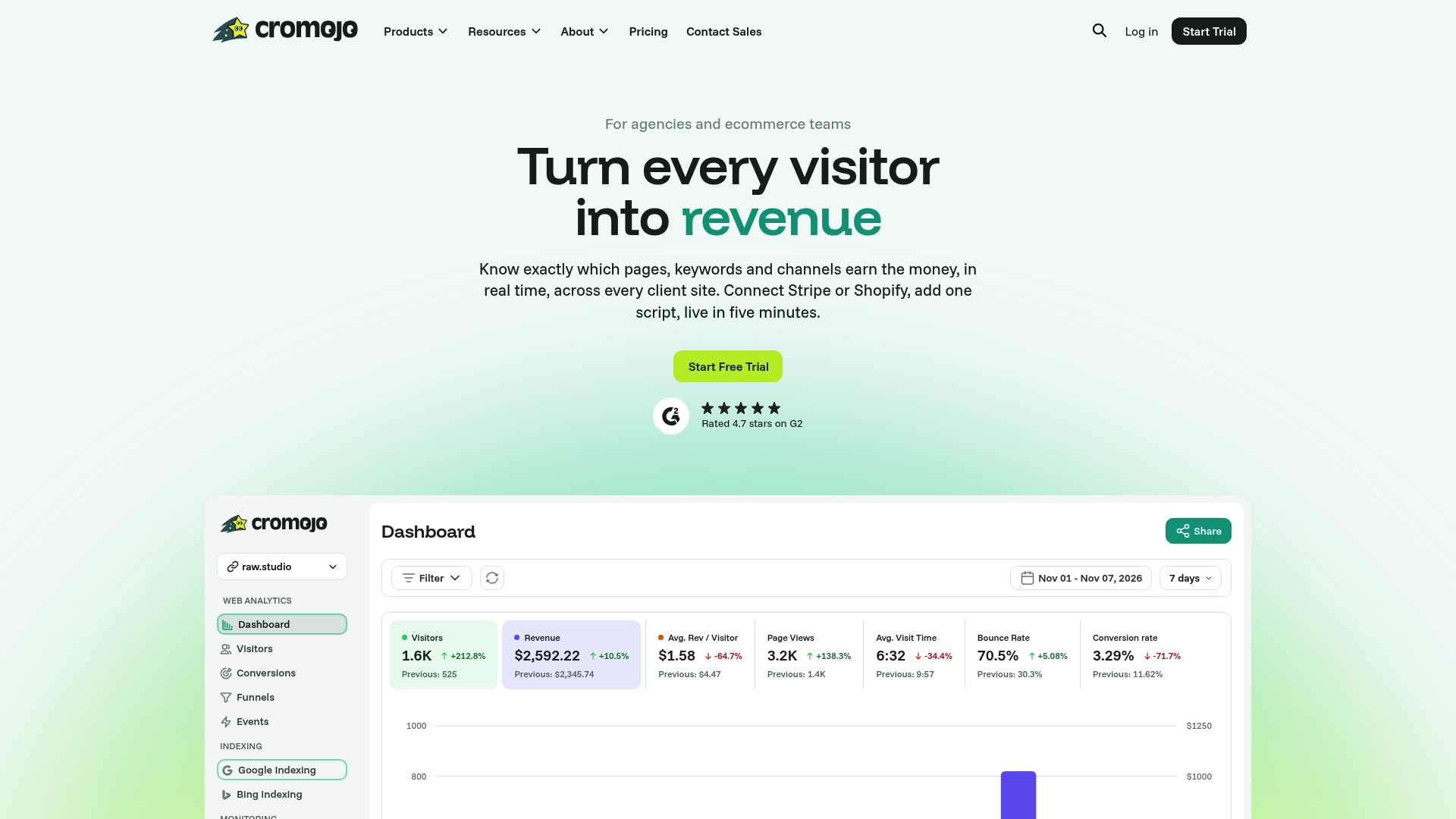
This fits ecommerce teams and agencies who want revenue-first reporting without building the attribution plumbing themselves.
- Real-time revenue attribution tied to Stripe and Shopify sales data.
- Cookieless tracking that reduces consent-related data gaps.
- Automated indexing and site monitoring bundled into the same platform.
Plans start at $19 a month on the Starter tier, with Pro, Business, and Agency tiers scaling for larger catalogs and client portfolios. Check the pricing page to find the tier that matches your traffic and revenue volume.