



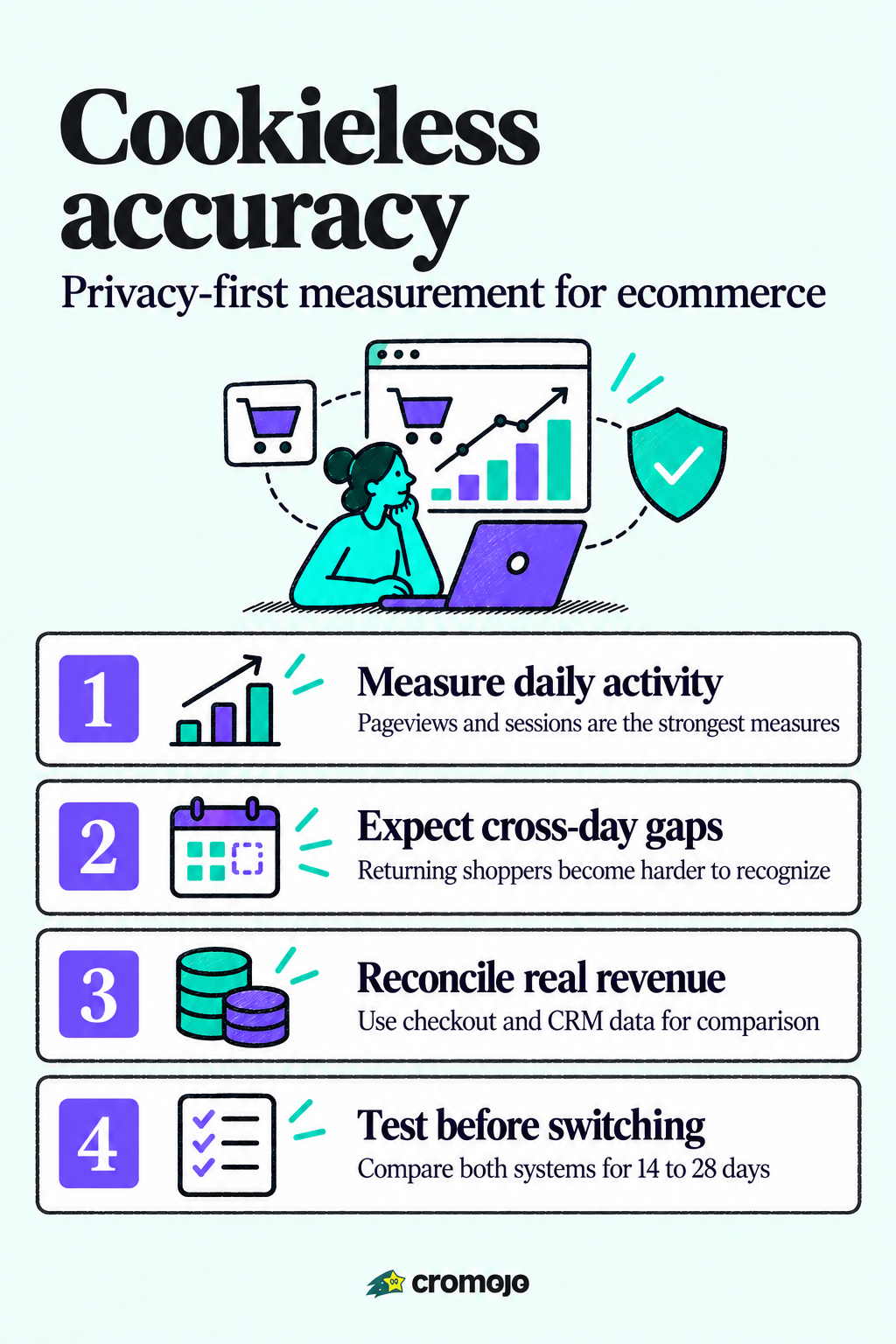
Cookieless tracking accuracy is strong for pageviews, sessions, and same-day unique visitors, typically within a few percentage points of cookie-based numbers. It breaks down for anything that needs to recognize the same person across multiple days: cross-day deduplication, multi-touch attribution, retention, and lifetime value all lose precision without a deterministic identifier. If your revenue reporting depends on daily and weekly trends, cookieless capture works today. If it depends on tracking one shopper across a three-week consideration window, you need a hybrid approach.
How Accurate Is Cookieless Tracking, Really?
The honest answer depends entirely on which method you mean and which metric you're checking. "Cookieless tracking" isn't one technology. It's a category of five distinct approaches, each with its own accuracy profile, and conflating them is where most marketers get burned.
Here's the taxonomy you'll actually encounter when evaluating vendors or building your own stack:
- Server-side daily-scoped hashes and ephemeral IDs. The system computes a hash from a visitor's IP address, user agent, and a salt that rotates every 24 hours, then discards the raw IP immediately. This produces a temporary identifier good for exactly one day, which is why daily unique counts come out nearly identical to cookie-based tracking, according to Margin's implementation analysis. The trade-off is built in: because the salt changes daily, the same visitor gets a new hash tomorrow, so cross-day identity is deliberately impossible.
- Device and browser fingerprinting. This method combines signals like screen resolution, installed fonts, time zone, and browser configuration into a composite fingerprint. Research on behavioral telemetry has found that signals like mouse movement and scroll dynamics can identify returning visitors with notably high accuracy in controlled test environments. That accuracy doesn't transfer cleanly to production, where browser updates, privacy extensions, and anti-fingerprinting features in Safari and Firefox degrade signal quality and create legal exposure.
- Identity graphs and CRM joins. These connect anonymous browsing behavior to a known customer record once someone logs in, enters an email at checkout, or clicks an emailed link. Accuracy here is deterministic, not probabilistic, but it only works for the fraction of traffic that authenticates or converts.
- Universal ID solutions. These rely on a shared identifier, often built from a hashed email, that multiple publishers or ad platforms recognize. Their accuracy is a direct function of match rate: how many visitors have registered an email with the identity provider in the first place.
- Consent-mode and probabilistic modeling. When a visitor declines tracking consent, platforms like Google Analytics can model what likely happened using patterns from consenting users. It's statistical inference, not observation, and its reliability rises and falls with your site's consent rate.
Every one of these methods trades some form of precision for either privacy compliance, technical simplicity, or coverage. None gives you all three.
What Accuracy Numbers Should You Actually Expect?
The short version: daily numbers are trustworthy, longer windows drift, and modeled data is a best-effort patch, not a replacement.
Server-side daily hashing delivers daily unique visitor counts within roughly 1% to 3% of cookie-based tracking, based on comparative benchmarks from Improvado's attribution analysis. That's close enough for day-to-day trend monitoring and campaign pacing decisions.
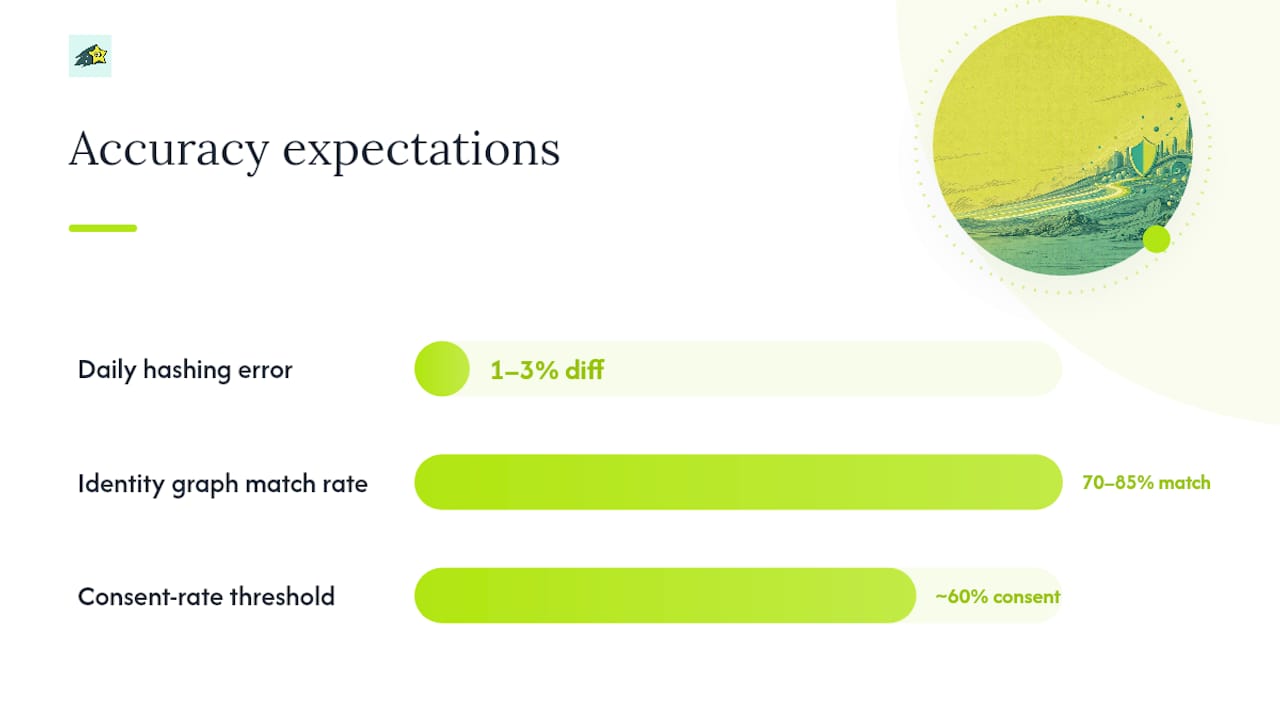
The problem shows up when you zoom out. A shopper who visits Monday, Wednesday, and Friday looks like three different people instead of one returning visitor. This isn't a bug you can patch. It's the direct, unavoidable consequence of how ephemeral hashing is designed, as JustAnalytics' technical breakdown explains.
Identity graphs and CRM joins perform better on cross-day matching, but only where coverage is strong. Match rates commonly land in the 70% to 85% range when a business has solid email or login capture, though that figure swings heavily based on how much personal data customers share and what consent they've given, according to Improvado's benchmark data.
Accuracy Snapshot: Advanced Consent Mode v2 is estimated to recover a substantial portion of attribution data otherwise lost to opted-out traffic, but that recovery rate depends heavily on your site's overall consent rate. Performance degrades noticeably once consent rates drop below about 60%, according to Trackingplan's cookieless research.
Fingerprinting sits in an odd spot. It can post impressive accuracy numbers in a lab setting, but production traffic is messier, and regulators increasingly treat persistent fingerprinting as functionally equivalent to cookies under privacy law. Treat any fingerprinting vendor's accuracy claims as a ceiling, not a guarantee.
When you compare a published benchmark against your own numbers, check these variance drivers first:
- Your traffic's return-visit frequency (higher repeat visits mean more overcounting from daily-rotation methods).
- Your site's actual consent opt-in rate, which directly caps modeled recovery.
- The share of traffic on mobile carriers or corporate networks using shared IP ranges.
- Whether your CRM or login system captures identity early in the funnel or only at final checkout.
Which Metrics Stay Reliable, and Which Don't?
Pageviews and session counts hold up well under cookieless methods because they don't require recognizing the same person twice. Each page load or session gets counted as it happens, with no dependency on stitching visits together over time.
Channel and campaign attribution at the session level also stays accurate. A UTM tag on a link tells you exactly where that single session came from, regardless of whether you can later connect it to the same visitor's next session.
Here's where accuracy erodes:
- Cross-day unique visitors get overcounted, as covered above, once daily identifiers stop being comparable across dates.
- New versus returning visitor segmentation becomes unreliable, since "returning" requires recognizing a prior visit that a rotating identifier has already forgotten.
- Retention and cohort analysis lose accuracy for the same reason: you can't measure a 30-day retention curve with an identifier that resets every 24 hours.
- Multi-touch attribution degrades sharply, since crediting five touchpoints across two weeks requires linking sessions that cookieless methods intentionally don't link.
- Lifetime value calculations suffer without a deterministic customer identifier tying purchases together over months.
The practical fix isn't abandoning cookieless tracking. It's substituting shorter measurement windows and event-level revenue figures where cross-day identity used to fill the gap, and reserving deterministic matching for the metrics that genuinely need it.
What Causes Cookieless Tracking to Misfire?
Every measurement error has a signature. Learning to recognize these signatures in your own data is faster than guessing why your numbers look off.
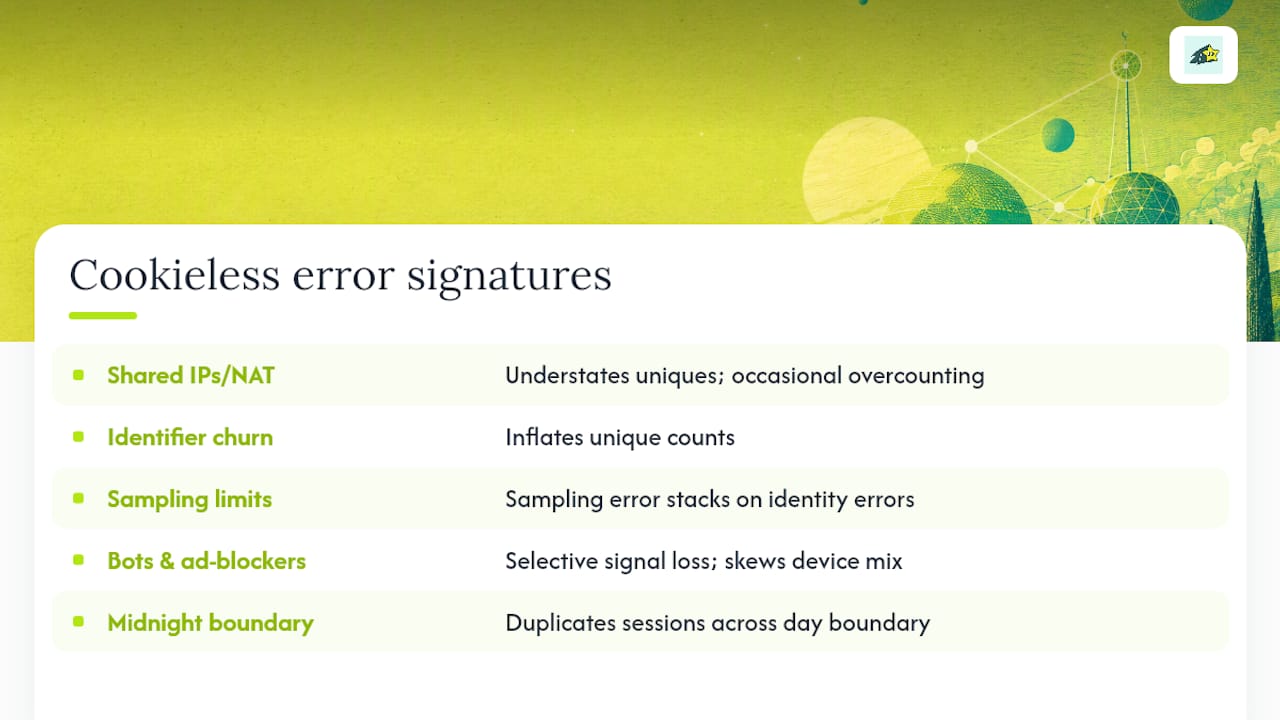
Shared IP addresses and carrier-grade NAT create a specific bias: a hash built partly from IP address will lump together dozens of visitors on the same corporate network or mobile carrier, understating true unique visitor counts in those slices while occasionally overcounting in others.
Identifier churn happens when a visitor's IP address or user agent changes mid-session, say, switching from Wi-Fi to mobile data, and the system generates a new hash for what's actually the same person. This tends to inflate unique counts rather than deflate them.
Sampling and metered-data limitations introduce their own bias. The Total Error framework used in survey and web-trace research identifies coverage error, measurement error, and representation error as distinct failure modes that compound each other in metered tracking systems, according to research published through LSE. If your analytics platform samples traffic rather than capturing it in full, that sampling error stacks on top of any identity-resolution error.
Bot traffic and ad-blockers remove signal selectively rather than randomly. Ad-blockers tend to strip tracking scripts more aggressively on desktop than mobile, which can skew device-mix reporting even when total traffic looks stable.
Midnight-boundary artifacts occur because daily-rotation salts typically reset at a fixed time. A visitor browsing at 11:58 PM and returning at 12:03 AM gets counted twice, even though only five minutes passed.
Pro Tip:Before you flag a sudden traffic anomaly as a tracking bug, check whether it lines up with a timezone boundary or a salt rotation window. Half the "mystery spikes" marketing teams chase down turn out to be sessionization artifacts, not real behavior changes.
How Do You Test Cookieless Accuracy On Your Own Site?
Benchmarks from other companies tell you what's possible. They don't tell you what's happening on your site, with your traffic mix, your consent rates, and your product catalog. Here's a validation plan you can run without hiring outside auditors.
- Run cookie-based and cookieless instrumentation in parallel on your consenting traffic segment, keeping every other variable identical: same tagging, same page templates, same time window. A first-party analytics setup makes this easier because you control the data pipeline rather than relying on a third-party script.
- Hold the parallel run for 14 to 28 days minimum. Shorter windows get skewed by single-day anomalies like a flash sale or a viral social post; a practical validation approach recommends this range specifically to smooth out day-to-day noise, per Improvado's implementation roadmap.
- Compute five deltas: daily unique visitor variance, weekly and monthly unique variance, pageview parity, conversion capture rate, and revenue match rate between the two systems.
- Set acceptance thresholds before you start, not after you see the results. A common calibration is a daily-unique delta under 5% and a conversion-capture delta under 3%, adjusted for your traffic volume, based on Improvado's benchmark methodology.
- Reconcile revenue through CRM or login events. When a visitor authenticates or checks out, join that event back to their anonymous session history within a bounded window, typically 30 days, treating the match as a best-effort reconciliation rather than absolute proof of identity, as described in one engineer's account of building anonymous-to-signed-in tracking.
- Document any consistent bias you find, whether that's a 9% weekly overcount or a 12% gap in mobile conversion capture, and report it to stakeholders as a known measurement characteristic rather than an unexplained discrepancy.
Benchmark to test against: if your parallel run shows daily unique visitor variance under 5% and conversion capture delta under 3%, your cookieless setup is performing in line with published industry ranges. Numbers outside that band usually point to a configuration issue, not an inherent limitation of the method.
How Can You Improve Accuracy Without Losing Privacy?
You don't have to choose between "fully cookieless" and "fully deterministic." Most ecommerce teams land somewhere in between, and the smartest implementations are deliberately hybrid.
Start with the server-side pattern: compute your visitor hash from IP, user agent, and a daily-rotating salt, discard the raw IP the moment the hash is generated, and never persist a cross-day linkable identifier. This design, detailed in Margin's technical guide, gives you accurate daily metrics with minimal data retention risk.
Layer in Advanced Consent Mode v2 where your consent management platform supports it. Below roughly 60% consent, the modeling has too little signal to extrapolate reliably, according to Trackingplan's research. If your consent rates are already weak, fixing your consent banner UX will do more for your data quality than any modeling upgrade.
For revenue and lifetime value specifically, CRM and login joins are your deterministic fallback. The moment a customer logs in or completes checkout with an email, you can retroactively connect that identity to their recent anonymous behavior, giving you accurate attribution for the piece of the funnel that matters most financially.
- Rotate hashing salts on a strict daily schedule and never log the pre-hash inputs.
- Cap any anonymous-to-authenticated backfill window at a defined period, commonly 30 days, rather than linking indefinitely.
- Treat identity graphs and universal IDs as useful but conditional. Even when you skip a consent banner because you're not storing client-side identifiers, GDPR still classifies hashed IPs as pseudonymized personal data, meaning you need a documented lawful basis regardless, as Margin's compliance analysis points out.
- Write your retention policy and salt rotation logic into your privacy documentation so a legitimate-interest argument holds up under scrutiny.
Pro Tip:If your consent rate is under 60%, spend your engineering budget on consent UX before spending it on more sophisticated modeling. Modeled recovery can't outrun a bad consent rate.
How Should You Report Cookieless Numbers To Stakeholders?
The fastest way to lose a stakeholder's trust in analytics is to let cookieless and cookie-based numbers blend together on the same chart without a label. If your measurement method changed mid-quarter, your dashboard needs to say so.
A few reporting habits keep this from becoming a credibility problem. Favor percent-change trends over raw totals, since relative movement stays meaningful even when the absolute count has a known bias. Report on shorter windows, daily and weekly rather than monthly, where accuracy is strongest. Pull event-level and revenue-level figures forward in the report, since those tend to be more reliable than derived metrics like unique visitor counts.
For agencies migrating a client's measurement stack, run through a short checklist before the switch: confirm which metrics the client relies on for decisions, flag which ones will lose fidelity, get sign-off on the parallel-run validation plan, and agree in writing on what "acceptable variance" looks like before you report the first post-migration number.
Why Privacy-First Measurement Is the Right Default for Ecommerce
Most ecommerce teams don't actually need perfect cross-day identity resolution. They need to know which channels, pages, and campaigns generate revenue this week, and cookieless methods answer that question well. The instinct to chase deterministic tracking everywhere usually comes from attribution habits built in a cookie-rich era that no longer matches how browsers and regulators behave.
Where I'd push back on the conventional wisdom: teams treat "cookieless" and "imprecise" as synonyms, when the real issue is using the wrong metric for the method. A daily-hash system isn't a worse version of cookie tracking. It's a different tool suited to different questions. Hybrid reconciliation through login and CRM events closes the gap for the metrics that genuinely need deterministic identity, without forcing every pageview through invasive fingerprinting. Start any migration with an honest audit of which decisions actually depend on cross-day identity, then run the parallel validation before you report a single number to leadership.
Validate Revenue Accuracy Without Sacrificing Privacy
Certain revenue analytics platforms offer ecommerce teams and agencies real-time revenue attribution built cookieless from the ground up, allowing measurement of accuracy trade-offs directly. Some platforms integrate with payment and ecommerce services to help reconcile revenue numbers against actual transactions rather than modeled estimates, and conversion funnels indicate where cookieless capture is effective and where additional CRM-join fallback may be needed.
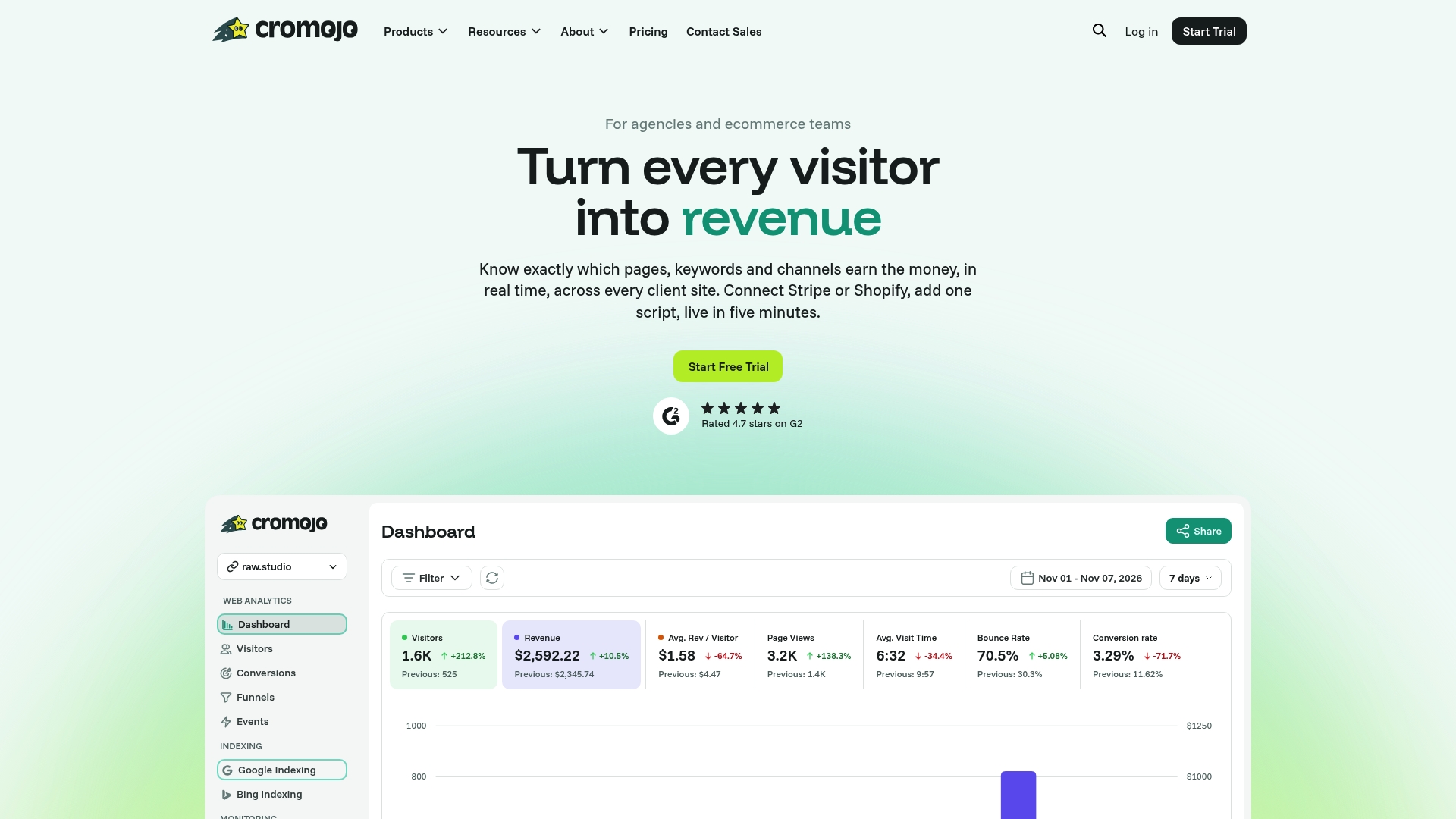
If you're running the parallel-validation plan from this article, Cromojo's revenue analytics gives you the deterministic Stripe and Shopify data to reconcile against your cookieless numbers directly. Pricing plans vary by features and usage levels; check the provider's site for current pricing details. Check current pricing and plan details to find the tier that matches your traffic, or start a pilot on your own storefront this week.