
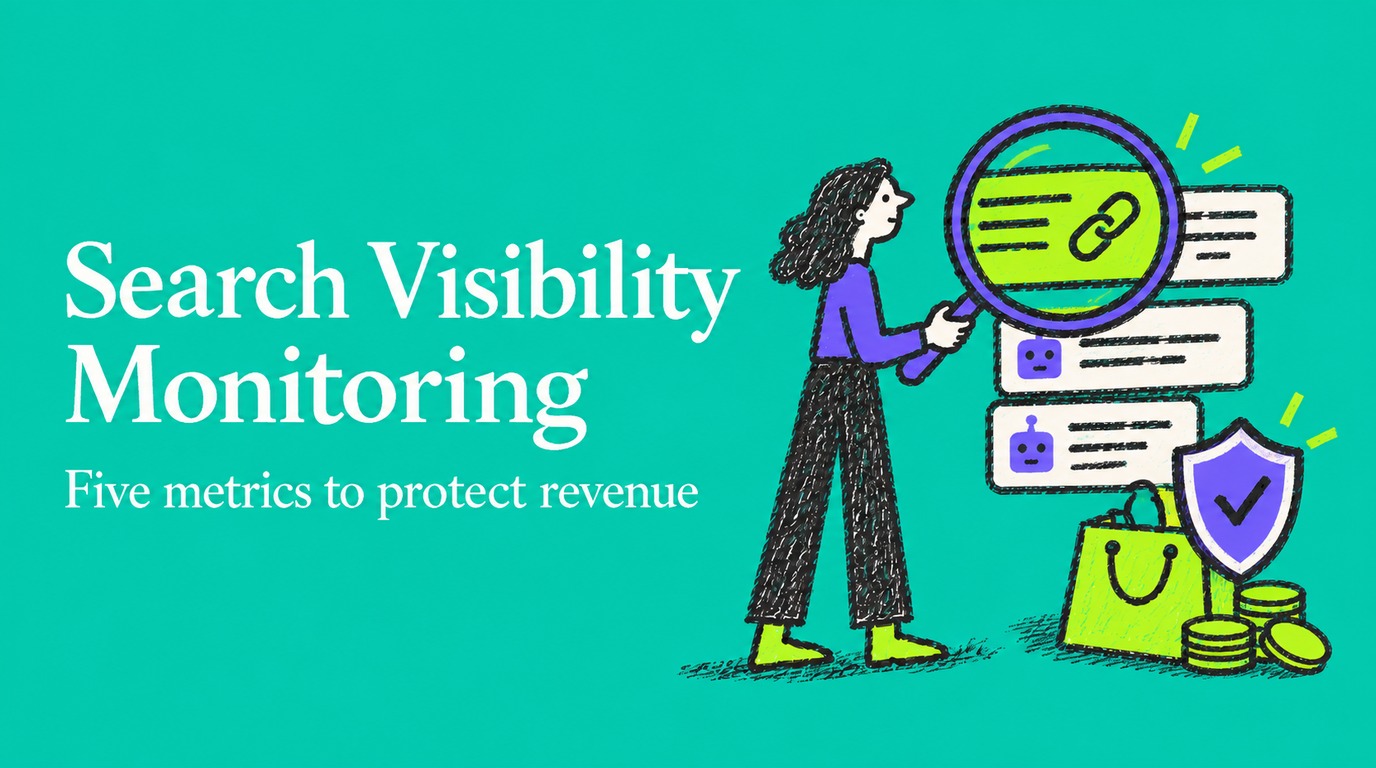

Search visibility monitoring is the practice of tracking how often and how prominently AI answer engines like ChatGPT, Google AI Overviews, and Perplexity mention your brand, then acting on those signals before competitors take the citation. The payoff is direct: catch a mention-rate drop early, and you protect the share of voice that drives clicks and sales. Tools like HubSpot's AI Search Sensor and Google Search Console each play a piece of that workflow.
What Is Search Visibility Monitoring and Why Does It Matter Now?
Traditional rank tracking checks a fixed position on a static results page. Search visibility monitoring checks something far less stable: whether a language model chooses to name your brand at all when someone asks it a buying question, and that answer changes depending on phrasing, session, and the day's model update.
This is the core shift behind Answer Engine Optimization (AEO). A page ranking third for "best project management software" used to mean predictable traffic. Now a user might ask ChatGPT the same question and get three brand names in a paragraph, with no link and no guaranteed order. If your brand isn't one of the three, you don't just lose a ranking spot. You disappear from the conversation entirely.
That distinction matters for how conversions happen. A neutral explainer on generative engine optimization frames this as a fundamentally different discipline from classic SEO, because the "page" a user sees is synthesized fresh each time rather than pulled from a cached index. Being named early in a generated answer, or cited as a source with a clickable link, now carries more weight than sitting in position four of a search results page nobody scrolls to.
The business consequences of ignoring this show up quietly, then all at once:
- Lost visibility in AI-generated answers rarely triggers an obvious signal like a traffic cliff; it shows up as a slow decline in branded search and direct traffic.
- Missed conversions happen because buyers increasingly research inside the chat interface itself, never reaching your site until they've already narrowed to two options.
- Regressions compound because model updates roll out silently. Without a monitoring cadence, you find out weeks after a shift already cost you visibility.
Search visibility monitoring exists to catch that decline while it's still a small, fixable problem.
Which AI Engines Should You Actually Monitor?
Not every engine behaves the same way, and treating them as interchangeable wastes monitoring budget. Some platforms cite sources aggressively; others summarize without attribution at all.
- ChatGPT-style assistants tend to blend brand mentions into conversational answers, often without a visible citation, which makes mention rate more useful than citation share here.
- Google AI Overviews and AI Mode pull heavily from indexed, well-structured pages, so technical SEO health still matters enormously in this lane.
- Perplexity-style citation-first models show sources prominently, making citation share and rank-in-response the metrics worth watching closest.
- Claude, Grok, and Microsoft Copilot vary by training data recency and integration context, and are worth adding once your core three engines are stable.
Weight your sampling by where your buyers actually research. A B2B SaaS company selling to technical buyers should prioritize ChatGPT and Perplexity, where detailed comparison queries thrive. A retail brand leaning on broad discovery queries should weight Google AI Overviews heavier, since it still dominates general product search.
What Metrics Actually Tell You Something?
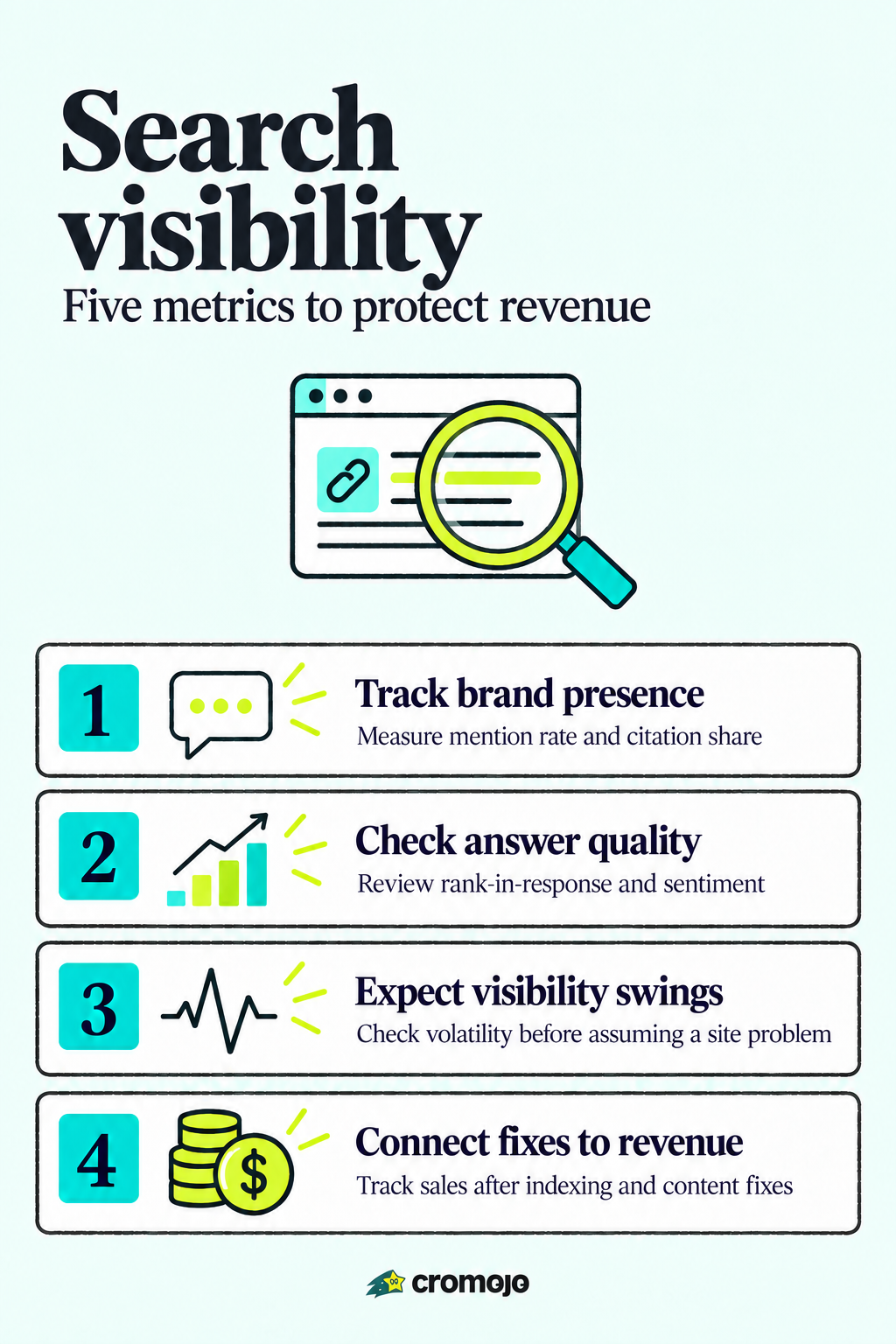
Five metrics matter, and most teams only track one or two of them, which is why they miss problems early.
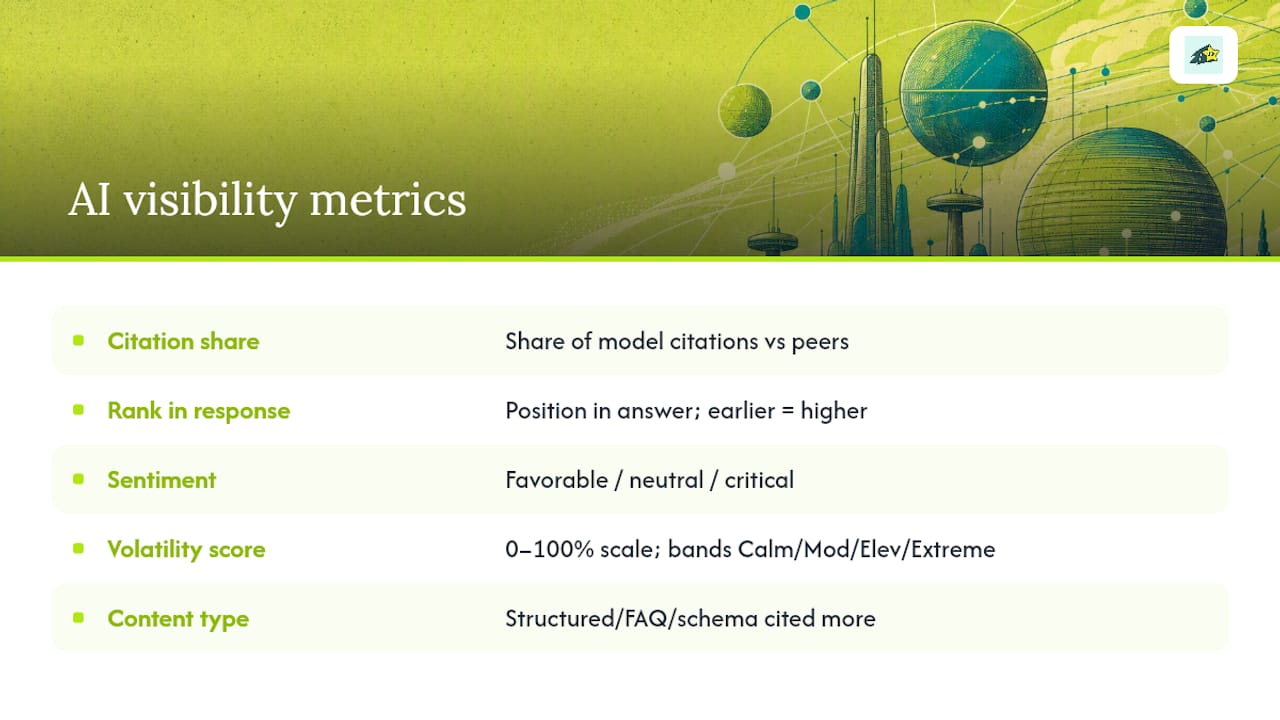
Mention rate measures the proportion of sampled responses that name your brand. Track it against a consistent prompt set so changes reflect visibility rather than a different mix of questions.
Citation share measures your portion of all linked sources when a model does cite something, calculated against competitors answering the same prompt. Rank-in-response captures where in the answer you appear, since a mention weighted toward the opening lines counts for more than one buried in paragraph four, because users read the first sentence far more reliably than the last. Sentiment flags whether the mention is favorable, neutral, or critical, which matters more in AI answers than in search snippets because the model is often making an implicit recommendation, not just listing a result.
Volatility score rounds out the picture, and it's the one metric most teams ignore until it's too late.
HubSpot's AI Search Sensor tracks daily volatility on a 0 to 100% scale, split into four bands: Calm (0-29), Moderate (30-59), Elevated (60-89), and Extreme (90+), and notes that daily volatility figures can shift for up to three days as data settles. A citation-share drop paired with Calm industry-wide volatility points to a brand-specific or site-level problem. The same drop during an Extreme volatility window is probably a model update affecting everyone, not just you.
Content type shapes citation odds too. Structured comparison content, FAQ blocks, and pages with clear schema markup get cited more consistently than narrative blog posts, according to guidance on tracking AI visibility that stresses citation context and quality as much as raw frequency.
How Do You Set Up Search Visibility Monitoring?
Building a monitoring system that actually holds up over months, not just for a one-time audit, comes down to four operational decisions.
- Generate prompts from real buyer language, not guesses. Seed your prompt list from top-intent keywords, actual sales call questions, and long-tail variations that include brand aliases and misspellings. A tool like can help generate a baseline set of prompts to start from.
- Set sampling cadence by engine volatility. Run daily scans on engines prone to rapid shifts, and reserve weekly aggregation for trend analysis where day-to-day noise would otherwise obscure a real pattern.
- Store immutable snapshots of every response. Save the raw model output alongside the parsed citation data (URL plus surrounding context) so you can replay exactly what the model said after an update, which is the only way to debug a sudden drop forensically rather than by guesswork.
- Score mentions with position-weighting. Detect the mention, extract any citation, then weight it by where it landed in the response before computing weekly share-of-voice. A brand named in the first sentence should count for meaningfully more than one buried at the end.
Pro Tip:Run your prompt set through at least three engines before trusting the trend line. A single-model dip can be that model's own hiccup, not a real visibility loss.
Retention matters as much as collection. Historical snapshots let you correlate a visibility change with a specific model release date months later, which is often the only way to explain a dip to a client or a boss who wants a reason, not just a chart.
How Do You Triage a Visibility Drop?
A monitoring dashboard without a triage process just produces anxiety. Set concrete alert thresholds before you need them: a jump into Elevated or Extreme volatility, or a mention-rate drop of a meaningful margin week over week, should trigger a defined checklist, not a scramble.
- Check indexing status and URL Inspection in Google Search Console first; a page that dropped from the index can't be cited anywhere.
- Confirm the page still renders correctly, since a broken template or a blocked script can quietly remove content models rely on.
- Review recent content or theme changes on the pages that used to get cited, since a redesign can strip the structured data that earned the mention.
- Cross-check industry-level volatility dashboards, because HubSpot's Sensor explicitly recommends ruling out a model-wide shift before assuming the problem is yours alone.
Once you've isolated the cause, map it to the right fix. A schema or FAQ gap calls for structured data updates. A stale but once-cited page calls for a republish with fresher data. An indexing failure calls for resubmitting the URL rather than waiting for a crawler to find it naturally. A citation lost to a competitor calls for outreach to rebuild authority signals elsewhere.
Pro Tip:Wire your visibility alerts into the same dashboard as uptime and Core Web Vitals monitoring. A visibility drop that coincides with a slow-loading page or a downtime window usually has one root cause, not two.
How Does Monitoring Actually Turn Into Recovered Revenue?
Visibility signals only matter if they connect to a fix that ships fast, and that's where most monitoring setups stall. A team spots a citation-share drop, confirms it's brand-specific, then waits days for a developer to resubmit a URL or a content editor to notice the assignment in a backlog.
Closing that loop faster is the entire point of pairing visibility monitoring with revenue and site-health tooling in one place. Cromojo's automated indexing resubmits fixed pages to Google, Bing, Yandex, and Baidu without a manual request, which shortens the gap between "we found the problem" and "the model can see the fix." Website monitoring flags the downtime, rendering error, or SEO health issue that likely caused the drop in the first place, often before a marketer even notices the visibility dashboard moved.
The revenue side matters just as much as the technical side. Real-time revenue attribution tied directly to Stripe and Shopify data shows whether a citation-share recovery actually translated into sales, not just a vanity metric bounce. Combined with cookieless tracking that avoids consent friction, the workflow looks like this in practice:
- Detect a visibility drop through prompt-based sampling.
- Confirm the cause with automated site monitoring rather than manual URL-by-URL checks.
- Trigger re-indexing the moment a fix ships, instead of waiting on organic recrawl timing.
- Attribute the resulting revenue change directly to the pages and channels involved.
Why Volatility Without Context Is the Trap Most Teams Fall Into
The biggest mistake I see is treating a volatility spike as noise, or worse, treating it as a crisis without checking whether it's industry-wide first. Both reactions waste a week. The second mistake is subtler: monitoring one engine because it's the easiest to query, then building an entire content strategy around a mention-rate trend that only reflects one model's quirks that particular month.
Visibility monitoring is still young enough that most teams underinvest in the boring part: storing snapshots long enough to see a real pattern instead of a blip. Expect engine coverage to keep expanding. Treat every dashboard as a starting point, not a verdict.
Get Search Visibility and Revenue Data in One Dashboard
Cromojo is the alternative to running separate visibility, indexing, and revenue tools that never talk to each other. Instead of juggling a citation-tracking dashboard, a Search Console tab, and a Stripe report to piece together what a visibility drop actually cost you, Cromojo ties automated indexing, website monitoring, and real-time revenue attribution into one workflow with a lightweight setup script.
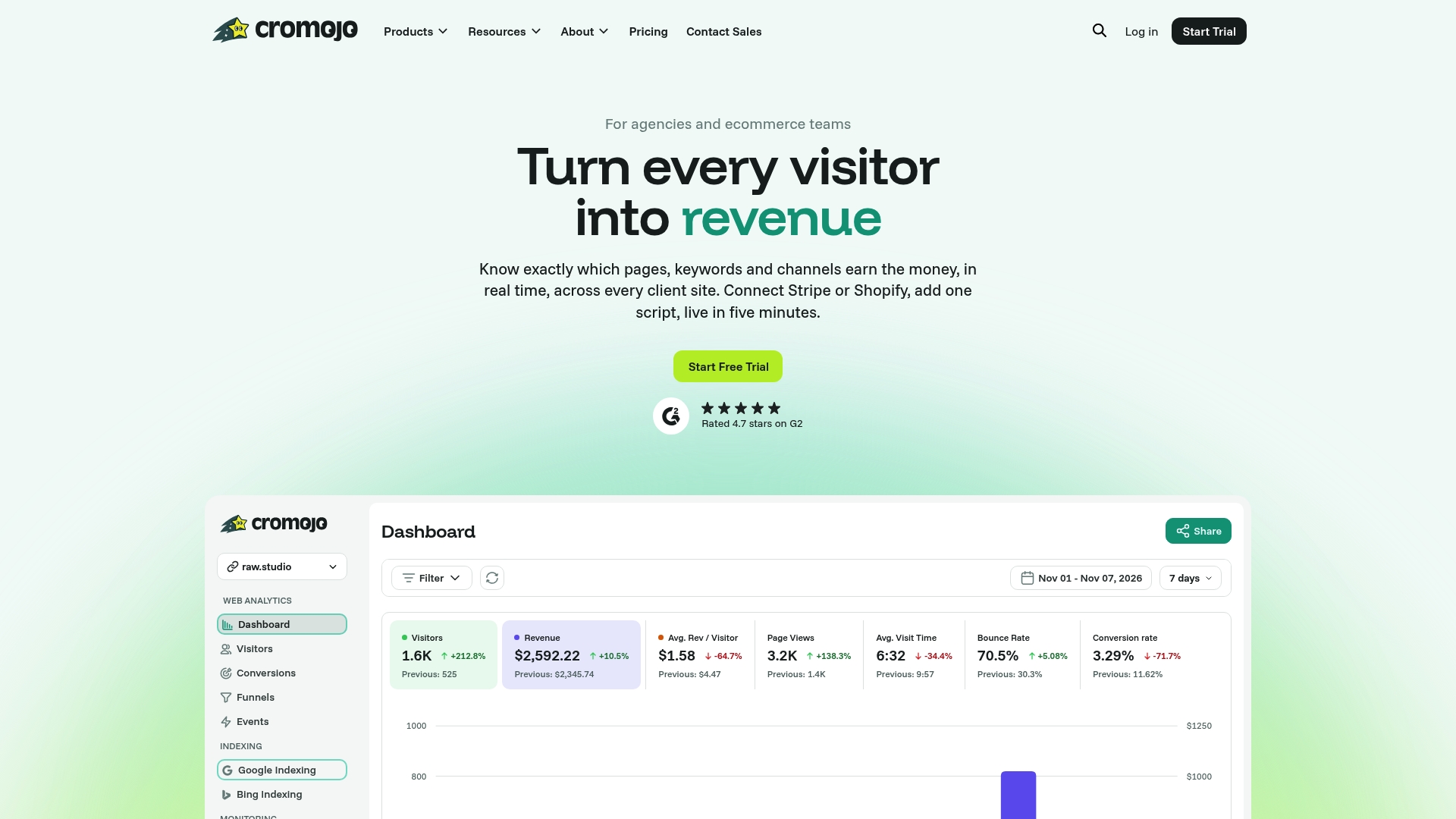
Setup typically takes a matter of minutes on most site stacks, since the tracking script drops in without disrupting existing analytics. From there, you can watch which pages, keywords, and channels convert to actual revenue while automated indexing keeps fixed pages visible to Google, Bing, Yandex, and Baidu without manual resubmission. Start with the Starter plan at $19 per month to see the revenue and monitoring data side by side, or check the Business and Agency tiers if you're managing multiple client sites. Agencies weighing a lighter-weight alternative can also compare Cromojo against Simple Analytics directly on the site.