
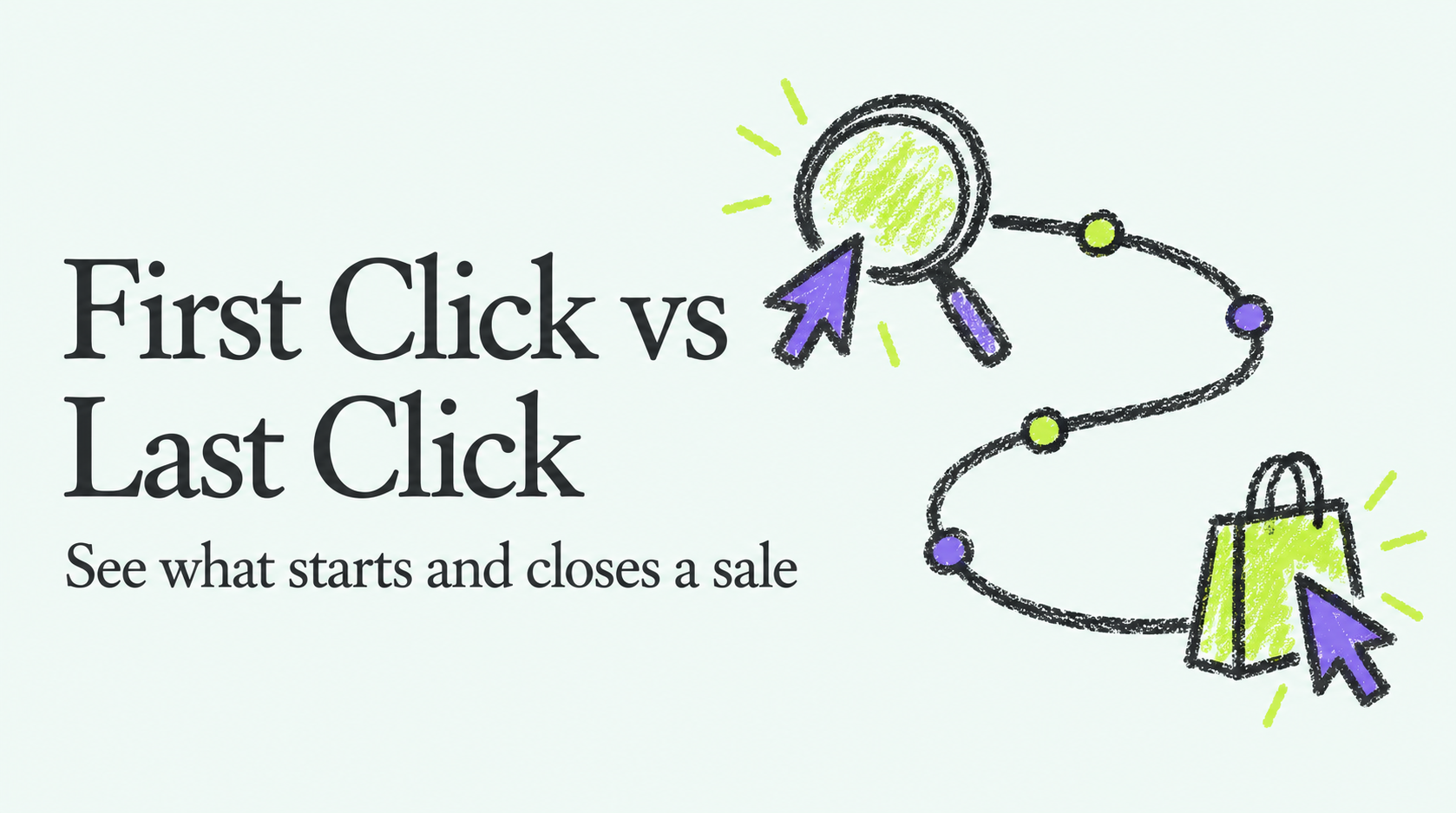

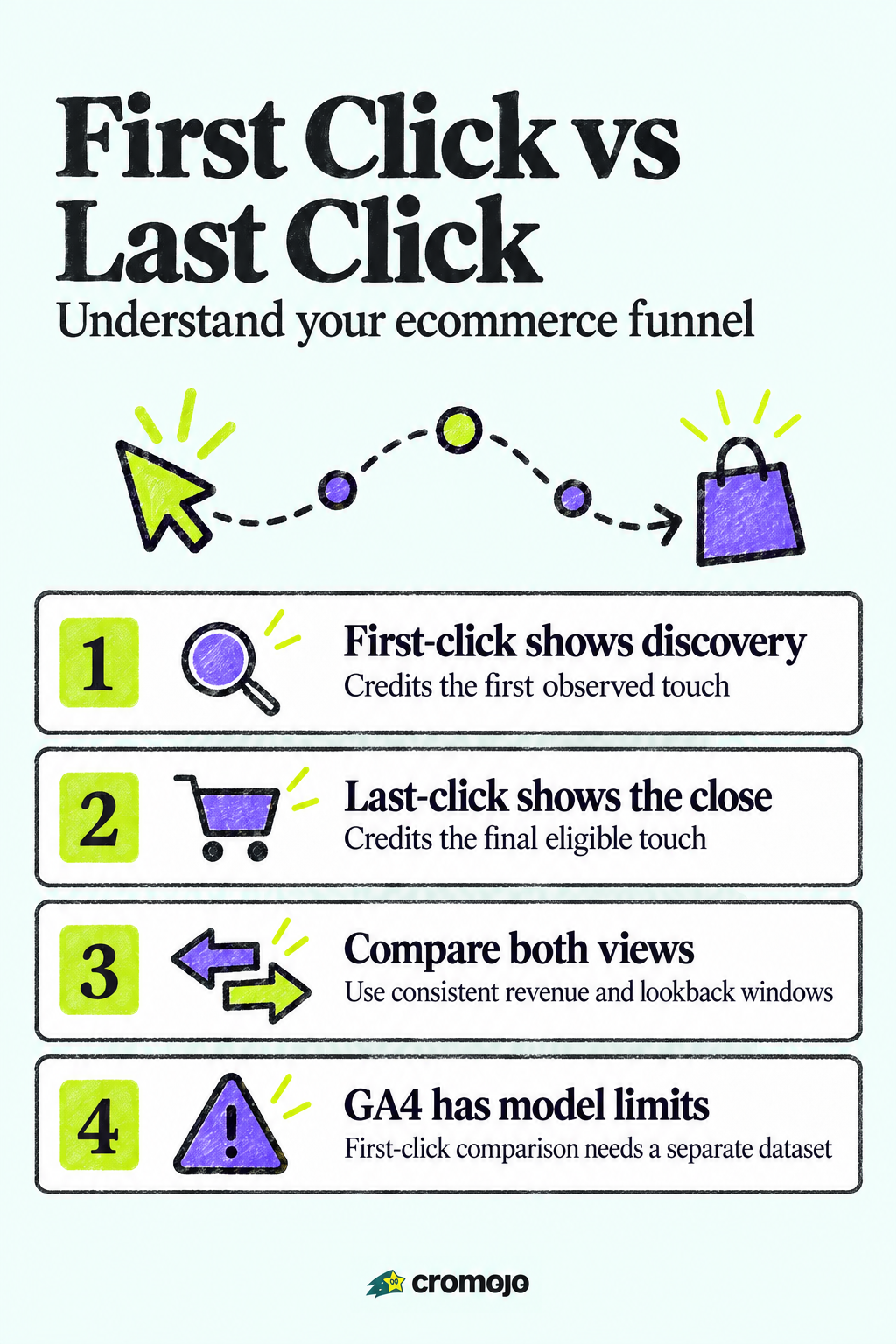
First-click attribution gives 100% of the credit for a conversion to the very first channel that brought a visitor to your site, inside whatever lookback window your platform uses. That window matters more than most dashboards let on. If your tracking uses a 30-day lookback and a shopper’s first visit happened 45 days ago, that channel disappears from the report entirely. It’s not “first” in any absolute sense. It’s first within the window your identifiers can see.
Picture a shopper who finds a skincare brand through a blog post ranking on Google, leaves without buying, comes back three weeks later through a retargeting ad, and finally converts after clicking a branded search ad. First-click hands the entire sale to that original organic blog post. The retargeting ad and the branded search click get nothing.
That’s useful for one thing: figuring out who actually introduced the customer to the brand, a point echoed in practitioner guidance on complementary attribution lenses. It is a poor tool for judging who deserves your next budget increase.
Where first-click earns its keep:
Pro Tip: If your CFO keeps asking “why are we spending on content when it doesn’t convert,” pull a first-click report before that meeting. It usually settles the argument.
The flip side: first-click ignores everything that happens after the opening touch. A channel can look like a hero here while contributing nothing to the actual close, which tempts teams to overfund awareness spend without ever checking whether it turns into revenue.
What Last-Click Attribution Rewards (And Why It’s Still the Default)
It’s the oldest attribution convention in digital marketing, and it’s still the default in most analytics tools for a simple reason: it’s easy to compute and it matches how a sales team thinks about “who closed this.”
Common variants tweak the definition slightly. “Last non-direct click” ignores direct visits and credits the last real marketing touch instead, which stops branded typing-the-URL-in traffic from swallowing credit that belongs to a campaign. Some platforms split it further into last paid click versus last organic click, which matters when you’re comparing paid and organic performance side by side.
Take that same skincare shopper. Under last-click, the branded search ad clicked right before purchase gets the entire sale. The organic blog post that started the journey and the retargeting ad that re-engaged the shopper get nothing, even though both did real work.
Matomo’s breakdown of last-click attribution points out exactly why this model persists: it’s simple, and it gives a clean answer for short, direct-response sales cycles where the final click really does reflect intent.
Where last-click earns its keep:
Pro Tip: Watch for a channel that wins every last-click report but never shows up in your first-click data. That channel is usually a closer riding on demand someone else created, not a growth engine.
The cost of relying on last-click alone: it systematically overvalues bottom-funnel closers and starves the channels that actually generate demand, because they rarely get the final click.
First-Click vs Last-Click: Where Each One Misleads You
Set the two models side by side and the disagreements become the useful part.
The gap between the two reports is where the real diagnosis happens. A channel with a big positive delta (it looks much stronger under first-click than last-click) is a demand creator. A channel with a big negative delta (it looks weak on first-click but dominant on last-click) is a demand harvester, closing sales that other channels opened. Practitioner analysis on running these reports side by side treats this delta as the actual insight, not either model alone.
Budget mistakes almost always trace back to trusting one model in isolation. Cut your SEO or content spend because last-click says it “doesn’t convert,” and you often cut the channel introducing most of your future buyers. Pour more budget into retargeting because last-click makes it look unstoppable, and you can end up spending to reach people who already decided to buy. One frequently cited pattern: incremental testing shows that 20 to 40% of apparent last-click wins on branded and retargeting channels disappear once you run a real holdout test against them.
When to Use First-Click vs Last-Click: A Decision Checklist
Pick the model that matches the question you’re actually trying to answer, not the one that’s already loaded in your dashboard.
Pro Tip: Don’t let the model choice become a permanent policy. Revisit it every time your average sales cycle shifts by more than a week, or when a new channel enters the mix. For a broader map of where multi-touch fits into this decision, see what multi-touch attribution actually solves.
How to Run a First-Click vs Last-Click Comparison
Running the comparison is mechanical once you know what to pull.
While you’re in there, watch these metrics rather than raw conversion counts alone:
Google’s own Model comparison report is the standard tool for step one, and Google explicitly recommends testing before shifting bids based on any model switch. For the testing layer, start small: shift a modest slice of budget, hold out a comparable audience or geography, and give it a full reporting cycle before drawing conclusions.
Fixing the Tracking Gaps Behind Both Models
Google has already deprecated most rule-based single-touch models in Google Ads, including several first-click variants, and pushes data-driven attribution as the default for accounts with enough volume. That shift reflects a real limitation: rule-based models like first-click and last-click were never measuring the true customer journey. They were measuring whatever your cookies and lookback windows happened to capture.
That’s the deeper problem hiding under this whole comparison. Without durable tracking, “first click” often just means “the first click we happened to see” inside a short cookie window, not the actual first touch. A few fixes narrow that gap:
Pro Tip: Audit your UTM naming conventions before you audit your attribution model. A messy tagging structure will wreck both first-click and last-click reports equally, and no model fixes that. Clean UTM tracking solves more attribution confusion than swapping models ever will.
This is also where revenue-first platforms earn their place in the stack. Cromojo captures revenue per channel in real time through direct Stripe and Shopify integration, so you’re comparing actual sales, not proxy conversion events, and it does that with cookieless tracking built to hold up as server-side capture becomes the norm rather than the exception.

A Pragmatic Workflow for Attribution
Run first-click and last-click side by side every reporting cycle, and treat the gap between them as the actual insight, not a problem to resolve. A channel that looks strong on one and weak on the other isn’t broken. It’s telling you its role in the funnel.
Before any major budget shift, run a quarterly holdout test on your top two or three channels. Attribution models estimate; holdouts measure. Never hero a channel based on a single-model read, and never let one good last-click quarter justify cutting a demand creator. Combine the models with real incrementality data, the same way analytics-driven budgeting approaches recommend, and the guesswork mostly disappears.
Closing the Attribution Gap With Real Revenue Data
Most attribution headaches come down to one thing: you’re guessing at revenue instead of seeing it. Cromojo tracks real-time revenue by channel, keyword, and page through direct Stripe and Shopify integration, so when you run your first-click versus last-click comparison, you’re comparing actual dollars closed, not modeled conversion events sitting three steps removed from your bank account.
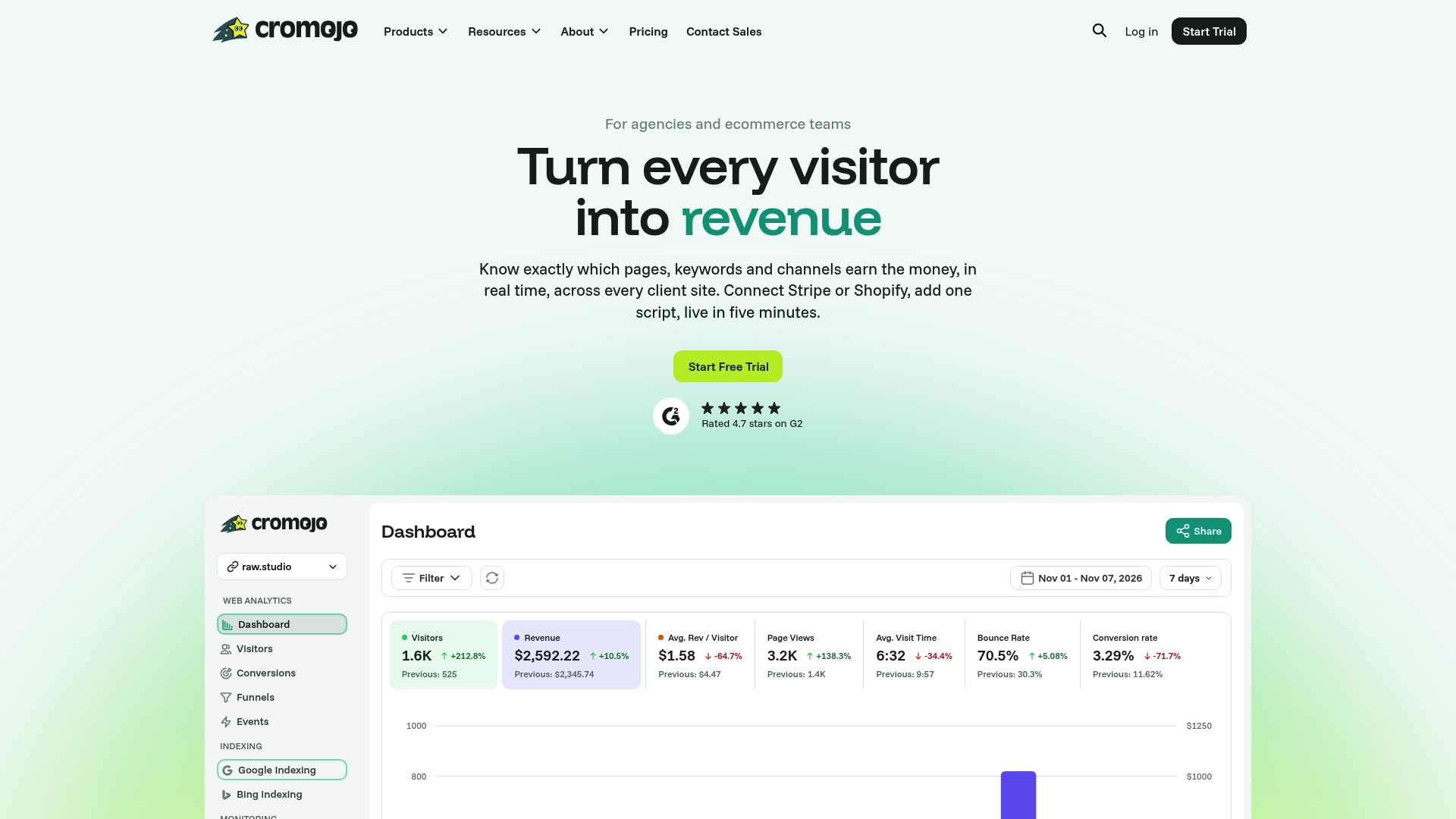
The tracking gaps described above (short cookie windows, lost UTMs, disappearing signal) are exactly what Cromojo’s cookieless, server-side-friendly script is built to close, with a lightweight setup that drops into any stack without months of implementation work. If you want to see your own first-click and last-click delta on real revenue instead of estimated conversions, start with the free plan or check the Revenue Analytics feature page to see what channel-level reporting looks like before you commit to a paid tier.