
.avif)

Most SEO teams treat Bing like an afterthought.
They track Google rankings, optimize for Google Search Console, build content calendars around Google keywords, and report on Google traffic, impressions, and click-through rates.
That approach makes sense because Google is still the dominant search engine worldwide. However, focusing only on Google can leave a serious gap in your organic visibility.

Ignoring Bing does not mean Bing stops sending traffic. It simply means your competitors may be collecting traffic that you are not tracking, optimizing for, or trying to capture.
For many businesses, Bing is not the largest traffic source. However, it can still be a valuable one, especially for desktop users, B2B buyers, Microsoft ecosystem users, older audiences, enterprise teams, and people searching through Edge, Windows, Copilot, Yahoo, DuckDuckGo, and other Bing-powered search experiences.
This is where many SEO tools fall short. Most of them are built around a Google-first workflow. Some offer basic Bing rank tracking or reporting, but very few treat Bing indexing, IndexNow, and cross-search visibility as a serious part of the SEO pipeline.
That creates a competitive gap.
If your SEO workflow only focuses on Google, you may be missing faster indexing opportunities, lower-competition traffic, and visibility across search ecosystems that your competitors are not fully optimizing for either.
The Problem With Google-Only SEO Thinking
Most SEO strategies are built around one assumption: if you perform well on Google, everything else is secondary.
That thinking is understandable, but it is incomplete.

Google has the largest market share, but search behavior is more fragmented than many marketers realize. People search through browsers, operating systems, AI assistants, voice tools, mobile devices, app ecosystems, and search engines that may rely partly on Bing’s index.
Bing also has a stronger presence on desktop than many teams assume. According to StatCounter, Bing held around 5% of global search engine market share in May 2026, while its global desktop share was higher at around 10%. That may sound small compared with Google, but in SEO, even 5% to 10% of search demand can represent meaningful traffic, leads, and revenue.
This matters even more in competitive niches.
If you are in SaaS, ecommerce, finance, legal, real estate, B2B services, software, cybersecurity, productivity, or local services, a small percentage of search traffic can still be valuable. A few extra high-intent visits each day can become demo requests, purchases, consultations, sign-ups, or booked calls.
The issue is not that Bing should replace Google. The issue is that Bing should not be ignored.
Yet most SEO tools, workflows, and content operations still behave as if Google is the only platform that matters.
Why SEO Tools Ignore Bing
There are a few reasons most SEO tools pay less attention to Bing.
The first reason is market share. Google has the biggest share of search, so SEO software companies naturally build around the platform most customers ask about. If most teams want Google rankings, Google keyword data, Google Search Console integrations, and Google-focused reports, tool builders will prioritize those features.

The second reason is habit. Many SEO teams use Bing only as a reporting footnote. They might check Bing traffic in analytics occasionally, but they rarely build dedicated workflows around Bing discovery, indexing, and visibility.
The third reason is misunderstanding. Some people assume that if a page ranks in Google, it will automatically perform well in Bing. While there can be overlap, Bing has its own crawling, indexing, ranking, and discovery systems. Treating it as an automatic by-product of Google SEO is a mistake.
The fourth reason is that many tools focus on analysis instead of action. They show keyword positions, backlinks, traffic estimates, technical errors, or content suggestions, but they do not always help pages enter search ecosystems faster. That is a major gap because rankings cannot happen without indexing.
This is especially important for websites that publish frequently. If your team is publishing blog posts, landing pages, comparison pages, product pages, or programmatic SEO content, slow discovery can limit growth. You may be creating new pages, but not all of them are entering search results quickly or consistently.
Cromojo covers this issue in Publishing Faster Won’t Save You Unless You Fix This, which explains how content velocity can become wasted effort when indexing systems do not keep up with publishing output.
Creating more content is not enough. Your content also needs to be found.
Bing Is Not Small If The Traffic Is Valuable
One of the biggest mistakes marketers make is confusing smaller market share with low value.
Bing does not need to beat Google to matter.

If Bing contributes even 5% of your organic search opportunity, that traffic can still be significant depending on your business model. For a SaaS company, it could mean more product trials. For an ecommerce store, it could mean more product discovery. For an agency, it could mean more consultation requests. For a publisher, it could mean more impressions and ad revenue.
Bing also tends to matter more in certain environments.
Many desktop users search through Microsoft Edge or Windows. Many workplace devices are tied to Microsoft products. Many users interact with Microsoft Copilot, which is connected to Bing’s search infrastructure. Yahoo search also relies on Bing in many contexts, and DuckDuckGo has historically used Bing as one of its major search result sources.
This means Bing visibility can reach beyond Bing.com.
When SEO tools ignore Bing, they are not just ignoring one search engine. They are ignoring part of the wider discovery layer that influences how users find content across Microsoft-powered and Bing-connected environments.
That is why Bing should be seen as a visibility channel, not a side note.
The Indexing Gap Most Teams Miss
Ranking is not the first step in SEO. Indexing is.
Before a page can appear in search results, it has to be discovered, crawled, processed, and indexed. If that does not happen, the page has no organic search visibility, no matter how good the content is.
This is where Google-only SEO workflows become risky.
A team may publish a new article, submit it through Google Search Console, monitor Google indexing, and assume the job is done. However, that workflow still leaves important questions unanswered.
Has the page been submitted to Bing? Is IndexNow being used? Are updated URLs being pushed into multiple discovery pipelines, or is the team relying on one search engine to find the content eventually?
Bing supports IndexNow, a protocol that allows websites to notify participating search engines when content is created, updated, or deleted. Instead of waiting for search engines to discover a change later through crawling, IndexNow gives websites a faster way to signal content updates.

This is a major opportunity for websites that publish often.
New blog posts, updated service pages, product changes, pricing updates, documentation edits, and landing page revisions can be pushed into the discovery pipeline faster. For businesses competing in fast-moving niches, that speed matters.
Cromojo explains this in Why Your Content Isn’t Ranking And It’s Not What You Think, where it highlights how discoverability and indexing infrastructure can be the hidden reason content struggles to rank.
If your pages are not being discovered quickly and consistently, your SEO performance will always be limited.
Why IndexNow Matters For Competitive SEO
Traditional crawling is passive.
You publish content, update your sitemap, add internal links, and wait for search engines to come back. This can work, but it is not always fast enough.
IndexNow changes the workflow.
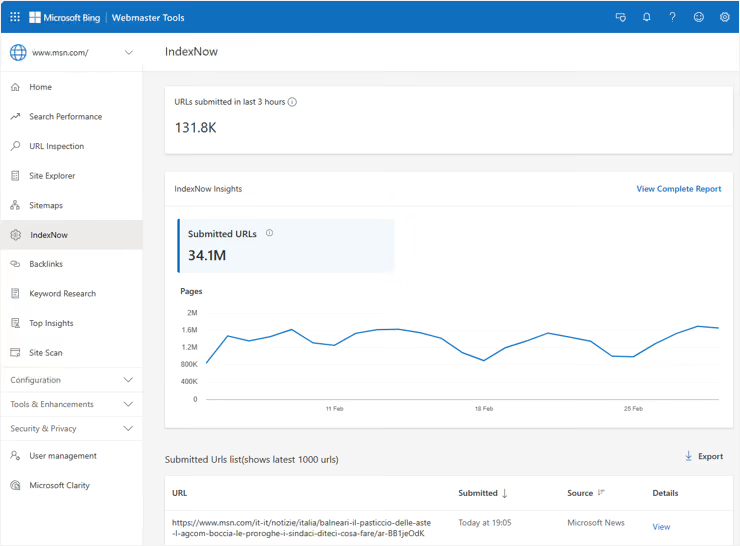
Instead of waiting, your website can notify participating search engines that a URL has been added, updated, or removed. This gives search engines a clearer signal and helps reduce the delay between publishing and discovery.
That matters because SEO is often a race for early visibility.
If two companies publish similar content around the same topic, the one that gets discovered faster may have an early advantage. It can start collecting impressions sooner, appear for long-tail queries sooner, gather engagement data sooner, and be improved sooner based on real search performance.
The slower page may still rank eventually, but the faster page had the first opportunity.
This becomes even more important for content that is time-sensitive. Industry news, product launches, seasonal landing pages, trend-based articles, software updates, comparison pages, new feature pages, ecommerce category changes, and local service updates all depend on fast discovery.
Fast discovery does not guarantee high rankings, but slow discovery can delay your ability to compete.
That is why indexing tools are becoming more important for modern SEO. Cromojo’s article on the Top 5 Indexing Tool for Google and Bing in 2026 explains how indexing tools help websites submit URLs faster, monitor index status, detect problems, and support visibility across more than one search engine.
Cromojo’s Bing And IndexNow Workflow Improvements
This is where Cromojo has a real differentiator.
Cromojo’s Bing and IndexNow Indexing Workflow Improvements release focused on improving the setup experience and day-to-day indexing management for Bing and IndexNow.
The update introduced simplified Bing onboarding, which allows users to connect Bing Webmaster Tools from Site Settings. It also improved the OAuth flow, so users return to the correct site context after connecting their account. Cromojo also added an automatic Bing verification attempt, which helps reduce manual setup friction and helps users reach an active state faster.
The update also made integration states clearer by showing whether Bing is Not Connected, Not Verified, or Active. This matters because one of the biggest issues with SEO tooling is uncertainty. Users need to know what is working, what is incomplete, and what action they need to take next.
Cromojo also expanded the Bing indexing experience with a dedicated Bing indexing overview, URL-level visibility, indexing actions, and sitemap management. IndexNow settings were improved as well, with setup, verification, enable and disable controls, and auto-index behavior integrated into settings.
This is not just a small product update. It reflects a bigger SEO shift. Serious teams need indexing workflows that cover more than Google.
The Hidden Cost Of Ignoring Bing
Ignoring Bing can cost you in several ways.
First, you lose potential traffic from users who prefer or default to Bing-powered search experiences.
Second, you miss lower-competition ranking opportunities. Many competitors focus almost entirely on Google, which can leave gaps in Bing search results.
Third, your indexing workflow becomes incomplete. If you only submit and monitor URLs through Google, you have less visibility into how your pages perform across other search systems.
Fourth, you may miss early discovery opportunities through IndexNow. If your competitors are notifying search engines faster while you are waiting for traditional crawling, they may enter the search results sooner.
Fifth, your reporting becomes narrower. You may believe a page is underperforming when it is actually missing from one part of the search ecosystem.
A complete SEO workflow should include Bing, not as the main event, but as a meaningful part of your visibility strategy.
What A Better Bing SEO Workflow Looks Like
A stronger Bing SEO workflow does not need to be complicated.
It starts with making sure your website is connected to Bing Webmaster Tools. From there, you should verify that important pages are crawlable, indexable, and included in your sitemap. You should also monitor whether new and updated URLs are being submitted properly.
For teams publishing at scale, this process should be automated as much as possible.
Manual submission can work for occasional updates, but it breaks down when you publish frequently. If you are managing hundreds or thousands of URLs, you need systems that can submit pages, track status, and surface issues before they become traffic problems.
A better workflow should include automated URL submission, Bing Webmaster Tools connection, IndexNow support, sitemap submission and monitoring, URL-level indexing visibility, alerts or status checks for failed indexing, clear integration states, and ongoing monitoring after publication.
This is where Cromojo’s approach becomes useful. Instead of treating Bing as a side report, Cromojo helps make Bing and IndexNow part of the actual indexing workflow.
Bing, AI Search, And The Future Of Discovery
The future of search is not limited to ten blue links on Google.
AI-powered search, answer engines, browser assistants, and operating-system-level search experiences are changing how people discover content. Microsoft’s ecosystem is part of that shift through Bing, Edge, Windows, and Copilot.
That means Bing visibility may become more important as search habits continue to spread across AI-assisted tools.
If your SEO strategy is only built around Google rankings, you may be preparing for an older version of search.
The modern goal is broader discoverability.
That means making sure your content is visible, indexable, and accessible across the search environments that matter. Google still matters most for many websites, but it is not the only place where discovery happens.
Brands that recognize this early can build a competitive advantage before everyone else catches up.
Final Thoughts
Most SEO tools ignore Bing because Google gets most of the attention.
However, that does not mean Bing is unimportant.
Bing represents a meaningful slice of search traffic, especially on desktop and across Microsoft-powered discovery environments. It also supports IndexNow, which gives websites a faster way to notify search engines about new, updated, or removed content.
Google still matters, but it should not be your only indexing strategy.
Cromojo helps you build a faster, broader, and more reliable indexing workflow across Google, Bing, and IndexNow. Instead of relying on one search engine to discover your content eventually, Cromojo helps you submit, monitor, and manage indexing across the search platforms that matter.
With Cromojo, you can submit new URLs faster, improve your Bing indexing workflow, use IndexNow to notify search engines about content changes, monitor indexing status, reduce manual SEO work, and capture traffic your competitors may be ignoring.
If your content deserves to be found, do not limit your visibility to one search engine.
Use Cromojo to get indexed faster, stay visible, and compete across the search ecosystem.